

Ready & Packaged Foods
All →Vegetables & Legumes
All →Desserts & Confectionery
All →Meat & Protein
All →Grains & Bakery
All →Beverages
All →Milk & Dairy
All →

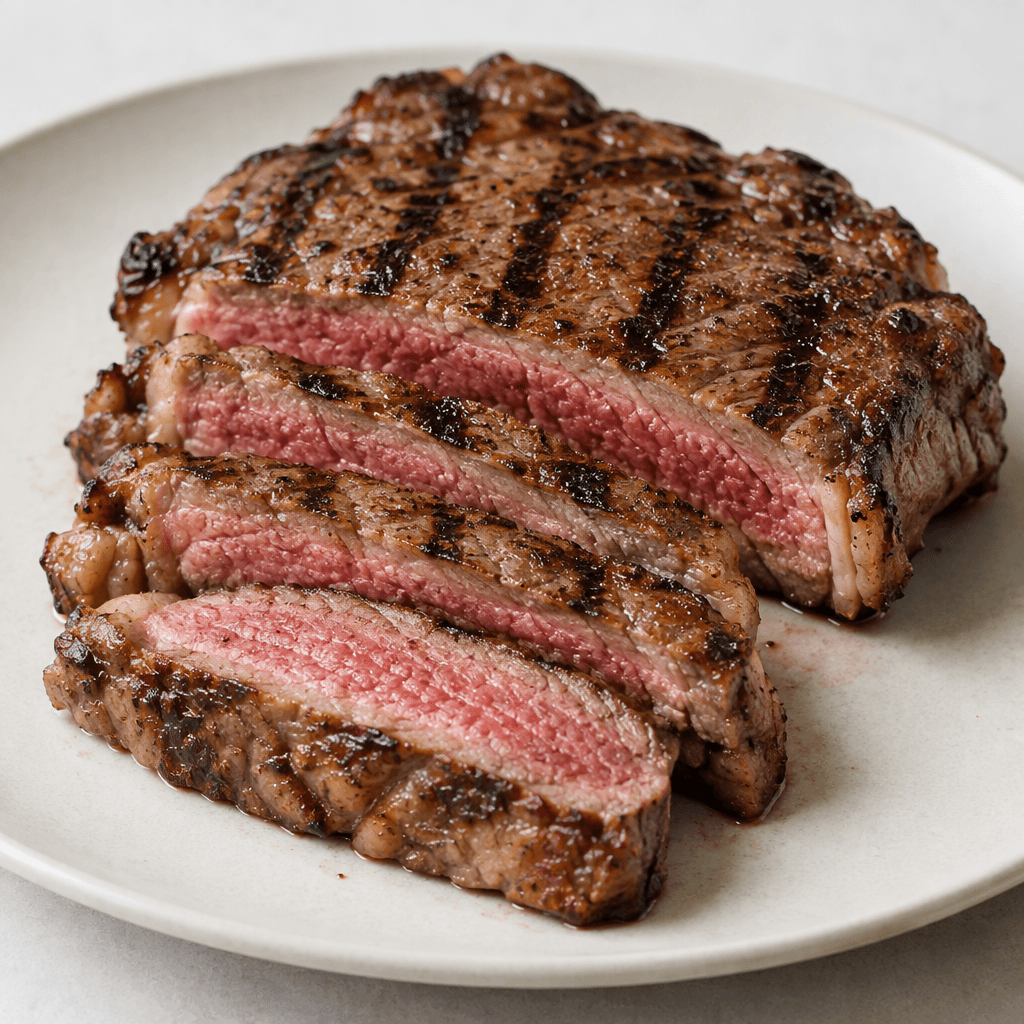
Grilled red meat Calories
High in protein, iron, and B12
CALORIES · 100 G
GI
POTASSIUM · 100 G
FIBER · 100 G
Quick answer
1 piece (medium) of Grilled red meat (150 g) has 375 calories. That works out to 250 calories per 100 g. It contains 0 g of carbs, 39 g of protein, 24 g of fat and 0 g of fiber. Its 3.6 µg of B12 covers 150% of the Daily Value. Its glycemic index is 0 (low), so it raises blood sugar slowly.
Grilled red meat Nutrition Facts
Selected: 1 piece (medium) · 150 g
375
KCAL / 150G
Carbs
0g
· 0% DV
Protein
39g
· 78% DV
Fat
24g
· 31% DV
Fiber
0g
· 0% DV
DV is the share of the daily value covered, on a 2,000 kcal reference diet.
Calories come from: Carbs 0% · Protein 42% · Fat 58%
Grilled red meat nutrition facts table · 1 piece (medium) (150 g)
| Nutrient | Amount | % DV |
|---|---|---|
| Calories | 375 kcal | |
| Total fat | 24 g | 31% |
| Saturated fat | 9.3 g | 47% |
| Trans fat | 0.9 g | |
| Sodium | 108 mg | 5% |
| Total carbohydrate | 0 g | 0% |
| Fiber | 0 g | 0% |
| Protein | 39 g | 78% |
Calories: Calories measure energy. Average daily need is 2,000 kcal. Excess calories are stored as fat, too few cause weight loss.
Carbs: Your body's primary energy source. The brain runs exclusively on carbs. Daily need: 275g.
Protein: Essential for muscle repair and cell growth. Daily need: 50g. Keeps you full and boosts metabolism.
Fat: Needed for hormone production and vitamin absorption. Daily need: 78g. Limit saturated fats, choose unsaturated.
Fiber: Critical for digestive health and satiety. Daily need: 28g. Stabilizes blood sugar, lowers cholesterol.

Log this food in EatBetter
100,000+ people use it
- Get your daily calorie target
- Snap your meal, log it in seconds
- See every vitamin and mineral

📸 Scan the code to get the app free.

How Many Calories in 1 Medium Grilled red meat?
| Serving | Amount | Calories |
|---|---|---|
| 1 piece (medium) | 150 g | 375 kcal |
| 1 ounce (small) | 28 g | 70 kcal |
| 1 piece (small) | 90 g | 225 kcal |
| 100 g | 100 g | 250 kcal |
| 1 serving (thin) | 120 g | 300 kcal |
| 1 cup (diced) | 140 g | 350 kcal |
| 1 serving (thick) | 180 g | 450 kcal |
| 1 piece (large) | 220 g | 550 kcal |
| 2 piece (double) | 300 g | 750 kcal |
| 3 piece (triple) | 450 g | 1125 kcal |
Calculated from 250 calories per 100 g.
Frequently Asked Questions About Grilled red meat
How do you keep grilled red meat tender?
To keep grilled red meat tender, choose a suitable cut, avoid overcooking it, and slice it across the grain after resting. Lean, connective-tissue-rich cuts can dry out quickly over direct heat, so move them away from intense flames and cook more gently.
How do you marinate grilled red meat?
For grilled red meat, use a marinade with oil, herbs, garlic, or spices, and keep the meat refrigerated while it marinates. A strongly acidic marinade can make the surface mushy if left too long. Never brush cooked meat with marinade that touched raw meat.
Why does grilled red meat get tough?
Grilled red meat often gets tough when it is overcooked, cut with the grain, or made from a naturally chewy cut. Let it rest, then slice across the muscle fibers. High heat can quickly dry out lean pieces.
How do you stop grilled red meat from burning on the outside?
To prevent grilled red meat from burning outside before it cooks through, move it away from direct flames and use a gentler part of the grill. Turn it as needed, and cook thick pieces more gradually rather than leaving them over intense heat.
Why does grilled red meat flare up on the barbecue?
Grilled red meat flares up when dripping fat reaches the flames or hot coals. Move the meat to a cooler area until the flames die down, and trim excessive surface fat if needed. Flare-ups can char the outside before the center is cooked.
Is charred grilled red meat bad for you?
Frequently eating heavily charred grilled red meat is best avoided: high heat and smoke can create compounds associated with health risks. Cook over glowing coals rather than open flames, prevent fat from dripping onto them, and remove blackened parts before eating.
Can grilled red meat be eaten rare?
Grilled red meat can be served rare, but meat that is raw or undercooked carries a greater risk of foodborne illness. People who are pregnant, very young, older, or immunocompromised should choose thoroughly cooked meat.
Should grilled red meat rest before slicing?
Yes, let grilled red meat rest briefly before slicing. Resting helps limit how much juice runs onto the board, making the slices more succulent. Keep the meat covered loosely and do not leave it at room temperature for an extended period.
What is the best way to grill a thick piece of red meat?
For a thick piece of grilled red meat, sear it briefly over hotter coals, then finish it in a cooler part of the grill. This gives the outside color while allowing the center to cook more evenly without scorching.
How should leftover grilled red meat be stored?
Store leftover grilled red meat in a covered container in the refrigerator and do not leave it at room temperature for more than two hours. Reheat it thoroughly before eating, and discard it if it develops an unusual smell or sticky texture.
Grilled red meat Vitamins & Minerals
Vitamins
B12
3.6µg · 150% DV
B3
9.75mg · 61% DV
B6
0.68mg · 40% DV
B2
0.3mg · 23% DV
Minerals
Zinc
7.2mg · 65% DV
Selenium
27µg · 49% DV
Phosphorus
315mg · 45% DV
Iron
3.9mg · 22% DV
Potassium ⭐
480mg · 14% DV
Sodium
108mg · 5% DV
Grilled red meat Glycemic Index
GLYCEMIC INDEX
GLYCEMIC LOAD
Accounts for portion size — a more realistic measure than GI alone.
How to Burn Off Grilled red meat
To burn the 375 calories in 1 piece (medium) (150 g):
🚶
Walking (5 km/h)
🏃
Running (8 km/h)
🚴
Cycling
🏊
Swimming
Times are calculated with the MET equation for a 70 kg adult. Actual burn varies with your weight, age and pace.
What is Grilled red meat?
Grilled red meat is beef or lamb cooked over an open flame or hot coals, often as steaks, chops or kebab pieces. It is enjoyed in many food traditions, from Turkish mangal gatherings to backyard barbecues elsewhere, with the cut and seasoning varying by cook.
The browned, smoky outside contrasts with a tender centre, which may remain pink depending on the cut and how it is cooked. Serve it with grilled vegetables, salad or flatbread, or slice it into a shared platter. It is rich in protein and provides iron and vitamin B12, with no carbohydrates. For a lighter meal, choose a leaner cut and pair it with vegetables rather than heavier sides.
How Nutritious Is Grilled red meat?
Nutrient density
High
How many vitamins, minerals and how much fiber this food carries per calorie. A high score means a lot of nutrition for few calories.
Satiety score
Medium
An EatBetter score computed from fiber, protein and calorie density. A high score means staying full longer on the same calories.
Both scores are calculated per 100 g and do not change with the selected portion. The satiety score is EatBetter's own calculation, not a clinical measure.
Is Grilled red meat Processed?
NOVA 2
Minimally Processed
1. Unprocessed
2. Minimally Processed
3. Processed
4. Ultra-Processed
NOVA classifies foods into 4 groups by industrial processing. NOVA 1 (unprocessed) is the healthiest.
Does Grilled red meat Contain Allergens?
No known major allergens
Which Diets Is Grilled red meat Good For?
Vegan
— Not suitable
Vegetarian
— Not suitable
Gluten-Free
✓ Suitable
Dairy-Free
— Not suitable
Mediterranean
✓ Suitable
Paleo
✓ Suitable
Whole30
— Not suitable
DASH
— Not suitable
Keto
✓ Suitable
Low FODMAP
— Not suitable
Grilled red meat Fat Profile
SATURATED
9.3g
MONOUNSATURATED
10.65g
POLYUNSATURATED
0.75g
Omega 6:3 ratio 4.3:1
Above the ideal 4:1 (4.3:1).
Compare Grilled red meat
Foods Similar to Grilled red meat
Have another question about Grilled red meat?
Ask the AI nutrition coach — calories, portions, alternatives and more, answered in seconds in the app.

Scan calories with your camera
Instant AI nutrition analysis

Nutrition data compiled from USDA FoodData Central and scientific sources.