

Ready & Packaged Foods
All →Vegetables & Legumes
All →Desserts & Confectionery
All →Meat & Protein
All →Grains & Bakery
All →Beverages
All →Milk & Dairy
All →

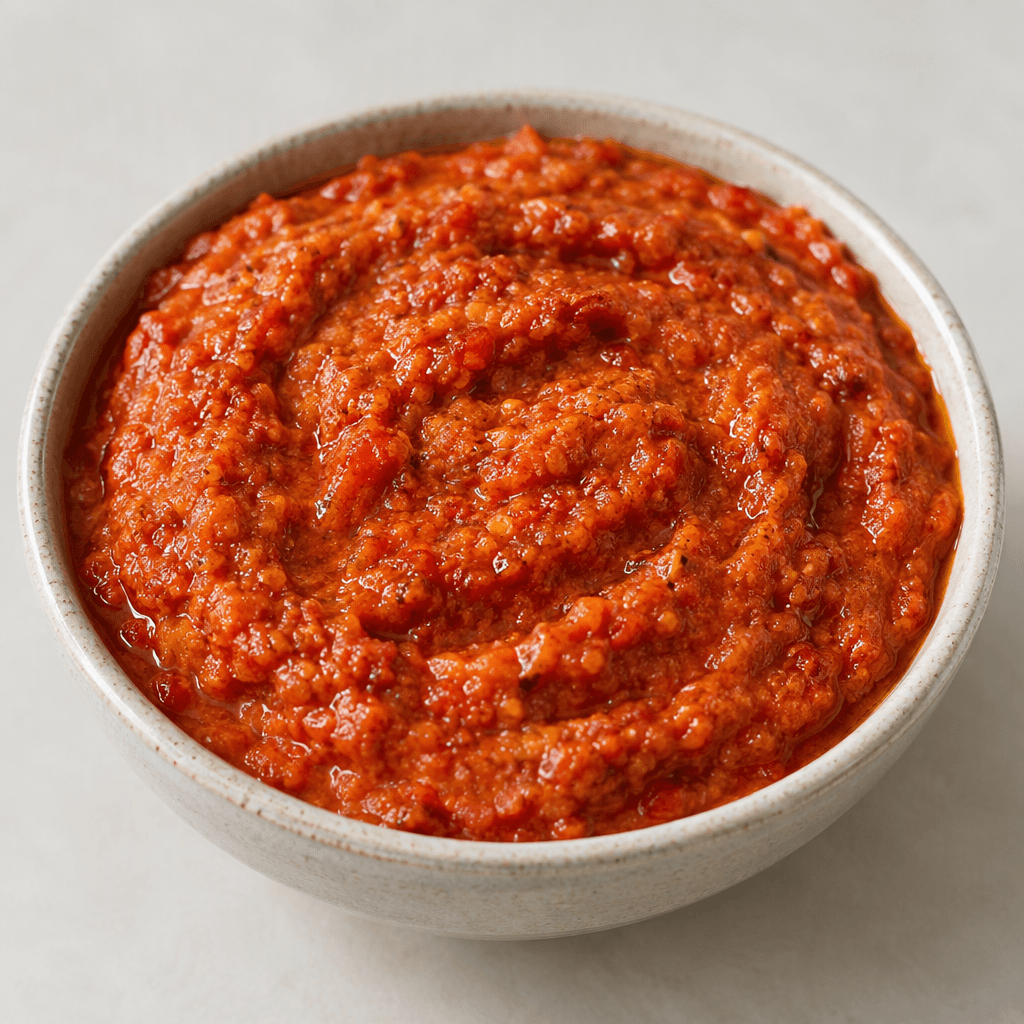
Lutenitsa Calories
Balkan vegetable spread, tomato and pepper based, source of fiber and vitamin C
In season: Summer · Autumn
CALORIES
GI
POTASSIUM
FIBER
Quick answer
2 tablespoon (medium) of Lutenitsa (40 g) has 28 calories. That works out to 70 calories per 100 g. It contains 5.4 g of carbs, 0.6 g of protein, 0.6 g of fat and 1.3 g of fiber. Its 140 µg of Vitamin A covers 16% of the Daily Value. Its glycemic index is 40 (low), so it raises blood sugar slowly.
What is Lutenitsa?
Lutenitsa is a thick Balkan vegetable spread, especially associated with Bulgaria. It is made by cooking down roasted red peppers and tomatoes; some household recipes also include aubergine, garlic or spices. The result is usually a coarse, red-orange relish rather than a smooth purée.
Its mellow sweetness and smoky pepper flavour work well spread on bread, served with cheese, or spooned alongside grilled meats and other savoury dishes. In Bulgaria and neighbouring parts of the Balkans, it is a familiar pantry staple, while elsewhere it makes an easy addition to a mezze-style spread or sandwich. Mostly vegetable-based, it provides fibre: a 100 g portion contains 3.2 g. Use a modest layer with eggs or cheese for a more filling breakfast.
Lutenitsa Nutrition Facts
Selected: 100 g
70
KCAL / 100G
Carbs
13.5g
· 5% DV
Protein
1.5g
· 3% DV
Fat
1.5g
· 2% DV
Fiber
3.2g
· 11% DV
DV is the share of the daily value covered, on a 2,000 kcal reference diet.
Calories come from: Carbs 73% · Protein 8% · Fat 19%
Lutenitsa Vitamins & Minerals
Vitamins
Vitamin A
350µg · 39% DV
Vitamin C
22mg · 24% DV
B6
0.12mg · 7% DV
B5
0.3mg · 6% DV
Minerals
Sodium
320mg · 14% DV
Iron
1mg · 6% DV
Potassium ⭐
210mg · 6% DV
Phosphorus
28mg · 4% DV
How Nutritious Is Lutenitsa?
Nutrient density
Medium
How many vitamins, minerals and how much fiber this food carries per calorie. A high score means a lot of nutrition for few calories.
Satiety score
Medium
An EatBetter score computed from fiber, protein and calorie density. A high score means staying full longer on the same calories.
Both scores are calculated per 100 g and do not change with the selected portion. The satiety score is EatBetter's own calculation, not a clinical measure.
Lutenitsa Glycemic Index
GLYCEMIC INDEX
GLYCEMIC LOAD
Accounts for portion size — a more realistic measure than GI alone.
How to Burn Off Lutenitsa
To burn the 70 calories in 100 g:
🚶
Walking (5 km/h)
🏃
Running (8 km/h)
🚴
Cycling
🏊
Swimming
Times are calculated with the MET equation for a 70 kg adult. Actual burn varies with your weight, age and pace.
Is Lutenitsa Processed?
NOVA 3
Processed
1. Unprocessed
2. Minimally Processed
3. Processed
4. Ultra-Processed
NOVA classifies foods into 4 groups by industrial processing. NOVA 1 (unprocessed) is the healthiest.
Does Lutenitsa Contain Allergens?
No known major allergens
Which Diets Is Lutenitsa Good For?
Vegan
✓ Suitable
Vegetarian
✓ Suitable
Gluten-Free
✓ Suitable
Dairy-Free
— Not suitable
Mediterranean
✓ Suitable
Paleo
— Not suitable
Whole30
— Not suitable
DASH
— Not suitable
Keto
— Not suitable
Low FODMAP
— Not suitable
Lutenitsa Fat Profile
SATURATED
0.3g
MONOUNSATURATED
0.6g
POLYUNSATURATED
0.2g
Omega 6:3 ratio 6:1
Above the ideal 4:1 (6:1).
Compare Lutenitsa
Foods Similar to Lutenitsa
Frequently Asked Questions About Lutenitsa
What is Lutenitsa?
Lutenitsa is a thick Balkan spread made mainly from cooked red peppers and tomatoes. It is especially associated with Bulgaria and is eaten on bread, served alongside meals, or used to add a sweet, smoky vegetable flavor to sandwiches.
How do you eat Lutenitsa?
Lutenitsa is commonly spread on bread or toast. You can also serve it with cheese, grilled meat, or vegetables, or use it as a sandwich condiment; its concentrated pepper-and-tomato flavor works well without much extra seasoning.
Is Lutenitsa the same as ajvar?
No, Lutenitsa and ajvar are related Balkan spreads, but their usual emphasis differs. Lutenitsa typically contains a substantial amount of tomato, while ajvar is usually more pepper-forward and often includes eggplant.
Where does Lutenitsa come from?
Lutenitsa is most closely associated with Bulgarian cuisine, though similar pepper-and-tomato spreads are made across the Balkans. Recipes and names vary by region, so it is better understood as a traditional regional food than as an exclusively Bulgarian invention.
What is Lutenitsa made of?
Lutenitsa is made primarily from red peppers and tomatoes, which are cooked and ground or mashed. Depending on the recipe, it may also contain eggplant, carrots, onions, oil, salt, and spices.
How do you make Lutenitsa at home?
To make Lutenitsa at home, roast and peel red peppers, then cook them with tomatoes until very soft. Mash or grind the vegetables and simmer the mixture until thick; recipes may add eggplant, carrots, onion, or spices.
How long does Lutenitsa last after opening?
Opened Lutenitsa should be kept refrigerated in a tightly closed container. Use a clean utensil each time and follow the storage directions on the jar; discard it if you notice mold, an off smell, or an unusual change in appearance.
Can you freeze Lutenitsa?
Yes, Lutenitsa can be frozen in small portions. Leave a little space in each freezer-safe container for expansion, then thaw a portion in the refrigerator and use it soon after thawing rather than refreezing it.
What does Lutenitsa taste like?
Lutenitsa tastes savory, gently sweet, and often smoky, with red pepper and tomato at the forefront. The exact flavor depends on the recipe: eggplant can make it earthier, while carrots may bring extra sweetness.
What can you use instead of Lutenitsa?
Ajvar is the closest common substitute for Lutenitsa, although it is often less tomato-forward. Roasted red pepper spread can also work on bread or in sandwiches, but it may lack Lutenitsa’s cooked tomato depth.
Have another question about Lutenitsa?
Ask the AI nutrition coach — calories, portions, alternatives and more, answered in seconds in the app.

Scan calories with your camera
Instant AI nutrition analysis

Nutrition data compiled from USDA FoodData Central and scientific sources.