

Ready & Packaged Foods
All →Vegetables & Legumes
All →Desserts & Confectionery
All →Meat & Protein
All →Grains & Bakery
All →Beverages
All →Milk & Dairy
All →

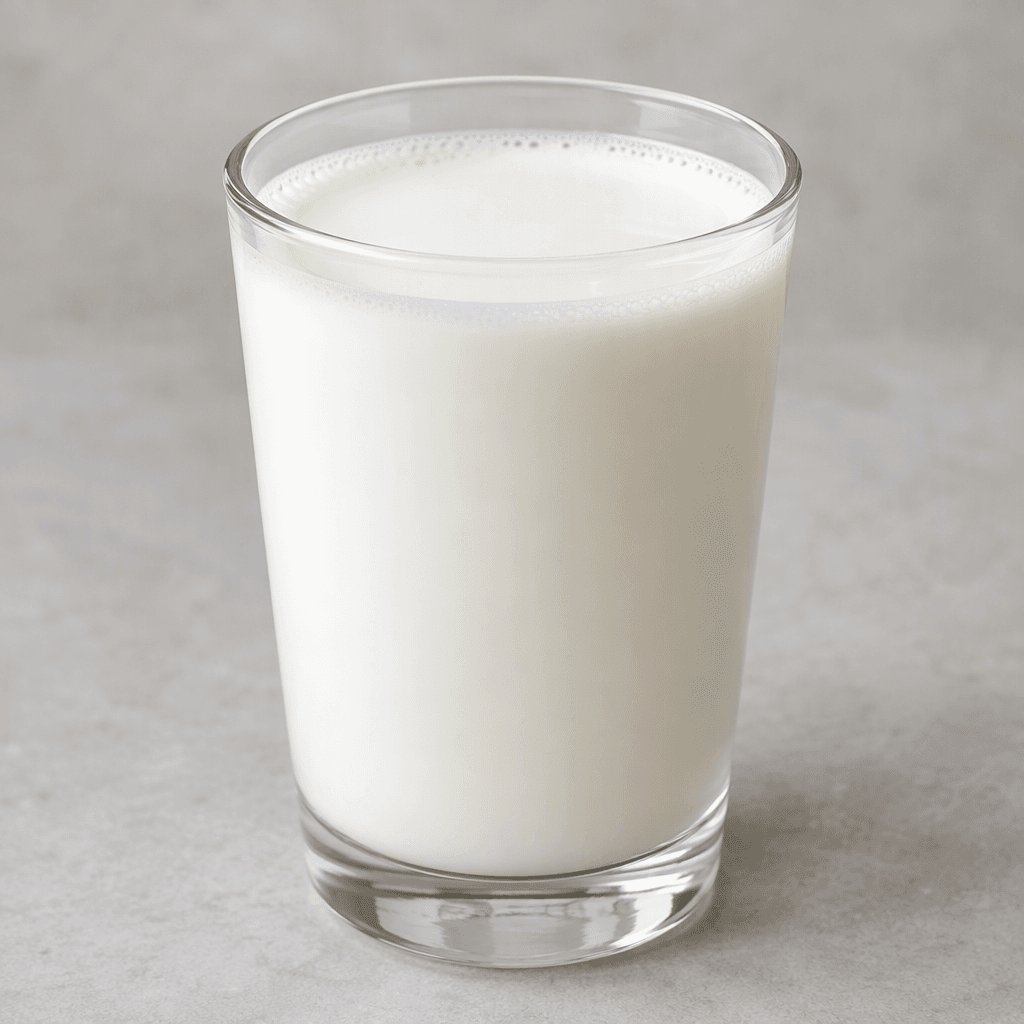
Low-fat milk Calories
Low-fat milk is rich in protein and calcium, with reduced fat content.
In season: Spring · Summer · Autumn · Winter
CALORIES
GI
POTASSIUM
FIBER
Quick answer
1 cup (medium) of Low-fat milk (240 g) has 113 calories. That works out to 47 calories per 100 g. It contains 11.8 g of carbs, 8.2 g of protein, 2.4 g of fat and 0 g of fiber. Its 1.1 µg of B12 covers 45% of the Daily Value. Its glycemic index is 30 (low), so it raises blood sugar slowly.
What is Low-fat milk?
Low-fat milk is dairy milk with some of its fat removed, so it has a lighter feel than whole milk while retaining its familiar mild, creamy taste. It is often served cold by the glass or poured over cereal and oats, and is also used in coffee, smoothies, sauces and baking.
Its texture is smooth and pourable, making it easy to use both chilled and warmed. It provides protein and calcium with less fat than whole milk. For a simple breakfast, pair it with oats or fruit, or use it in coffee without adding sweetener.
Low-fat milk Nutrition Facts
Selected: 100 g
47
KCAL / 100G
Carbs
4.9g
· 2% DV
Protein
3.4g
· 7% DV
Fat
1g
· 1% DV
Fiber
0g
· 0% DV
DV is the share of the daily value covered, on a 2,000 kcal reference diet.
Calories come from: Carbs 46% · Protein 32% · Fat 22%
Low-fat milk Vitamins & Minerals
Vitamins
B12
0.45µg · 19% DV
B2
0.18mg · 14% DV
Biotin
3.5µg · 12% DV
B5
0.36mg · 7% DV
Minerals
Phosphorus
95mg · 14% DV
Calcium
120mg · 12% DV
Iodine
16µg · 11% DV
Selenium
2µg · 4% DV
How Nutritious Is Low-fat milk?
Nutrient density
High
How many vitamins, minerals and how much fiber this food carries per calorie. A high score means a lot of nutrition for few calories.
Satiety score
Medium
An EatBetter score computed from fiber, protein and calorie density. A high score means staying full longer on the same calories.
Both scores are calculated per 100 g and do not change with the selected portion. The satiety score is EatBetter's own calculation, not a clinical measure.
Low-fat milk Glycemic Index
GLYCEMIC INDEX
GLYCEMIC LOAD
Accounts for portion size — a more realistic measure than GI alone.
How to Burn Off Low-fat milk
To burn the 47 calories in 100 g:
🚶
Walking (5 km/h)
🏃
Running (8 km/h)
🚴
Cycling
🏊
Swimming
Times are calculated with the MET equation for a 70 kg adult. Actual burn varies with your weight, age and pace.
Is Low-fat milk Processed?
NOVA 2
Minimally Processed
1. Unprocessed
2. Minimally Processed
3. Processed
4. Ultra-Processed
NOVA classifies foods into 4 groups by industrial processing. NOVA 1 (unprocessed) is the healthiest.
Does Low-fat milk Contain Allergens?
Contains these allergens:
Which Diets Is Low-fat milk Good For?
Vegan
— Not suitable
Vegetarian
✓ Suitable
Gluten-Free
— Not suitable
Dairy-Free
— Not suitable
Mediterranean
✓ Suitable
Paleo
— Not suitable
Whole30
— Not suitable
DASH
— Not suitable
Keto
— Not suitable
Low FODMAP
— Not suitable
Low-fat milk Fat Profile
SATURATED
0.65g
MONOUNSATURATED
0.25g
POLYUNSATURATED
0.07g
Omega 6:3 ratio 0.7:1
Below the ideal 4:1 — a good omega balance.
Compare Low-fat milk
Foods Similar to Low-fat milk
Frequently Asked Questions About Low-fat milk
Is low-fat milk healthier than whole milk?
Low-fat milk can be a useful choice if you want the protein and calcium in milk with less fat. Whole milk has a richer taste and more milk fat, so the better fit depends on your preferences and needs.
Does low-fat milk contain lactose?
Yes, ordinary low-fat milk contains lactose because reducing the fat does not remove the milk sugar. Choose milk specifically labeled lactose-free if lactose causes you symptoms.
Can you use low-fat milk instead of whole milk in baking?
Yes, low-fat milk usually works in baking as a direct substitute for whole milk. The result may be slightly less rich or tender, especially in recipes where milk fat contributes strongly to texture.
Does low-fat milk help with weight loss?
Low-fat milk can fit into a weight-loss eating plan, but it does not cause weight loss by itself. Its protein can help make a meal or snack more filling; consider what you add to it as well.
Can you froth low-fat milk for coffee?
Yes, low-fat milk froths well and can produce plenty of foam, though it may feel less creamy than whole-milk foam. Start with cold milk and avoid overheating it for a smoother result.
How long does low-fat milk last after opening?
Keep low-fat milk refrigerated with the container tightly closed and follow its package guidance after opening. Discard it if it smells sour, looks curdled, or has been left out for too long.
Can you freeze low-fat milk?
Yes, you can freeze low-fat milk, but it may separate or become grainy after thawing. Leave room in the container for expansion, thaw it in the refrigerator, and shake it well before using.
Does low-fat milk work in mashed potatoes and sauces?
Yes, low-fat milk works in mashed potatoes, soups, and sauces, but the result will be less rich than with whole milk. Add it gradually so you can control the consistency.
Does low-fat milk need to be boiled before drinking?
No, packaged pasteurized or UHT low-fat milk does not need boiling before you drink it. Raw milk is different and needs proper heat treatment for safety.
Does low-fat milk have less protein than whole milk?
Usually, no: removing some milk fat does not substantially remove the protein, so low-fat milk provides much the same protein as whole milk. Check the nutrition panel if comparing specific brands or formulations.
Have another question about Low-fat milk?
Ask the AI nutrition coach — calories, portions, alternatives and more, answered in seconds in the app.

Scan calories with your camera
Instant AI nutrition analysis

Nutrition data compiled from USDA FoodData Central and scientific sources.