

Ready & Packaged Foods
All →Vegetables & Legumes
All →Desserts & Confectionery
All →Meat & Protein
All →Grains & Bakery
All →Beverages
All →Milk & Dairy
All →

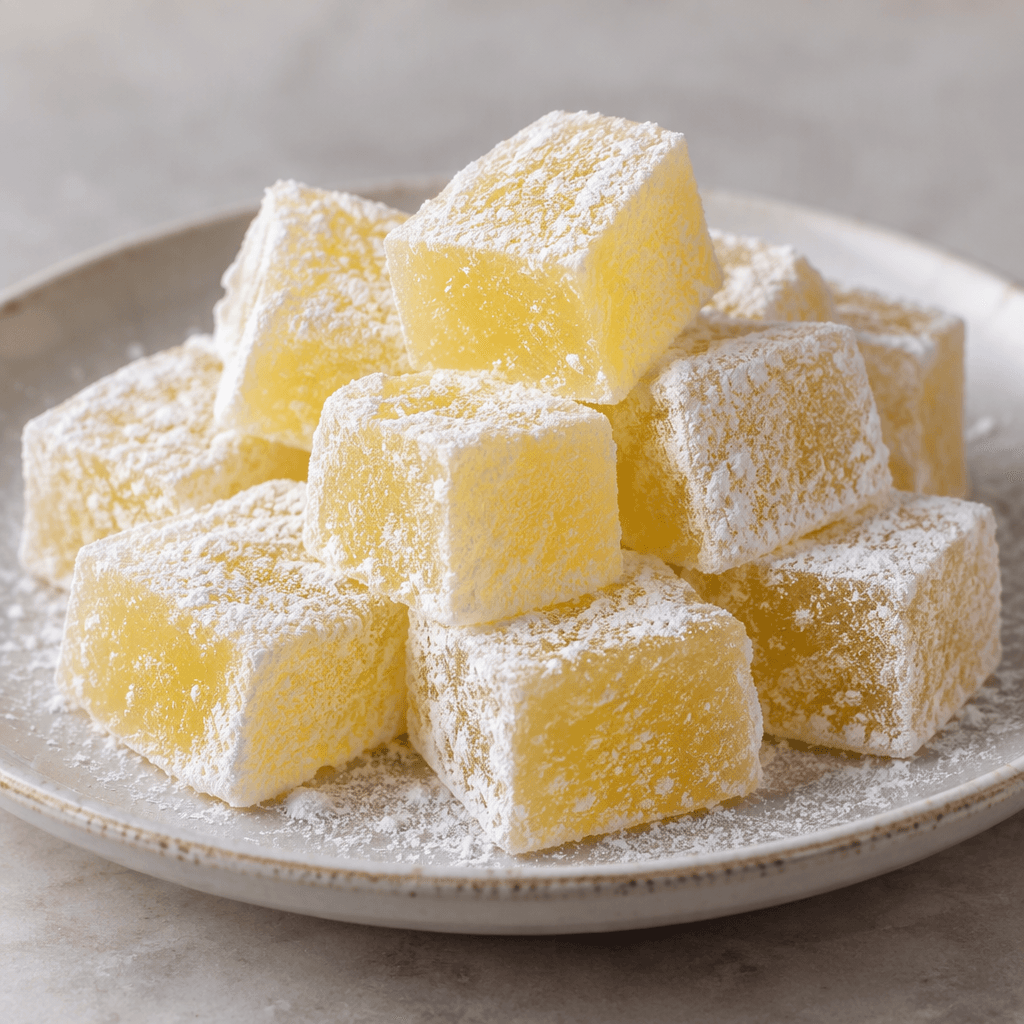
Lemon Turkish Delight Calories
Traditional lemon-flavored Turkish delight, high in sugar, starchy sweet.
In season: Spring · Summer · Autumn · Winter
CALORIES
GI
POTASSIUM
FIBER
Quick answer
2 piece (medium) of Lemon Turkish Delight (40 g) has 130 calories. That works out to 325 calories per 100 g. It contains 32 g of carbs, 0.1 g of protein, 0 g of fat and 0.1 g of fiber. Its glycemic index is 80 (high), so it raises blood sugar quickly.
What is Lemon Turkish Delight?
Lemon Turkish Delight is a traditional Turkish confection made by cooking sugar and starch with lemon flavouring until the mixture sets into a soft, springy sweet. It is cut into small cubes and often lightly dusted with icing sugar to keep the pieces from sticking.
Its bright citrus aroma gives a slight tang, though the overall taste is distinctly sweet; the texture is tender and chewy. In Turkey it is commonly offered with tea or coffee, especially when welcoming guests or during celebrations. It is mostly carbohydrate, with very little protein or fat, so a small piece can be enough for a sweet bite. Serve it with unsweetened tea or coffee to balance its sweetness.
Lemon Turkish Delight Nutrition Facts
Selected: 100 g
325
KCAL / 100G
Carbs
80g
· 29% DV
Protein
0.2g
· 0% DV
Fat
0.1g
· 0% DV
Fiber
0.3g
· 1% DV
DV is the share of the daily value covered, on a 2,000 kcal reference diet.
Calories come from: Carbs 99% · Protein 0% · Fat 1%
Lemon Turkish Delight Vitamins & Minerals
Vitamins
B1
0.01mg · 1% DV
B2
0.01mg · 1% DV
B6
0.01mg · 1% DV
Biotin
0.2µg · 1% DV
Minerals
Calcium
4mg · 0% DV
Iron
0mg · 0% DV
Magnesium
1mg · 0% DV
Zinc
0mg · 0% DV
How Nutritious Is Lemon Turkish Delight?
Nutrient density
Low
How many vitamins, minerals and how much fiber this food carries per calorie. A high score means a lot of nutrition for few calories.
Satiety score
Low
An EatBetter score computed from fiber, protein and calorie density. A high score means staying full longer on the same calories.
Both scores are calculated per 100 g and do not change with the selected portion. The satiety score is EatBetter's own calculation, not a clinical measure.
Lemon Turkish Delight Glycemic Index
GLYCEMIC INDEX
GLYCEMIC LOAD
Accounts for portion size — a more realistic measure than GI alone.
How to Burn Off Lemon Turkish Delight
To burn the 325 calories in 100 g:
🚶
Walking (5 km/h)
🏃
Running (8 km/h)
🚴
Cycling
🏊
Swimming
Times are calculated with the MET equation for a 70 kg adult. Actual burn varies with your weight, age and pace.
Is Lemon Turkish Delight Processed?
NOVA 3
Processed
1. Unprocessed
2. Minimally Processed
3. Processed
4. Ultra-Processed
NOVA classifies foods into 4 groups by industrial processing. NOVA 1 (unprocessed) is the healthiest.
Does Lemon Turkish Delight Contain Allergens?
No known major allergens
Which Diets Is Lemon Turkish Delight Good For?
Vegan
— Not suitable
Vegetarian
✓ Suitable
Gluten-Free
— Not suitable
Dairy-Free
— Not suitable
Mediterranean
✓ Suitable
Paleo
— Not suitable
Whole30
— Not suitable
DASH
— Not suitable
Keto
— Not suitable
Low FODMAP
— Not suitable
Lemon Turkish Delight Fat Profile
SATURATED
0.01g
MONOUNSATURATED
0.01g
POLYUNSATURATED
0.01g
Compare Lemon Turkish Delight
Foods Similar to Lemon Turkish Delight
Frequently Asked Questions About Lemon Turkish Delight
What is Lemon Turkish Delight made of?
Lemon Turkish Delight is usually made with sugar, water, starch and lemon flavouring. Depending on the recipe, it may also contain lemon juice or zest; icing sugar is commonly dusted over the finished pieces.
Where did Lemon Turkish Delight come from?
Lemon Turkish Delight is a flavoured variety of lokum, the confection associated with Türkiye and commonly known in English as Turkish delight. Lemon is one of many flavours added to the traditional starch-based sweet.
Does Lemon Turkish Delight contain real lemon?
Sometimes, but not always. Lemon Turkish Delight may get its taste from lemon juice or zest, flavouring, or a combination; its pale yellow colour alone does not show whether real lemon was used.
Why is Lemon Turkish Delight coated in icing sugar?
Icing sugar helps keep Lemon Turkish Delight pieces from sticking to one another and to the serving plate. If the coating becomes damp and clumpy, gently shake or brush off the excess before serving.
How should you serve Lemon Turkish Delight?
Serve Lemon Turkish Delight in small pieces with Turkish coffee or tea, or offer it as a sweet after a meal. Its citrus flavour also pairs well with other lokum varieties on a mixed dessert plate.
How do you store Lemon Turkish Delight?
Keep Lemon Turkish Delight in an airtight container in a cool, dry place. Moisture can make its surface sticky, so refrigeration is usually unnecessary and may cause condensation when the sweets are brought back to room temperature.
Can you make Lemon Turkish Delight at home?
Yes, Lemon Turkish Delight can be made at home by thickening a sugar-and-starch mixture and adding lemon flavour. Let the mixture set fully before cutting, or the pieces may be too soft to hold their shape.
Why is my homemade Lemon Turkish Delight too soft or sticky?
Homemade Lemon Turkish Delight can stay soft or sticky if its mixture was not cooked or set long enough, or if it absorbed moisture. Allow it more time to set, then store it dry and dust the cut surfaces lightly.
Can you freeze Lemon Turkish Delight?
Freezing Lemon Turkish Delight is possible, but thawing can change its texture and leave moisture on the surface. For the best soft, smooth texture, store it in an airtight container in a cool, dry place instead.
Can people with diabetes eat Lemon Turkish Delight?
Lemon Turkish Delight is a sugary sweet and can raise blood glucose. People with diabetes should account for it in their individual meal plan; a doctor or dietitian can advise how it fits their treatment.
Have another question about Lemon Turkish Delight?
Ask the AI nutrition coach — calories, portions, alternatives and more, answered in seconds in the app.

Scan calories with your camera
Instant AI nutrition analysis

Nutrition data compiled from USDA FoodData Central and scientific sources.