

Ready & Packaged Foods
All →Vegetables & Legumes
All →Desserts & Confectionery
All →Meat & Protein
All →Grains & Bakery
All →Beverages
All →Milk & Dairy
All →

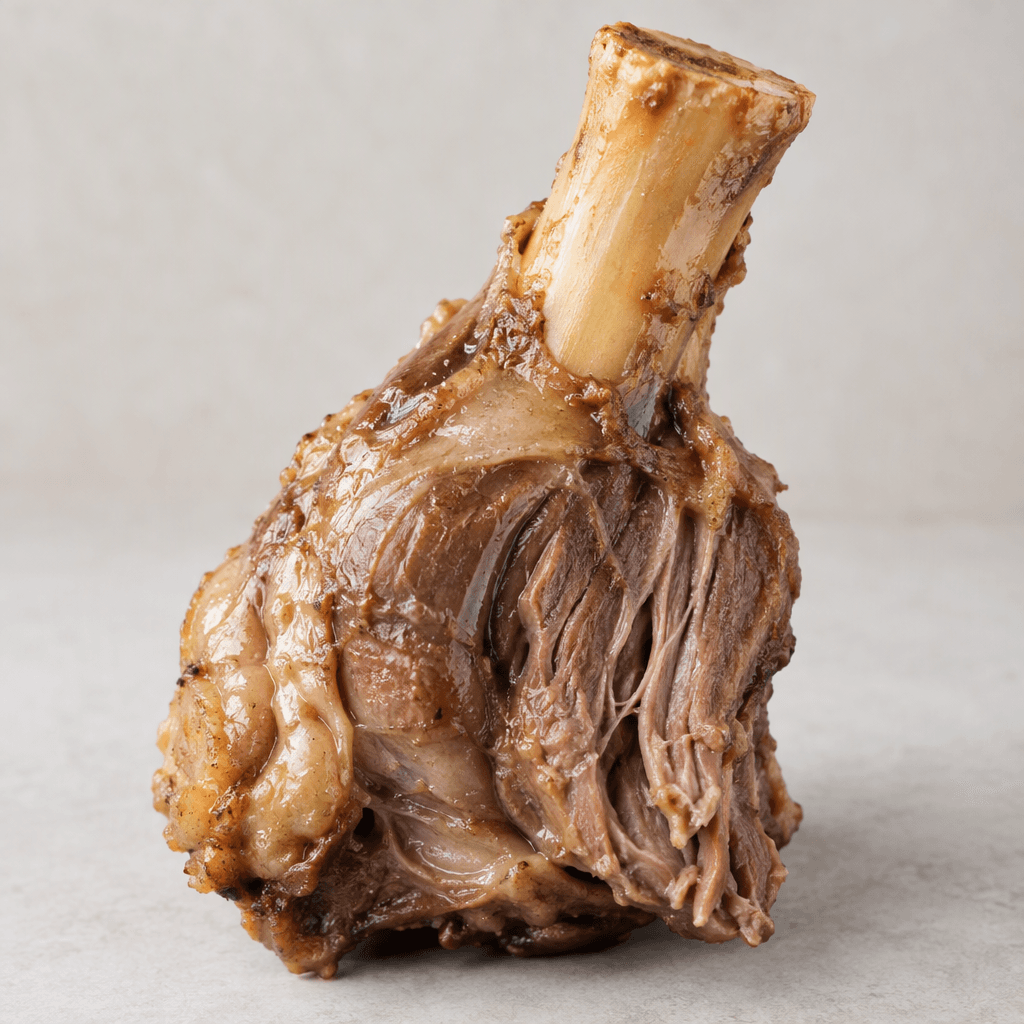
Boiled Lamb Shank Calories
Rich in protein and iron, low-fat boiled lamb meat
In season: Spring · Autumn · Winter
CALORIES
GI
POTASSIUM
FIBER
Quick answer
1 piece (medium) of Boiled Lamb Shank (180 g) has 324 calories. That works out to 180 calories per 100 g. It contains 0 g of carbs, 47.7 g of protein, 13.5 g of fat and 0 g of fiber. Its 4 µg of B12 covers 165% of the Daily Value. Its glycemic index is 0 (low), so it raises blood sugar slowly.
What is Boiled Lamb Shank?
Boiled lamb shank is a Turkish home-style preparation of bone-in lamb simmered until the meat turns tender and pulls easily from the bone. It may be cooked simply in water or with aromatics and vegetables, leaving a savoury broth alongside the meat. The result is soft, gently flavoured lamb with a glossy surface and fibrous texture.
In Turkey, it is commonly served hot with some of its cooking broth, often alongside bread, rice or vegetables. Elsewhere, it also works as a straightforward, hearty main course, especially in cooler weather. It is protein-rich and relatively lean for lamb; for a lighter plate, skim fat from the broth and pair the shank with vegetables.
Boiled Lamb Shank Nutrition Facts
Selected: 100 g
180
KCAL / 100G
Carbs
0g
· 0% DV
Protein
26.5g
· 53% DV
Fat
7.5g
· 10% DV
Fiber
0g
· 0% DV
DV is the share of the daily value covered, on a 2,000 kcal reference diet.
Calories come from: Carbs 0% · Protein 61% · Fat 39%
Boiled Lamb Shank Vitamins & Minerals
Vitamins
B12
2.2µg · 92% DV
B3
6.8mg · 43% DV
B2
0.22mg · 17% DV
B5
0.8mg · 16% DV
Minerals
Zinc
4mg · 36% DV
Phosphorus
210mg · 30% DV
Selenium
11µg · 20% DV
Iron
2mg · 11% DV
How Nutritious Is Boiled Lamb Shank?
Nutrient density
High
How many vitamins, minerals and how much fiber this food carries per calorie. A high score means a lot of nutrition for few calories.
Satiety score
Medium
An EatBetter score computed from fiber, protein and calorie density. A high score means staying full longer on the same calories.
Both scores are calculated per 100 g and do not change with the selected portion. The satiety score is EatBetter's own calculation, not a clinical measure.
Boiled Lamb Shank Glycemic Index
GLYCEMIC INDEX
GLYCEMIC LOAD
Accounts for portion size — a more realistic measure than GI alone.
How to Burn Off Boiled Lamb Shank
To burn the 180 calories in 100 g:
🚶
Walking (5 km/h)
🏃
Running (8 km/h)
🚴
Cycling
🏊
Swimming
Times are calculated with the MET equation for a 70 kg adult. Actual burn varies with your weight, age and pace.
Is Boiled Lamb Shank Processed?
NOVA 2
Minimally Processed
1. Unprocessed
2. Minimally Processed
3. Processed
4. Ultra-Processed
NOVA classifies foods into 4 groups by industrial processing. NOVA 1 (unprocessed) is the healthiest.
Does Boiled Lamb Shank Contain Allergens?
No known major allergens
Which Diets Is Boiled Lamb Shank Good For?
Vegan
— Not suitable
Vegetarian
— Not suitable
Gluten-Free
✓ Suitable
Dairy-Free
— Not suitable
Mediterranean
✓ Suitable
Paleo
✓ Suitable
Whole30
— Not suitable
DASH
— Not suitable
Keto
✓ Suitable
Low FODMAP
— Not suitable
Boiled Lamb Shank Fat Profile
SATURATED
3.2g
MONOUNSATURATED
2.9g
POLYUNSATURATED
0.4g
Omega 6:3 ratio 4.6:1
Above the ideal 4:1 (4.6:1).
Compare Boiled Lamb Shank
Foods Similar to Boiled Lamb Shank
Frequently Asked Questions About Boiled Lamb Shank
How do you cook boiled lamb shank so it turns tender?
Boiled lamb shank turns tender when it is simmered gently until the meat pulls away from the bone. Cover the shanks with water, skim off foam as it comes to a boil, then add aromatics such as onion and bay leaf and cook steadily rather than at a hard boil.
How long does boiled lamb shank take in a pressure cooker?
Boiled lamb shank usually takes about 40–50 minutes at pressure, with the timing starting once the cooker reaches pressure. Shank size and the cooker can change the cooking time; release pressure safely and check that the meat separates easily from the bone.
Why is my boiled lamb shank still tough?
Boiled lamb shank is usually tough because it has not cooked long enough for its connective tissue to soften. Keep it at a gentle simmer and give it more time; rapid boiling can make the meat cook unevenly without speeding up the tenderizing process.
What is a lamb shank, and where does it come from?
A lamb shank is the lower part of a lamb’s leg, below the shoulder or hip. It is a hardworking, bone-in cut with plenty of connective tissue, which is why boiled lamb shank needs slow cooking to become tender.
What should you serve with boiled lamb shank?
Boiled lamb shank goes well with mashed potatoes, rice, or simple cooked vegetables. A fresh salad or a sharp lemon dressing can balance the rich meat, and spooning a little of the strained cooking broth over the shank keeps it moist.
Can you use boiled lamb shank broth for soup?
Yes, boiled lamb shank broth makes a flavorful base for soup, grains, or a sauce. Strain out the bones and aromatics first; chill the broth if storing it, then remove some of the solidified fat from the surface if you prefer a lighter result.
Should boiled lamb shank be cooked with the bone in?
Yes, boiled lamb shank is commonly cooked bone-in. The bone and surrounding connective tissue add flavor and body to the cooking liquid, while the meat becomes tender enough to pull away for serving. You can serve it whole or remove the bone afterward.
How long does cooked boiled lamb shank keep in the fridge?
Cooked boiled lamb shank keeps for about three to four days in the refrigerator when stored promptly in a covered container. Store the meat with some broth to help it stay moist, and reheat it until steaming hot throughout before serving.
Can you freeze boiled lamb shank?
Yes, boiled lamb shank freezes well. Portion the meat with a little cooking broth in a tightly sealed, freezer-safe container to help prevent it drying out; thaw it in the refrigerator and reheat thoroughly before eating.
What seasonings go well in boiled lamb shank?
Black pepper, bay leaf, onion, and garlic are classic seasonings for boiled lamb shank. A few allspice berries can add warmth, too; keep the seasoning restrained so it complements the lamb and does not overpower the broth.
Have another question about Boiled Lamb Shank?
Ask the AI nutrition coach — calories, portions, alternatives and more, answered in seconds in the app.

Scan calories with your camera
Instant AI nutrition analysis

Nutrition data compiled from USDA FoodData Central and scientific sources.