

Ready & Packaged Foods
All →Vegetables & Legumes
All →Desserts & Confectionery
All →Meat & Protein
All →Grains & Bakery
All →Beverages
All →Milk & Dairy
All →

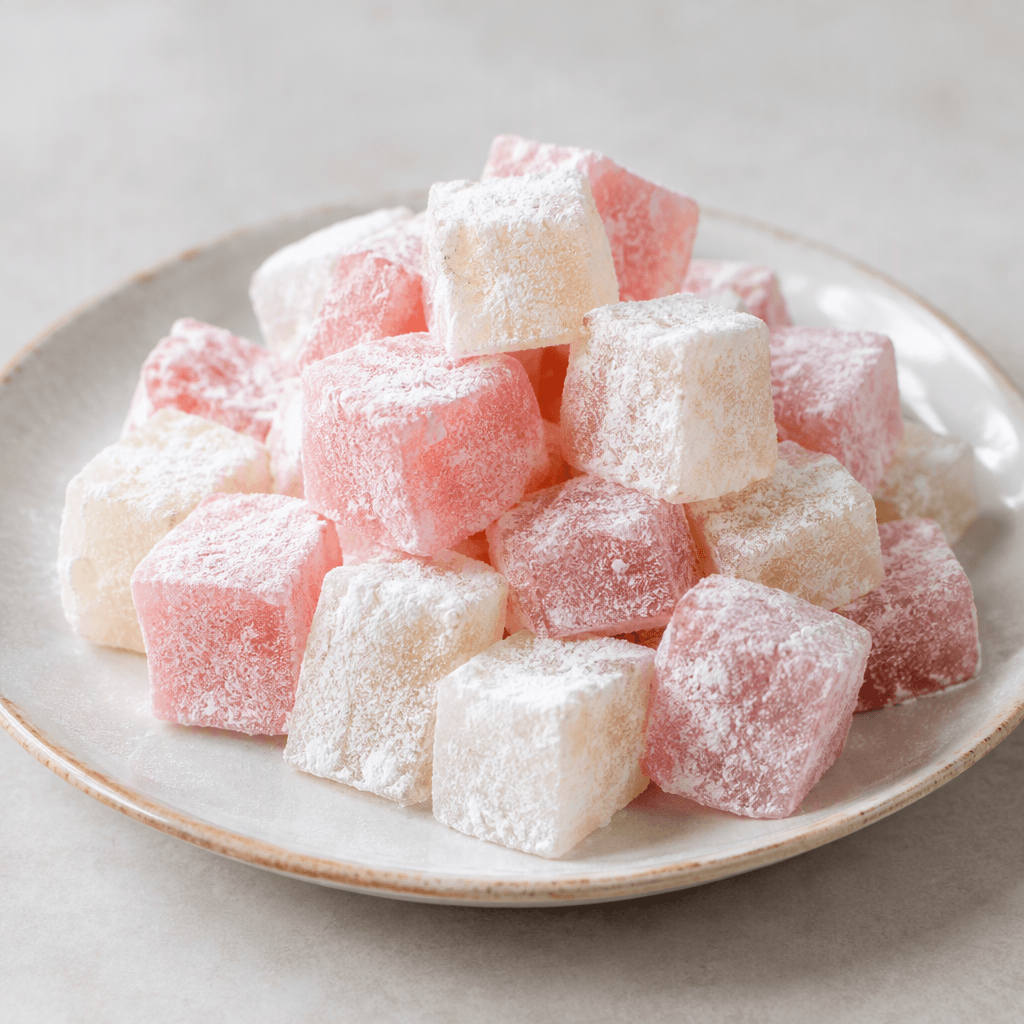
Kuş Lokumu Calories
Traditional Turkish confection, usually made with starch and sugar.
In season: Spring · Summer · Autumn · Winter
CALORIES
GI
POTASSIUM
FIBER
Quick answer
1 piece (medium) of Kuş Lokumu (15 g) has 50 calories. That works out to 330 calories per 100 g. It contains 12.3 g of carbs, 0 g of protein, 0 g of fat and 0 g of fiber. Its glycemic index is 80 (high), so it raises blood sugar quickly.
What is Kuş Lokumu?
Kuş Lokumu is a Turkish confection made in small, bite-sized pieces from a lokum mixture, traditionally based on starch and sugar. The pieces are often soft, slightly translucent cubes dusted with powdered sugar; some versions have added flavouring or colour.
Sweet and gently chewy, it is commonly offered with Turkish coffee or tea, especially when welcoming guests or during celebrations. Its nutritional profile is dominated by carbohydrates, with 82 g per 100 g, and very little fat. Since it is quite sweet, a small piece alongside unsweetened tea or coffee makes a simple serving.
Kuş Lokumu Nutrition Facts
Selected: 100 g
330
KCAL / 100G
Carbs
82g
· 30% DV
Protein
0.2g
· 0% DV
Fat
0.1g
· 0% DV
Fiber
0.1g
· 0% DV
DV is the share of the daily value covered, on a 2,000 kcal reference diet.
Calories come from: Carbs 99% · Protein 0% · Fat 1%
Kuş Lokumu Vitamins & Minerals
Vitamins
B1
0.01mg · 1% DV
B2
0.01mg · 1% DV
B6
0.01mg · 1% DV
Vitamin A
0µg · 0% DV
Minerals
Calcium
2mg · 0% DV
Iron
0mg · 0% DV
Magnesium
1mg · 0% DV
Zinc
0mg · 0% DV
How Nutritious Is Kuş Lokumu?
Nutrient density
Low
How many vitamins, minerals and how much fiber this food carries per calorie. A high score means a lot of nutrition for few calories.
Satiety score
Low
An EatBetter score computed from fiber, protein and calorie density. A high score means staying full longer on the same calories.
Both scores are calculated per 100 g and do not change with the selected portion. The satiety score is EatBetter's own calculation, not a clinical measure.
Kuş Lokumu Glycemic Index
GLYCEMIC INDEX
GLYCEMIC LOAD
Accounts for portion size — a more realistic measure than GI alone.
How to Burn Off Kuş Lokumu
To burn the 330 calories in 100 g:
🚶
Walking (5 km/h)
🏃
Running (8 km/h)
🚴
Cycling
🏊
Swimming
Times are calculated with the MET equation for a 70 kg adult. Actual burn varies with your weight, age and pace.
Is Kuş Lokumu Processed?
NOVA 3
Processed
1. Unprocessed
2. Minimally Processed
3. Processed
4. Ultra-Processed
NOVA classifies foods into 4 groups by industrial processing. NOVA 1 (unprocessed) is the healthiest.
Does Kuş Lokumu Contain Allergens?
No known major allergens
Which Diets Is Kuş Lokumu Good For?
Vegan
— Not suitable
Vegetarian
✓ Suitable
Gluten-Free
— Not suitable
Dairy-Free
— Not suitable
Mediterranean
— Not suitable
Paleo
— Not suitable
Whole30
— Not suitable
DASH
— Not suitable
Keto
— Not suitable
Low FODMAP
— Not suitable
Kuş Lokumu Fat Profile
SATURATED
0g
MONOUNSATURATED
0g
POLYUNSATURATED
0g
Compare Kuş Lokumu
Foods Similar to Kuş Lokumu
Frequently Asked Questions About Kuş Lokumu
What is kuş lokumu?
Kuş lokumu is a small, bite-sized Turkish confection related to lokum, or Turkish delight. It is typically soft and chewy, cut into little pieces, and lightly coated with powdered sugar to keep the pieces from sticking.
Is kuş lokumu the same as Turkish delight?
Kuş lokumu is a type of lokum, but the name usually refers to the small, bite-sized pieces rather than a completely different sweet. Its ingredients and texture are similar to Turkish delight, while flavors and coatings can vary.
What does kuş lokumu taste like?
Kuş lokumu tastes sweet and has a soft, chewy texture. Its flavor depends on the recipe: some versions are lightly flavored, while others may have rose or fruit notes.
What is kuş lokumu made of?
Kuş lokumu is usually made with sugar and starch, cooked together to form its characteristic soft, chewy texture. Recipes may also add flavorings or coloring, so the exact ingredients can differ between varieties.
Why is kuş lokumu cut into such small pieces?
Kuş lokumu is cut into small pieces so it can be served as a bite-sized sweet alongside tea or coffee. The small shape also makes it easy to share and helps distinguish it from larger pieces of lokum.
Why is kuş lokumu coated in powdered sugar?
Powdered sugar helps keep kuş lokumu pieces from sticking to one another and to the plate. It also gives the surface a dry finish; shake off any excess before serving if you prefer less coating.
How should you serve kuş lokumu?
Serve kuş lokumu at room temperature, arranged in a small dish, often with Turkish tea or coffee. Its small pieces are designed to be eaten in a bite, so there is no need to cut or prepare them.
How do you keep kuş lokumu fresh?
Keep kuş lokumu in an airtight container in a cool, dry place. Humidity can dissolve its powdered-sugar coating and make the pieces sticky, so avoid leaving it exposed or storing it in the refrigerator.
Can you freeze kuş lokumu?
Freezing kuş lokumu is not ideal because thawing can make the pieces damp and sticky and may change their soft texture. For short-term storage, keep it sealed in a cool, dry place instead.
Can you make kuş lokumu at home?
Yes, kuş lokumu can be made at home by cooking a sugar-and-starch mixture until thick, then letting it set before cutting it into small cubes. Dust the pieces with powdered sugar to reduce sticking.
Have another question about Kuş Lokumu?
Ask the AI nutrition coach — calories, portions, alternatives and more, answered in seconds in the app.

Scan calories with your camera
Instant AI nutrition analysis

Nutrition data compiled from USDA FoodData Central and scientific sources.