

Ready & Packaged Foods
All →Vegetables & Legumes
All →Desserts & Confectionery
All →Meat & Protein
All →Grains & Bakery
All →Beverages
All →Milk & Dairy
All →

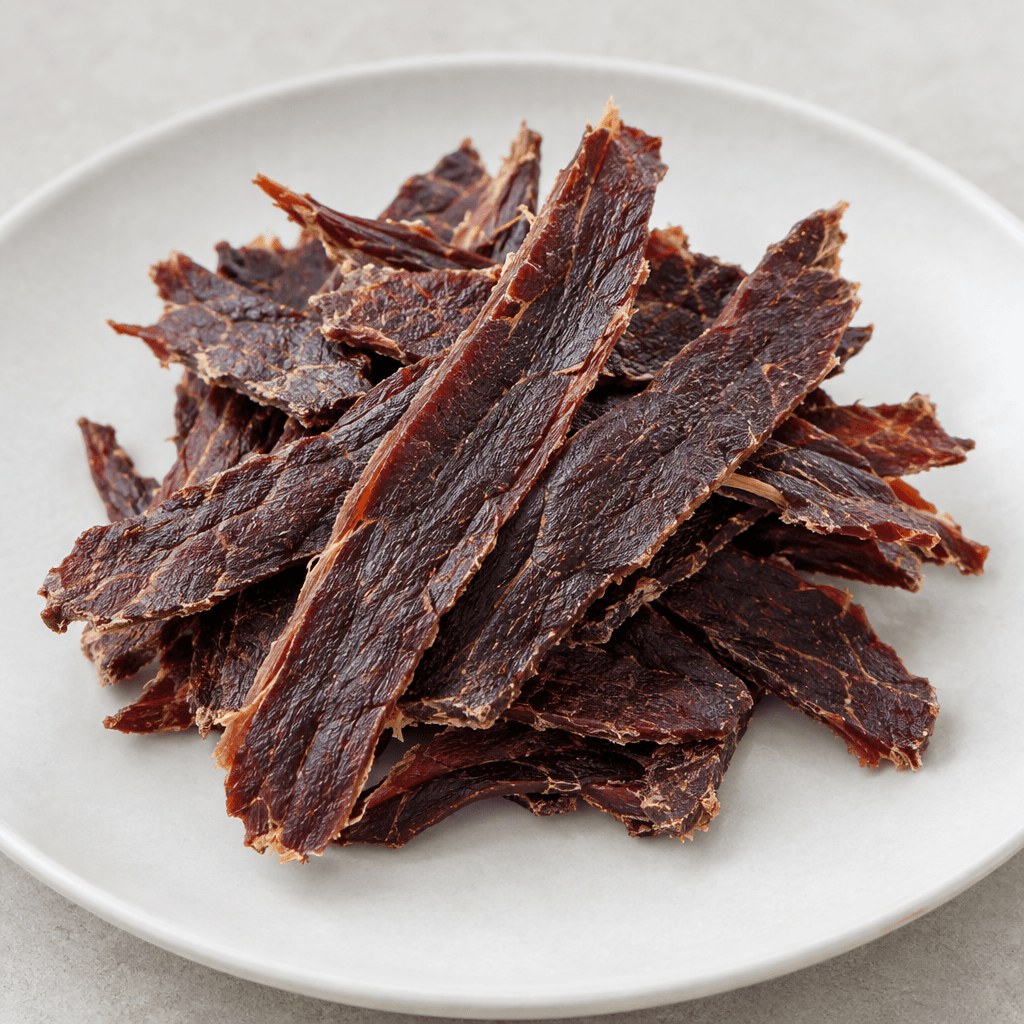
Dried Meat Calories
High protein, low moisture, long shelf life
In season: Spring · Summer · Autumn · Winter
CALORIES
GI
POTASSIUM
FIBER
Quick answer
1 piece (medium) of Dried Meat (30 g) has 96 calories. That works out to 320 calories per 100 g. It contains 0.6 g of carbs, 15 g of protein, 3.6 g of fat and 0 g of fiber. Its 0.8 µg of B12 covers 31% of the Daily Value. Its glycemic index is 0 (low), so it raises blood sugar slowly.
What is Dried Meat?
Dried meat is made by preserving meat through drying, sometimes after salting it; the result is a firm, fibrous strip with little moisture. It is an age-old way of keeping meat and appears in food traditions around the world, with ingredients and methods varying by region.
Its flavour is concentrated and savoury. The strips can be eaten as a snack, served alongside other small bites, or added to soups and stews, where they soften as they cook. Because it is low in moisture, dried meat is compact and high in protein: the listed amount is 50 g per 100 g. For a lighter snack, pair a small portion with fresh vegetables or fruit rather than making it the whole meal.
Dried Meat Nutrition Facts
Selected: 100 g
320
KCAL / 100G
Carbs
2g
· 1% DV
Protein
50g
· 100% DV
Fat
12g
· 15% DV
Fiber
0g
· 0% DV
DV is the share of the daily value covered, on a 2,000 kcal reference diet.
Calories come from: Carbs 3% · Protein 63% · Fat 34%
Dried Meat Vitamins & Minerals
Vitamins
B12
2.5µg · 104% DV
B3
4.5mg · 28% DV
B6
0.45mg · 26% DV
B2
0.25mg · 19% DV
Minerals
Phosphorus
340mg · 49% DV
Sodium
900mg · 39% DV
Zinc
4mg · 36% DV
Selenium
18µg · 33% DV
How Nutritious Is Dried Meat?
Nutrient density
High
How many vitamins, minerals and how much fiber this food carries per calorie. A high score means a lot of nutrition for few calories.
Satiety score
Medium
An EatBetter score computed from fiber, protein and calorie density. A high score means staying full longer on the same calories.
Both scores are calculated per 100 g and do not change with the selected portion. The satiety score is EatBetter's own calculation, not a clinical measure.
Dried Meat Glycemic Index
GLYCEMIC INDEX
GLYCEMIC LOAD
Accounts for portion size — a more realistic measure than GI alone.
How to Burn Off Dried Meat
To burn the 320 calories in 100 g:
🚶
Walking (5 km/h)
🏃
Running (8 km/h)
🚴
Cycling
🏊
Swimming
Times are calculated with the MET equation for a 70 kg adult. Actual burn varies with your weight, age and pace.
Is Dried Meat Processed?
NOVA 2
Minimally Processed
1. Unprocessed
2. Minimally Processed
3. Processed
4. Ultra-Processed
NOVA classifies foods into 4 groups by industrial processing. NOVA 1 (unprocessed) is the healthiest.
Does Dried Meat Contain Allergens?
No known major allergens
Which Diets Is Dried Meat Good For?
Vegan
— Not suitable
Vegetarian
— Not suitable
Gluten-Free
✓ Suitable
Dairy-Free
— Not suitable
Mediterranean
✓ Suitable
Paleo
✓ Suitable
Whole30
— Not suitable
DASH
— Not suitable
Keto
✓ Suitable
Low FODMAP
— Not suitable
Dried Meat Fat Profile
SATURATED
4.5g
MONOUNSATURATED
5.2g
POLYUNSATURATED
1.2g
Omega 6:3 ratio 5:1
Above the ideal 4:1 (5:1).
Compare Dried Meat
Foods Similar to Dried Meat
Frequently Asked Questions About Dried Meat
What is dried meat, and how is it different from jerky?
Dried meat is meat preserved by removing much of its moisture; jerky is one particular style of dried meat. Jerky is usually seasoned and cut into strips, while other dried meats may use different cuts, seasonings, and traditional methods.
How do you eat dried meat?
Dried meat can be eaten as a snack or added to cooked dishes. If it is tough, slice or break it into small pieces and simmer it in soup, stew, or another moist dish until it softens.
How is dried meat made at home?
Dried meat is made by drying lean meat under controlled conditions, often after seasoning or curing it. Use a tested food-safety method: simply leaving raw meat out to dry may not reliably destroy harmful bacteria.
How should dried meat be stored after opening?
Keep opened dried meat sealed in an airtight container in a cool, dry place, away from sunlight and moisture. Follow the package’s storage directions, since products differ in how they are prepared and packaged.
Can you rehydrate dried meat?
Yes, you can soften dried meat by soaking it briefly in warm water or simmering it in a moist dish. The time needed varies with the cut and how dry it is; discard the soaking water.
Can you eat dried meat without cooking it?
Some dried meat is ready to eat, but that is not true of every product. Preparation methods vary, so follow its eating instructions; if you cannot confirm it is ready to eat, cook it thoroughly.
Can dried meat be frozen?
Yes, dried meat can be frozen. Seal it well to protect it from air and moisture, thaw it in the refrigerator, and use it soon after thawing rather than refreezing it.
What cuts of meat work best for making dried meat?
Lean cuts work best for dried meat because they contain less fat, which can turn rancid during storage. Beef is commonly used, but the suitable cut depends on the drying method and the style being made.
How can you tell if dried meat has gone bad?
Discard dried meat if it has visible mold, a distinctly unpleasant smell, a sticky surface, or unusual discoloration. Do not taste it to test whether it is safe, and treat moisture exposure as a warning sign.
Does dried meat need to be refrigerated?
Not always: some commercially packaged dried meat is shelf-stable while sealed, whereas other products require refrigeration. After opening, refrigeration is a sensible choice if the package directs it or the storage conditions are uncertain.
Have another question about Dried Meat?
Ask the AI nutrition coach — calories, portions, alternatives and more, answered in seconds in the app.

Scan calories with your camera
Instant AI nutrition analysis

Nutrition data compiled from USDA FoodData Central and scientific sources.