

Ready & Packaged Foods
All →Vegetables & Legumes
All →Desserts & Confectionery
All →Meat & Protein
All →Grains & Bakery
All →Beverages
All →Milk & Dairy
All →

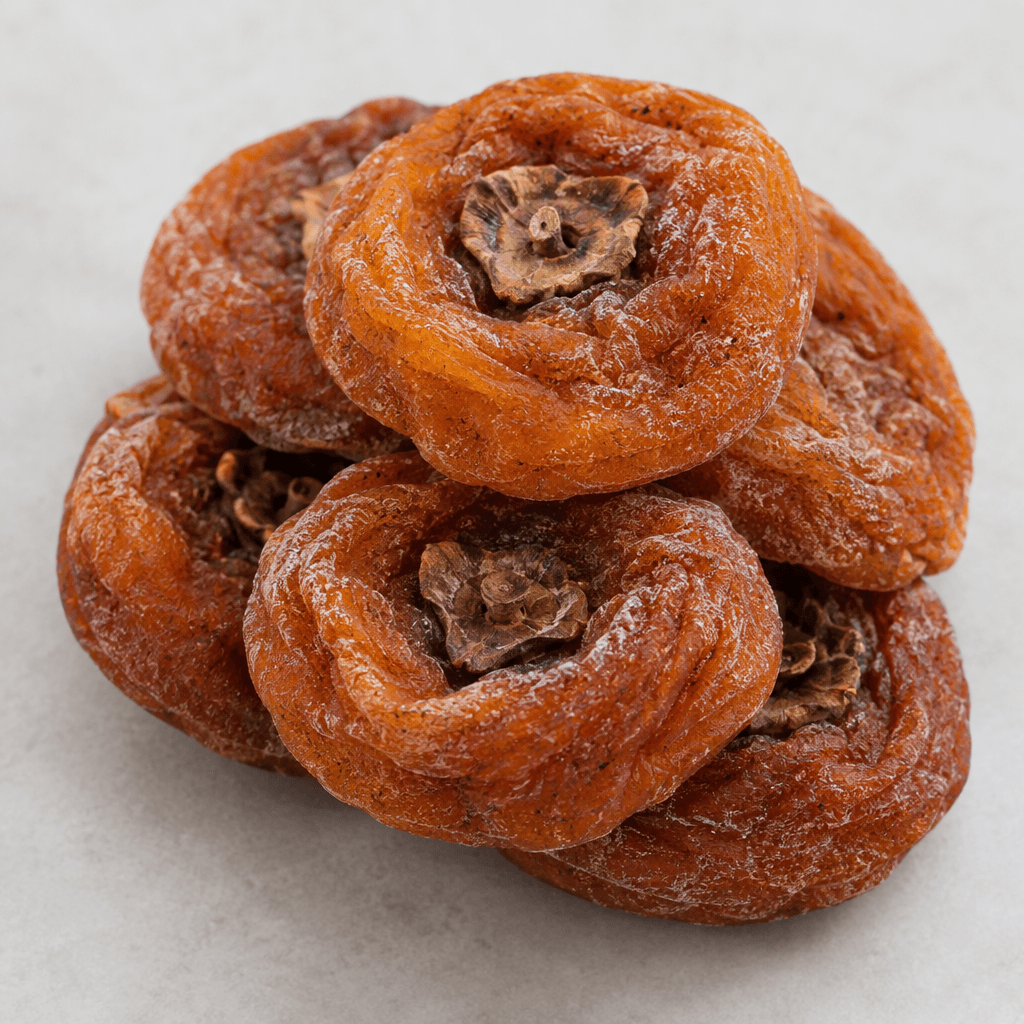
Dried Persimmon Calories
Naturally sweet, rich in fiber and antioxidants
In season: Autumn · Winter
CALORIES
GI
POTASSIUM
FIBER
Quick answer
1 piece (medium) of Dried Persimmon (35 g) has 96 calories. That works out to 274 calories per 100 g. It contains 25.7 g of carbs, 0.5 g of protein, 0.2 g of fat and 5.1 g of fiber. Its 0.9 mg of Iron covers 5% of the Daily Value. Its glycemic index is 55 (medium), so it raises blood sugar at a moderate pace.
What is Dried Persimmon?
Dried persimmon is made by drying ripe persimmons, often peeled and left whole, until their flesh becomes dense and chewy. The fruit turns a deep orange-brown and tastes intensely sweet; a fine pale coating on the surface can be crystallised fruit sugar. It is enjoyed as a snack in regions where persimmons are grown, and also works well chopped into porridge, yoghurt or baked goods.
It is naturally low in fat and notably high in fibre, with 14.5 g per 100 g. Its concentrated sweetness makes a small piece satisfying alongside nuts or a cup of tea. For a less sweet snack, pair it with plain yoghurt or a handful of unsalted nuts.
Dried Persimmon Nutrition Facts
Selected: 100 g
274
KCAL / 100G
Carbs
73.4g
· 27% DV
Protein
1.5g
· 3% DV
Fat
0.6g
· 1% DV
Fiber
14.5g
· 52% DV
DV is the share of the daily value covered, on a 2,000 kcal reference diet.
Calories come from: Carbs 96% · Protein 2% · Fat 2%
Dried Persimmon Vitamins & Minerals
Vitamins
Vitamin A
81µg · 9% DV
B1
0.07mg · 6% DV
B6
0.09mg · 5% DV
Vitamin E
0.73mg · 5% DV
Minerals
Iron
3mg · 17% DV
Potassium ⭐
490mg · 14% DV
Magnesium
33mg · 8% DV
Phosphorus
38mg · 5% DV
How Nutritious Is Dried Persimmon?
Nutrient density
High
How many vitamins, minerals and how much fiber this food carries per calorie. A high score means a lot of nutrition for few calories.
Satiety score
Medium
An EatBetter score computed from fiber, protein and calorie density. A high score means staying full longer on the same calories.
Both scores are calculated per 100 g and do not change with the selected portion. The satiety score is EatBetter's own calculation, not a clinical measure.
Dried Persimmon Glycemic Index
GLYCEMIC INDEX
GLYCEMIC LOAD
Accounts for portion size — a more realistic measure than GI alone.
How to Burn Off Dried Persimmon
To burn the 274 calories in 100 g:
🚶
Walking (5 km/h)
🏃
Running (8 km/h)
🚴
Cycling
🏊
Swimming
Times are calculated with the MET equation for a 70 kg adult. Actual burn varies with your weight, age and pace.
Is Dried Persimmon Processed?
NOVA 2
Minimally Processed
1. Unprocessed
2. Minimally Processed
3. Processed
4. Ultra-Processed
NOVA classifies foods into 4 groups by industrial processing. NOVA 1 (unprocessed) is the healthiest.
Does Dried Persimmon Contain Allergens?
No known major allergens
Which Diets Is Dried Persimmon Good For?
Vegan
✓ Suitable
Vegetarian
✓ Suitable
Gluten-Free
✓ Suitable
Dairy-Free
— Not suitable
Mediterranean
✓ Suitable
Paleo
✓ Suitable
Whole30
— Not suitable
DASH
— Not suitable
Keto
— Not suitable
Low FODMAP
— Not suitable
Dried Persimmon Fat Profile
SATURATED
0.03g
MONOUNSATURATED
0.09g
POLYUNSATURATED
0.12g
Omega 6:3 ratio 3:1
Below the ideal 4:1 — a good omega balance.
Compare Dried Persimmon
Foods Similar to Dried Persimmon
Frequently Asked Questions About Dried Persimmon
Why does Dried Persimmon have a white coating?
The thin, dry white coating on Dried Persimmon is often crystallized natural sugar that rises to the surface during drying. Fuzzy patches, an unpleasant smell, or dampness can signal spoilage instead; discard the fruit if you are unsure.
How do you eat Dried Persimmon?
Dried Persimmon can be eaten as it is: remove the stem and bite into it or cut it into pieces. It also works in oatmeal, yogurt, salads, and cheese boards. If it is too firm, briefly soaking it in warm water can soften it.
How should Dried Persimmon be stored?
Store Dried Persimmon in an airtight container in a cool, dry place. Refrigerate it if your kitchen is warm or humid, and keep moisture out of the container. Discard any fruit that develops fuzzy growth, an off smell, or damp spots.
How is Dried Persimmon made?
Dried Persimmon is commonly made by peeling firm persimmons and drying them whole, often by hanging them in a well-ventilated place. Drying time varies with humidity and temperature. Keep the fruit spaced apart and avoid damp conditions that can encourage mold.
How do you soften Dried Persimmon?
To soften Dried Persimmon, soak it briefly in warm water or let it rest in a closed container with a little moisture. Check the texture frequently so it does not become mushy. Once softened, eat it promptly or refrigerate it.
Can Dried Persimmon be frozen?
Yes, Dried Persimmon can be frozen in an airtight freezer-safe container or bag. Separate pieces so they do not stick together, and thaw only what you plan to eat. Keep it sealed while thawing to limit condensation on the fruit.
Do you need to wash Dried Persimmon before eating it?
No, Dried Persimmon does not usually need washing before eating. Water can leave the surface damp and shorten its keeping quality. If you see dust, rinse it quickly and dry it thoroughly; do not wash away suspicious fuzzy growth and then eat it.
Is the white powder on Dried Persimmon mold or sugar?
A fine, dry, fairly even white layer is usually sugar crystals, not mold. Mold is more likely to look fuzzy or patchy and may come with a musty or sour smell. When the appearance or smell is questionable, discard the fruit.
Is Dried Persimmon good for constipation?
Dried Persimmon contains fiber, which can help support regular bowel movements. Drink fluids alongside fiber-rich foods, since increasing fiber without enough fluid may worsen discomfort. It can also cause gas or bloating in people unaccustomed to much fiber.
Can people with diabetes eat Dried Persimmon?
People with diabetes may be able to include Dried Persimmon in a planned portion, but its natural sugars are concentrated by drying and can raise blood glucose. Portion size and meal timing matter, so follow your care team's advice for your individual plan.
Have another question about Dried Persimmon?
Ask the AI nutrition coach — calories, portions, alternatives and more, answered in seconds in the app.

Scan calories with your camera
Instant AI nutrition analysis

Nutrition data compiled from USDA FoodData Central and scientific sources.