

Ready & Packaged Foods
All →Vegetables & Legumes
All →Desserts & Confectionery
All →Meat & Protein
All →Grains & Bakery
All →Beverages
All →Milk & Dairy
All →

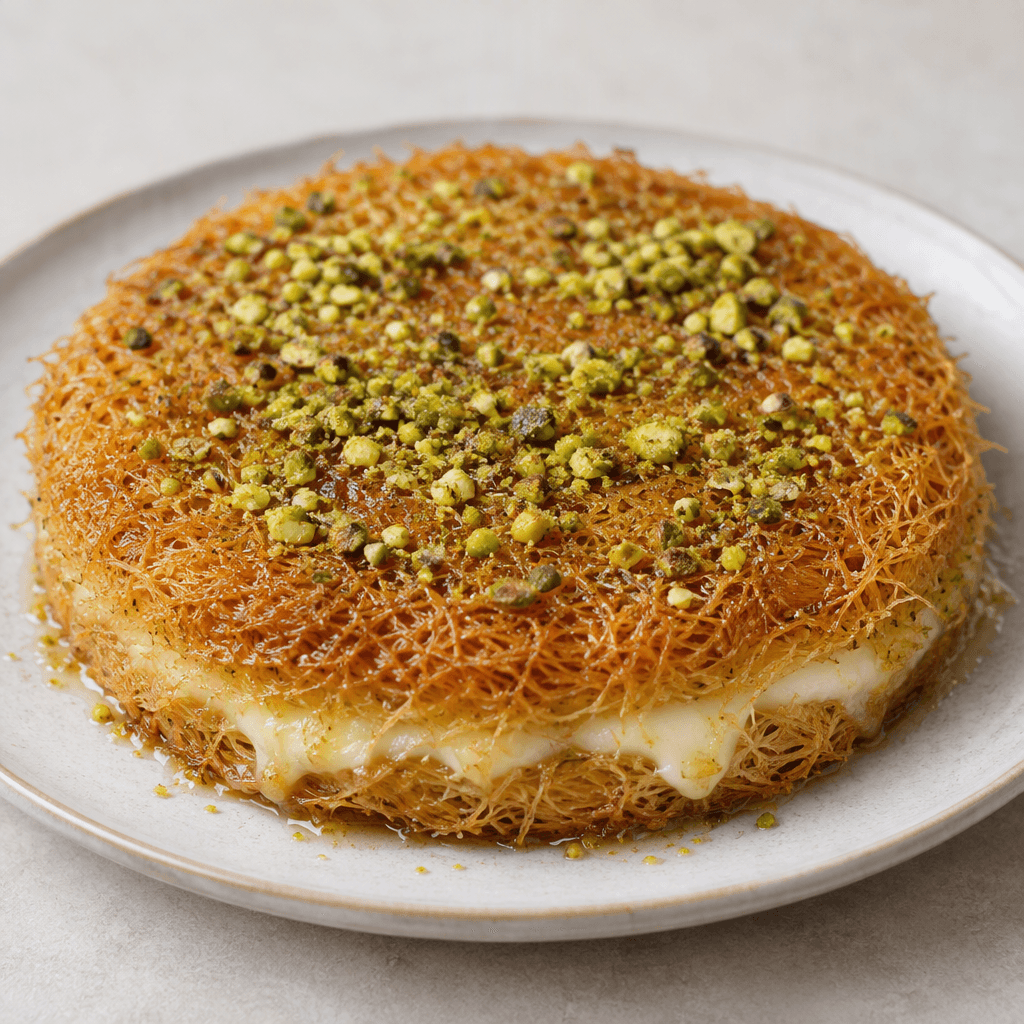
Kunefe with Pistachio Calories
Traditional Turkish dessert made with shredded pastry, cheese, pistachios, and syrup. Served warm.
In season: Spring · Summer · Autumn · Winter
CALORIES
GI
POTASSIUM
FIBER
Quick answer
1 piece (medium) of Kunefe with Pistachio (120 g) has 420 calories. That works out to 350 calories per 100 g. It contains 57.6 g of carbs, 9 g of protein, 16.8 g of fat and 2.5 g of fiber. Its 0.3 mg of Copper covers 29% of the Daily Value. Its glycemic index is 65 (high), so it raises blood sugar quickly.
What is Kunefe with Pistachio?
Kunefe with pistachio is a warm Turkish dessert, especially associated with Hatay. Shredded kadayif pastry is layered around a mild, melting cheese, cooked until golden, then soaked with sweet syrup and topped with chopped pistachios.
Its crisp, buttery strands contrast with the soft, stretchy cheese inside. It is usually served hot, before the syrup has cooled, as a dessert after a meal; in Turkey, it is also common to share it with tea. The pastry and syrup make it rich in carbohydrates, while the cheese contributes some protein. A smaller portion is satisfying, and unsweetened tea makes a good accompaniment.
Kunefe with Pistachio Nutrition Facts
Selected: 100 g
350
KCAL / 100G
Carbs
48g
· 17% DV
Protein
7.5g
· 15% DV
Fat
14g
· 18% DV
Fiber
2.1g
· 8% DV
DV is the share of the daily value covered, on a 2,000 kcal reference diet.
Calories come from: Carbs 55% · Protein 9% · Fat 36%
Kunefe with Pistachio Vitamins & Minerals
Vitamins
B2
0.18mg · 14% DV
Vitamin A
110µg · 12% DV
B12
0.28µg · 12% DV
B1
0.09mg · 8% DV
Minerals
Phosphorus
120mg · 17% DV
Calcium
160mg · 16% DV
Selenium
5.5µg · 10% DV
Zinc
1mg · 9% DV
How Nutritious Is Kunefe with Pistachio?
Nutrient density
Low
How many vitamins, minerals and how much fiber this food carries per calorie. A high score means a lot of nutrition for few calories.
Satiety score
Low
An EatBetter score computed from fiber, protein and calorie density. A high score means staying full longer on the same calories.
Both scores are calculated per 100 g and do not change with the selected portion. The satiety score is EatBetter's own calculation, not a clinical measure.
Kunefe with Pistachio Glycemic Index
GLYCEMIC INDEX
GLYCEMIC LOAD
Accounts for portion size — a more realistic measure than GI alone.
How to Burn Off Kunefe with Pistachio
To burn the 350 calories in 100 g:
🚶
Walking (5 km/h)
🏃
Running (8 km/h)
🚴
Cycling
🏊
Swimming
Times are calculated with the MET equation for a 70 kg adult. Actual burn varies with your weight, age and pace.
Is Kunefe with Pistachio Processed?
NOVA 3
Processed
1. Unprocessed
2. Minimally Processed
3. Processed
4. Ultra-Processed
NOVA classifies foods into 4 groups by industrial processing. NOVA 1 (unprocessed) is the healthiest.
Does Kunefe with Pistachio Contain Allergens?
Contains these allergens:
Which Diets Is Kunefe with Pistachio Good For?
Vegan
— Not suitable
Vegetarian
— Not suitable
Gluten-Free
— Not suitable
Dairy-Free
— Not suitable
Mediterranean
✓ Suitable
Paleo
— Not suitable
Whole30
— Not suitable
DASH
— Not suitable
Keto
— Not suitable
Low FODMAP
— Not suitable
Kunefe with Pistachio Fat Profile
SATURATED
6.2g
MONOUNSATURATED
4.8g
POLYUNSATURATED
2.1g
Omega 6:3 ratio 15:1
Above the ideal 4:1 (15:1).
Compare Kunefe with Pistachio
Foods Similar to Kunefe with Pistachio
Frequently Asked Questions About Kunefe with Pistachio
What is kunefe with pistachio made of?
Kunefe with pistachio is made with thin shredded pastry, a layer of melting cheese, butter, syrup, and chopped pistachios. It is cooked until the pastry turns golden, then served warm so the cheese stays soft and stretchy.
What cheese is used in kunefe with pistachio?
Kunefe with pistachio traditionally uses a mild, unsalted cheese that melts and stretches without overpowering the syrup. Turkish künefelik cheese is ideal; low-moisture mozzarella can work as a substitute, though its flavor and texture are not exactly the same.
Is kunefe with pistachio the same as kanafeh?
Kunefe with pistachio is a Turkish version of the dessert often called kanafeh or kunafa elsewhere in the Middle East. The name and regional recipe vary, especially in the cheese, pastry shape, syrup flavor, and choice of toppings.
Why is kunefe with pistachio served hot?
Kunefe with pistachio is served hot because the cheese is then soft and stretchy while the shredded pastry can remain crisp. As it cools, the cheese firms up and the syrup softens the pastry, changing the dessert’s signature texture.
Where did kunefe with pistachio originate?
Kunefe with pistachio is strongly associated with Hatay, especially Antakya, in southern Türkiye. Similar cheese-and-pastry desserts are made across the region, but the Turkish preparation is known for its thin kadayıf strands and local melting cheese.
How do you reheat kunefe with pistachio?
Reheat kunefe with pistachio in a covered skillet over low heat or in an oven until the cheese softens and the pastry warms through. A microwave is quicker but tends to make the shredded pastry soft rather than crisp.
What is the difference between kunefe with pistachio and baklava?
Kunefe with pistachio has shredded pastry and a melted-cheese filling, whereas baklava is made from layered sheets of phyllo pastry with nuts between them. Both are syrup-sweetened desserts, but their textures and fillings are distinctly different.
How do you keep kunefe with pistachio crispy?
To keep kunefe with pistachio crisp, cook the shredded pastry until evenly golden and pour on only enough syrup to moisten it. Serve it soon after cooking; storing it in syrup or reheating it in a microwave softens the pastry.
What is kunefe with pistachio served with?
Kunefe with pistachio is often served on its own while warm, with extra chopped pistachios on top. In Türkiye, some people add kaymak, a rich clotted cream, and Turkish tea or coffee makes a common accompaniment.
Can you make kunefe with pistachio ahead of time?
Yes, you can assemble kunefe with pistachio ahead and refrigerate it covered until cooking, keeping the syrup separate. Cook it shortly before serving so the pastry stays crisp and the cheese melts properly; add the pistachios after cooking.
Have another question about Kunefe with Pistachio?
Ask the AI nutrition coach — calories, portions, alternatives and more, answered in seconds in the app.

Scan calories with your camera
Instant AI nutrition analysis

Nutrition data compiled from USDA FoodData Central and scientific sources.