

Ready & Packaged Foods
All →Vegetables & Legumes
All →Desserts & Confectionery
All →Meat & Protein
All →Grains & Bakery
All →Beverages
All →Milk & Dairy
All →

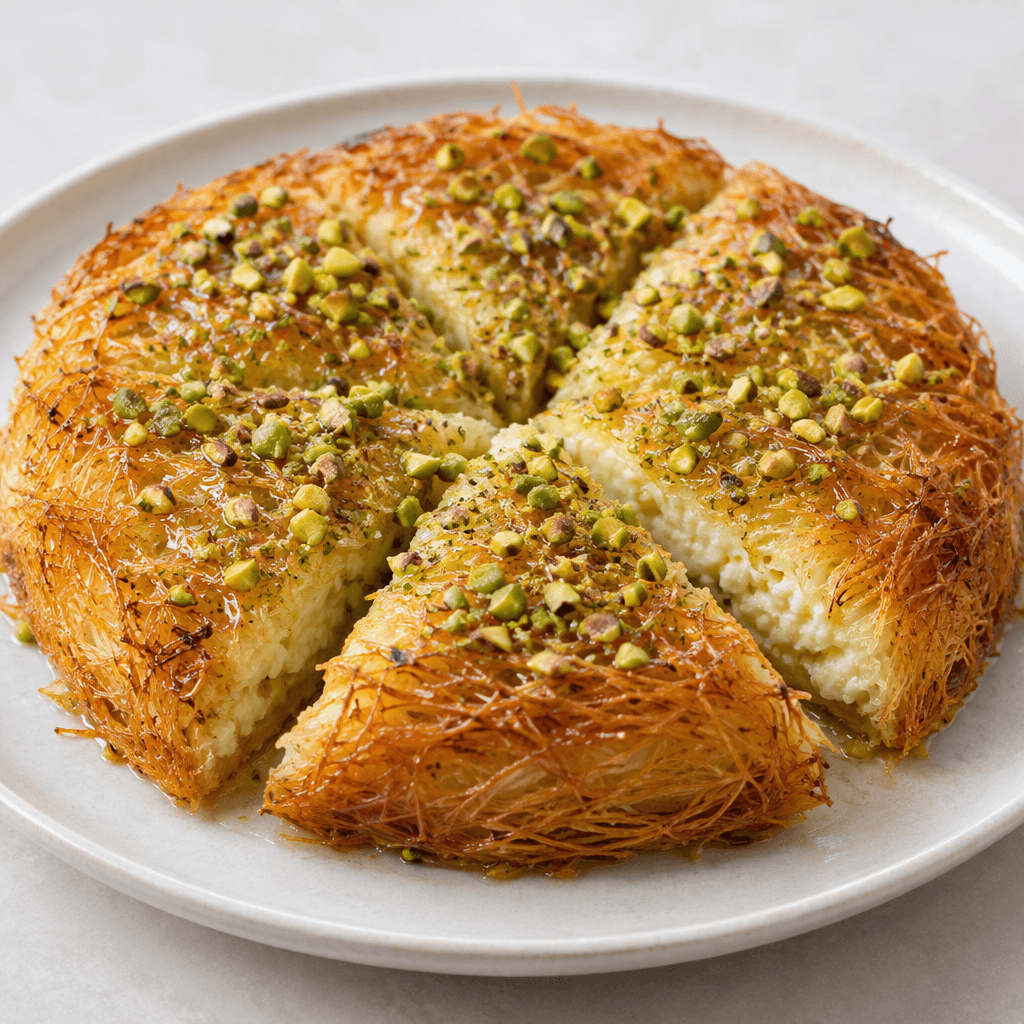
Kunefe Calories
Shredded pastry, cheese, syrup dessert
In season: Spring · Summer · Autumn · Winter
CALORIES
GI
POTASSIUM
FIBER
Quick answer
1 piece (medium) of Kunefe (120 g) has 408 calories. That works out to 340 calories per 100 g. It contains 62.4 g of carbs, 9 g of protein, 13.2 g of fat and 1.4 g of fiber. Its 0.6 µg of B12 covers 25% of the Daily Value. Its glycemic index is 75 (high), so it raises blood sugar quickly.
What is Kunefe?
Kunefe is a syrup-soaked dessert associated with Hatay in southern Turkey and the wider Levant. Fine strands of kadayıf pastry are layered around a mild, stretchy cheese, then cooked until golden and crisp; chopped pistachios are a common finishing touch.
It is served hot, so the cheese stays soft beneath the crisp pastry, while the syrup gives each bite a glossy sweetness. In Turkey it is often shared after a kebab meal or enjoyed with tea; elsewhere, it appears on Turkish and Middle Eastern restaurant menus as a warm dessert. The pastry and syrup make it carbohydrate-rich, with some protein from the cheese; a 100 g portion provides 340 calories. Its sweetness is substantial, so a smaller piece pairs well with unsweetened tea or coffee.
Kunefe Nutrition Facts
Selected: 100 g
340
KCAL / 100G
Carbs
52g
· 19% DV
Protein
7.5g
· 15% DV
Fat
11g
· 14% DV
Fiber
1.2g
· 4% DV
DV is the share of the daily value covered, on a 2,000 kcal reference diet.
Calories come from: Carbs 62% · Protein 9% · Fat 29%
Kunefe Vitamins & Minerals
Vitamins
B12
0.5µg · 21% DV
B2
0.22mg · 17% DV
Vitamin A
120µg · 13% DV
Biotin
2.5µg · 8% DV
Minerals
Calcium
210mg · 21% DV
Phosphorus
120mg · 17% DV
Sodium
240mg · 10% DV
Selenium
5.5µg · 10% DV
How Nutritious Is Kunefe?
Nutrient density
Low
How many vitamins, minerals and how much fiber this food carries per calorie. A high score means a lot of nutrition for few calories.
Satiety score
Low
An EatBetter score computed from fiber, protein and calorie density. A high score means staying full longer on the same calories.
Both scores are calculated per 100 g and do not change with the selected portion. The satiety score is EatBetter's own calculation, not a clinical measure.
Kunefe Glycemic Index
GLYCEMIC INDEX
GLYCEMIC LOAD
Accounts for portion size — a more realistic measure than GI alone.
How to Burn Off Kunefe
To burn the 340 calories in 100 g:
🚶
Walking (5 km/h)
🏃
Running (8 km/h)
🚴
Cycling
🏊
Swimming
Times are calculated with the MET equation for a 70 kg adult. Actual burn varies with your weight, age and pace.
Is Kunefe Processed?
NOVA 3
Processed
1. Unprocessed
2. Minimally Processed
3. Processed
4. Ultra-Processed
NOVA classifies foods into 4 groups by industrial processing. NOVA 1 (unprocessed) is the healthiest.
Does Kunefe Contain Allergens?
Contains these allergens:
Which Diets Is Kunefe Good For?
Vegan
— Not suitable
Vegetarian
✓ Suitable
Gluten-Free
— Not suitable
Dairy-Free
— Not suitable
Mediterranean
✓ Suitable
Paleo
— Not suitable
Whole30
— Not suitable
DASH
— Not suitable
Keto
— Not suitable
Low FODMAP
— Not suitable
Kunefe Fat Profile
SATURATED
6.2g
MONOUNSATURATED
3.2g
POLYUNSATURATED
1.1g
Omega 6:3 ratio 20:1
Above the ideal 4:1 (20:1).
Compare Kunefe
Foods Similar to Kunefe
Frequently Asked Questions About Kunefe
What is kunefe made of?
Kunefe is made with finely shredded pastry, a soft melting cheese, butter, and syrup, and is often topped with pistachios. The pastry is toasted around the cheese, then syrup is added so the outside stays crisp while the center turns gooey.
What cheese is used in kunefe?
Kunefe is traditionally made with a mild, unsalted cheese that melts and stretches without overpowering the syrup. Turkish versions commonly use künefe cheese; mozzarella can work as a substitute if it is not too salty.
Where does kunefe come from?
Kunefe is especially associated with Hatay and Antakya in southern Turkey, where it is a celebrated local dessert. Similar knafeh-style sweets are also made across the Middle East, with variations in cheese, pastry, toppings, and syrup.
How do you eat kunefe?
Kunefe is usually eaten hot, soon after it is cooked, while the cheese is soft and stretchy and the pastry is crisp. Cut it into wedges and eat it with a fork; unsweetened tea or coffee balances its syrupy sweetness.
Why is the cheese in kunefe stretchy?
The cheese in kunefe stretches because it is heated until it melts while retaining an elastic texture. A mild, low-salt cheese is used so its savory flavor does not clash with the sweet syrup.
Is kunefe the same as knafeh?
Kunefe and knafeh are closely related names for a family of syrup-soaked cheese and pastry desserts, not always one identical recipe. Turkish kunefe is particularly associated with Hatay and typically uses shredded pastry and melting cheese.
How is kunefe traditionally cooked?
Traditional kunefe is cooked in a shallow round pan, with cheese sandwiched between buttered strands of shredded pastry. It is toasted until golden on both sides, then soaked with syrup and served hot, often with pistachios.
Can you reheat kunefe?
Yes, reheat kunefe in a pan over low heat or in an oven until warmed through. Leaving it uncovered helps the pastry regain some crispness; a microwave is quicker but can make the pastry soft and the cheese rubbery.
How should leftover kunefe be stored?
Store leftover kunefe in a sealed container in the refrigerator. Its pastry will soften and the cheese will firm up as it sits, so it is best eaten fresh; reheat leftovers before serving rather than eating them cold.
Can people with diabetes eat kunefe?
People with diabetes can include kunefe occasionally, but its syrup and pastry can raise blood glucose. Portion size and the rest of the meal matter; ask your doctor or dietitian how it fits your individual glucose-management plan.
Have another question about Kunefe?
Ask the AI nutrition coach — calories, portions, alternatives and more, answered in seconds in the app.

Scan calories with your camera
Instant AI nutrition analysis

Nutrition data compiled from USDA FoodData Central and scientific sources.