

Ready & Packaged Foods
All →Vegetables & Legumes
All →Desserts & Confectionery
All →Meat & Protein
All →Grains & Bakery
All →Beverages
All →Milk & Dairy
All →

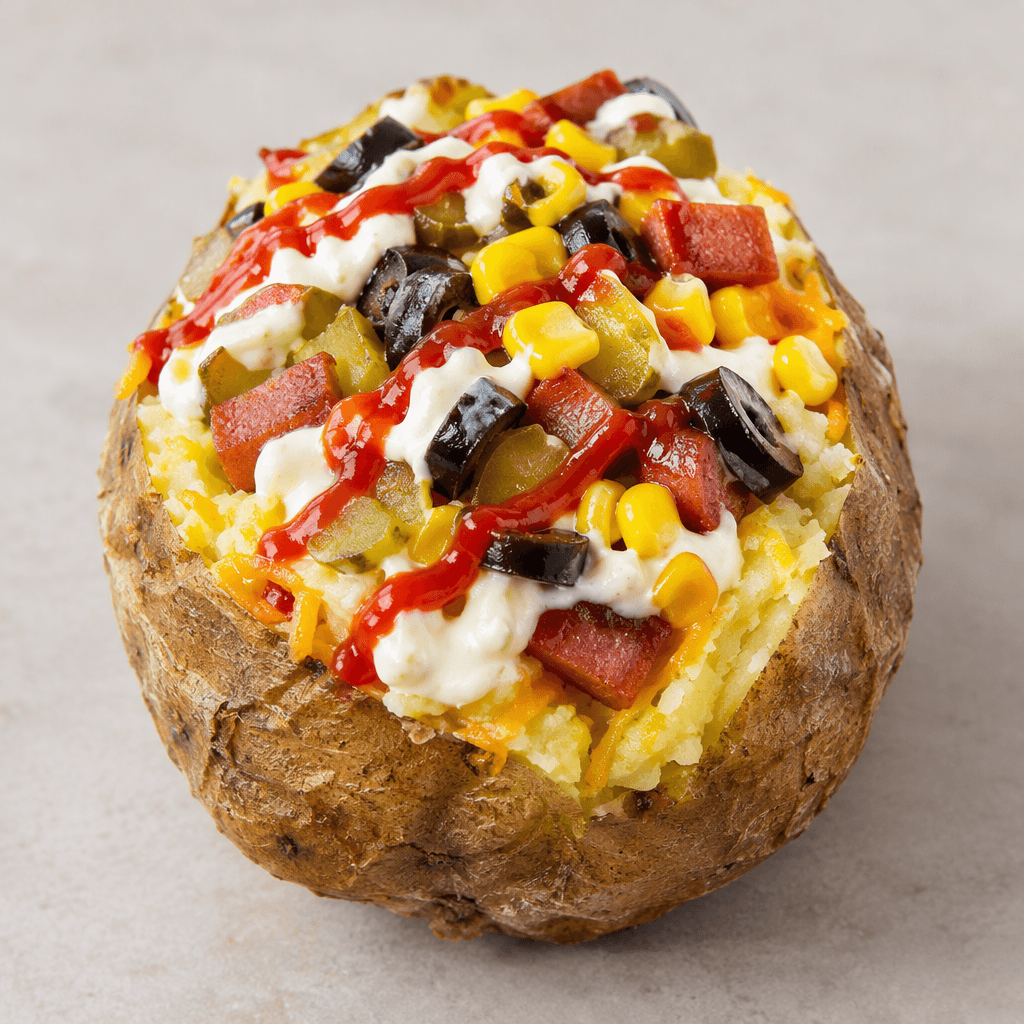
Kumpir (Turkish loaded baked potato) Calories
Baked potato, butter, cheese, assorted toppings
In season: Autumn · Winter
CALORIES
GI
POTASSIUM
FIBER
Quick answer
1 piece (large) of Kumpir (Turkish loaded baked potato) (350 g) has 490 calories. That works out to 140 calories per 100 g. It contains 75.3 g of carbs, 11.2 g of protein, 14.7 g of fat and 7.4 g of fiber. Its 910 mg of Sodium covers 40% of the Daily Value. Its glycemic index is 85 (high), so it raises blood sugar quickly.
What is Kumpir (Turkish loaded baked potato)?
Kumpir is a Turkish baked potato, usually made with a large potato cooked in its skin. The middle is split open and mashed with butter and cheese, then finished with toppings such as olives, sweetcorn, pickles, Russian salad or sausage. The combination is often chosen at the counter, so no two servings need be quite alike.
In Turkey it is a popular street-food meal, especially associated with Istanbul’s Ortaköy, and it is filling enough to eat on its own. The potato makes it mainly a carbohydrate-rich dish, while the butter, cheese and toppings add richness. For a lighter version, ask for less butter and cheese and choose more vegetable toppings.
Kumpir (Turkish loaded baked potato) Nutrition Facts
Selected: 100 g
140
KCAL / 100G
Carbs
21.5g
· 8% DV
Protein
3.2g
· 6% DV
Fat
4.2g
· 5% DV
Fiber
2.1g
· 8% DV
DV is the share of the daily value covered, on a 2,000 kcal reference diet.
Calories come from: Carbs 63% · Protein 9% · Fat 28%
Kumpir (Turkish loaded baked potato) Vitamins & Minerals
Vitamins
B6
0.18mg · 11% DV
Vitamin C
8mg · 9% DV
B5
0.4mg · 8% DV
B1
0.08mg · 7% DV
Minerals
Sodium
260mg · 11% DV
Potassium ⭐
340mg · 10% DV
Phosphorus
65mg · 9% DV
Iron
1mg · 6% DV
How Nutritious Is Kumpir (Turkish loaded baked potato)?
Nutrient density
Medium
How many vitamins, minerals and how much fiber this food carries per calorie. A high score means a lot of nutrition for few calories.
Satiety score
Medium
An EatBetter score computed from fiber, protein and calorie density. A high score means staying full longer on the same calories.
Both scores are calculated per 100 g and do not change with the selected portion. The satiety score is EatBetter's own calculation, not a clinical measure.
Kumpir (Turkish loaded baked potato) Glycemic Index
GLYCEMIC INDEX
GLYCEMIC LOAD
Accounts for portion size — a more realistic measure than GI alone.
How to Burn Off Kumpir (Turkish loaded baked potato)
To burn the 140 calories in 100 g:
🚶
Walking (5 km/h)
🏃
Running (8 km/h)
🚴
Cycling
🏊
Swimming
Times are calculated with the MET equation for a 70 kg adult. Actual burn varies with your weight, age and pace.
Is Kumpir (Turkish loaded baked potato) Processed?
NOVA 3
Processed
1. Unprocessed
2. Minimally Processed
3. Processed
4. Ultra-Processed
NOVA classifies foods into 4 groups by industrial processing. NOVA 1 (unprocessed) is the healthiest.
Does Kumpir (Turkish loaded baked potato) Contain Allergens?
Contains these allergens:
Which Diets Is Kumpir (Turkish loaded baked potato) Good For?
Vegan
— Not suitable
Vegetarian
✓ Suitable
Gluten-Free
— Not suitable
Dairy-Free
— Not suitable
Mediterranean
— Not suitable
Paleo
— Not suitable
Whole30
— Not suitable
DASH
— Not suitable
Keto
— Not suitable
Low FODMAP
— Not suitable
Kumpir (Turkish loaded baked potato) Fat Profile
SATURATED
2.1g
MONOUNSATURATED
1.2g
POLYUNSATURATED
0.15g
Omega 6:3 ratio 6:1
Above the ideal 4:1 (6:1).
Compare Kumpir (Turkish loaded baked potato)
Foods Similar to Kumpir (Turkish loaded baked potato)
Frequently Asked Questions About Kumpir (Turkish loaded baked potato)
What is kumpir?
Kumpir is a Turkish street food made from a large potato baked in its skin, then opened and mashed with butter and cheese. It is served with a choice of toppings, and is especially associated with Istanbul’s Ortaköy neighbourhood.
What toppings go on kumpir?
Common kumpir toppings include sweetcorn, olives, pickles, Russian salad, sausages, and sauces, placed over the buttery, cheesy potato. Toppings vary by stall, so you can usually choose a mix rather than follow one fixed recipe.
How do you make kumpir?
To make kumpir, bake a large potato whole until its centre is soft. Split it open, mash the inside with butter and cheese while it is hot, then add toppings such as corn, olives, pickles, or salad.
Where did kumpir come from?
Kumpir is a Turkish take on the loaded baked potato, rather than a dish tied to one traditional region. In Turkey it is strongly associated with Istanbul’s Ortaköy, where kumpir stalls helped make it a well-known street food.
Why is the inside of kumpir mashed?
The hot potato flesh is mashed inside the skin so the butter and cheese blend through it, giving kumpir its soft, creamy centre. Keeping the mixture in the potato skin also makes a convenient base for piling on toppings.
What kind of potato is best for kumpir?
A large, starchy potato works best for kumpir because its flesh becomes fluffy and easy to mash after baking. Choose one with enough room for toppings, and bake it whole until a knife slides easily into the centre.
Can you make kumpir without an oven?
Yes, you can cook the potato for kumpir in a microwave or air fryer, although the skin may not brown and crisp like an oven-baked one. Make sure the centre is fully tender before adding butter, cheese, and toppings.
What is the difference between kumpir and a loaded baked potato?
Kumpir is a Turkish style of loaded baked potato: its flesh is specifically mashed with butter and cheese inside the skin, then topped with a mix of garnishes. Other loaded baked potatoes may keep the flesh intact and use different toppings.
Can you keep leftover kumpir for the next day?
Yes, leftover kumpir can be refrigerated in a covered container and reheated the next day. Toppings such as pickles or salad may become watery, so if possible, store them separately and add them after reheating the potato.
Is kumpir a healthy meal?
Kumpir can be a filling meal, but its overall balance changes with the butter, cheese, sauces, and toppings added. For a lighter homemade version, use less butter and choose vegetables, olives, or other less-rich toppings.
Have another question about Kumpir (Turkish loaded baked potato)?
Ask the AI nutrition coach — calories, portions, alternatives and more, answered in seconds in the app.

Scan calories with your camera
Instant AI nutrition analysis

Nutrition data compiled from USDA FoodData Central and scientific sources.