

Ready & Packaged Foods
All →Vegetables & Legumes
All →Desserts & Confectionery
All →Meat & Protein
All →Grains & Bakery
All →Beverages
All →Milk & Dairy
All →

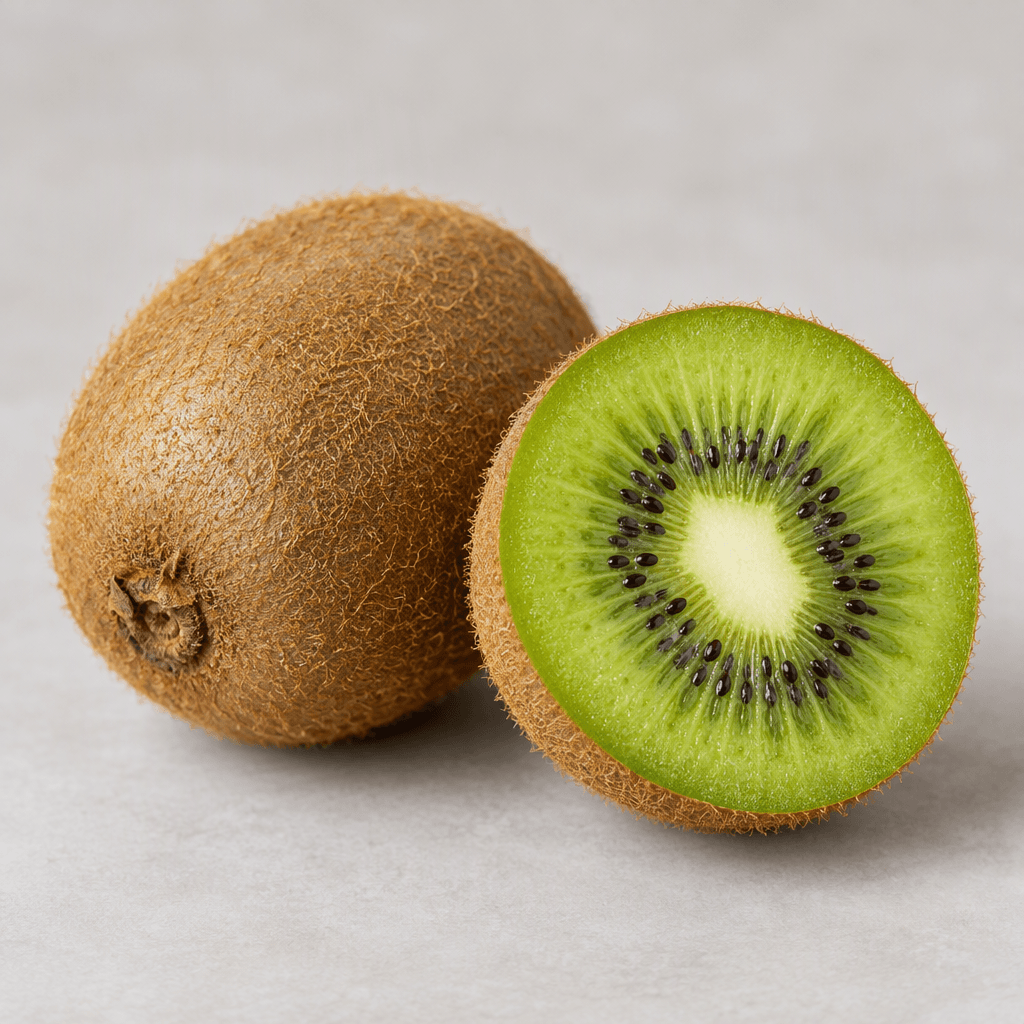
Kiwi Calories
High in vitamin C, fiber-rich, antioxidant, low-calorie
In season: Winter · Spring
CALORIES
GI
POTASSIUM
FIBER
Quick answer
1 piece (medium) of Kiwi (75 g) has 46 calories. That works out to 61 calories per 100 g. It contains 11 g of carbs, 0.8 g of protein, 0.4 g of fat and 2.3 g of fiber. Its 69.5 mg of Vitamin C covers 77% of the Daily Value. Its glycemic index is 50 (low), so it raises blood sugar slowly.
What is Kiwi?
Kiwi has a thin, fuzzy brown skin and juicy green flesh dotted with tiny black seeds. The fruit originated in China and was later widely cultivated in New Zealand, whose varieties helped make it familiar around the world. You can peel and slice it, or cut it in half and scoop out the flesh with a spoon.
Its sweet-tart flavour and soft texture work well at breakfast, as a snack, or stirred into yoghurt, porridge and fruit salad. It is also refreshing eaten on its own. Kiwi is notable for its vitamin C and fibre, while remaining relatively low in calories. Pair it with yoghurt or nuts for a more sustaining snack.
Kiwi Nutrition Facts
Selected: 100 g
61
KCAL / 100G
Carbs
14.7g
· 5% DV
Protein
1.1g
· 2% DV
Fat
0.5g
· 1% DV
Fiber
3g
· 11% DV
DV is the share of the daily value covered, on a 2,000 kcal reference diet.
Calories come from: Carbs 87% · Protein 6% · Fat 7%
Kiwi Vitamins & Minerals
Vitamins
Vitamin C
92.7mg · 103% DV
Vitamin K
40.3µg · 34% DV
Vitamin E
1.5mg · 10% DV
Folate
25µg · 6% DV
Minerals
Potassium ⭐
312mg · 9% DV
Phosphorus
34mg · 5% DV
Magnesium
17mg · 4% DV
Calcium
34mg · 3% DV
How Nutritious Is Kiwi?
Nutrient density
Very high
How many vitamins, minerals and how much fiber this food carries per calorie. A high score means a lot of nutrition for few calories.
Satiety score
Medium
An EatBetter score computed from fiber, protein and calorie density. A high score means staying full longer on the same calories.
Both scores are calculated per 100 g and do not change with the selected portion. The satiety score is EatBetter's own calculation, not a clinical measure.
Kiwi Glycemic Index
GLYCEMIC INDEX
GLYCEMIC LOAD
Accounts for portion size — a more realistic measure than GI alone.
How to Burn Off Kiwi
To burn the 61 calories in 100 g:
🚶
Walking (5 km/h)
🏃
Running (8 km/h)
🚴
Cycling
🏊
Swimming
Times are calculated with the MET equation for a 70 kg adult. Actual burn varies with your weight, age and pace.
Is Kiwi Processed?
NOVA 1
Unprocessed
1. Unprocessed
2. Minimally Processed
3. Processed
4. Ultra-Processed
NOVA classifies foods into 4 groups by industrial processing. NOVA 1 (unprocessed) is the healthiest.
Does Kiwi Contain Allergens?
No known major allergens
Which Diets Is Kiwi Good For?
Vegan
✓ Suitable
Vegetarian
✓ Suitable
Gluten-Free
✓ Suitable
Dairy-Free
— Not suitable
Mediterranean
✓ Suitable
Paleo
— Not suitable
Whole30
— Not suitable
DASH
— Not suitable
Keto
— Not suitable
Low FODMAP
— Not suitable
Kiwi Fat Profile
SATURATED
0.03g
MONOUNSATURATED
0.05g
POLYUNSATURATED
0.13g
Omega 6:3 ratio 2.3:1
Below the ideal 4:1 — a good omega balance.
Compare Kiwi
Foods Similar to Kiwi
Frequently Asked Questions About Kiwi
How can you tell if a kiwi is ripe?
A ripe kiwi gives slightly when pressed gently with your thumb, but it should not feel mushy. If it is very soft, leaking, or smells fermented, it may be overripe. A firm kiwi can finish ripening at room temperature.
Can you eat kiwi skin?
Yes, kiwi skin is edible and adds texture and fiber. Rinse the fruit well and rub the fuzzy skin gently to remove debris; if the fuzz bothers you, peel it or choose a gold kiwi, which is usually smoother.
Does kiwi help with constipation?
Kiwi can help support regular bowel movements because it provides fiber. Eat it as part of a routine that includes enough fluids; persistent constipation needs more than a single fruit as a solution.
Why does kiwi make your tongue tingle?
Kiwi contains actinidin, an enzyme that can irritate the mouth slightly, and its acidity may add to the tingling. A mild, brief sensation can happen, but swelling or trouble breathing is not a normal reaction and needs urgent attention.
Should you refrigerate kiwi?
Refrigerate ripe kiwi to slow further softening. Keep firm, unripe fruit at room temperature until it yields slightly to gentle pressure. Store kiwi away from ethylene-producing fruits such as apples and bananas if you want it to ripen more slowly.
Can you freeze kiwi?
Yes. Peel and slice kiwi, freeze the pieces in a single layer, then transfer them to a sealed container. The fruit becomes softer after thawing, so frozen kiwi works best in smoothies, sauces, or other blended recipes.
What is the difference between green and gold kiwi?
Green kiwi tends to taste tangier and has fuzzy skin, while gold kiwi is usually sweeter with smoother skin. Both have edible seeds and can be eaten fresh; choose based on the flavor and texture you prefer.
Can you mix kiwi with yogurt or milk?
Yes, but fresh kiwi can change the texture of dairy if it sits in it. Its actinidin enzyme breaks down milk proteins, so add kiwi just before serving yogurt or a smoothie. Heating the fruit deactivates the enzyme.
How do you cut a kiwi for fruit salad?
Rinse the kiwi, trim off both ends, and peel it with a small knife or vegetable peeler before slicing or dicing. For a quick serving, cut it in half and scoop out the flesh, then cut it into pieces.
How should you store cut kiwi?
Put cut kiwi in a clean, sealed container in the refrigerator and eat it promptly while the flesh is still fresh. Keeping it covered limits drying and odor transfer; discard pieces that develop a fermented smell or become unusually slimy.
Have another question about Kiwi?
Ask the AI nutrition coach — calories, portions, alternatives and more, answered in seconds in the app.

Scan calories with your camera
Instant AI nutrition analysis

Nutrition data compiled from USDA FoodData Central and scientific sources.