

Ready & Packaged Foods
All →Vegetables & Legumes
All →Desserts & Confectionery
All →Meat & Protein
All →Grains & Bakery
All →Beverages
All →Milk & Dairy
All →

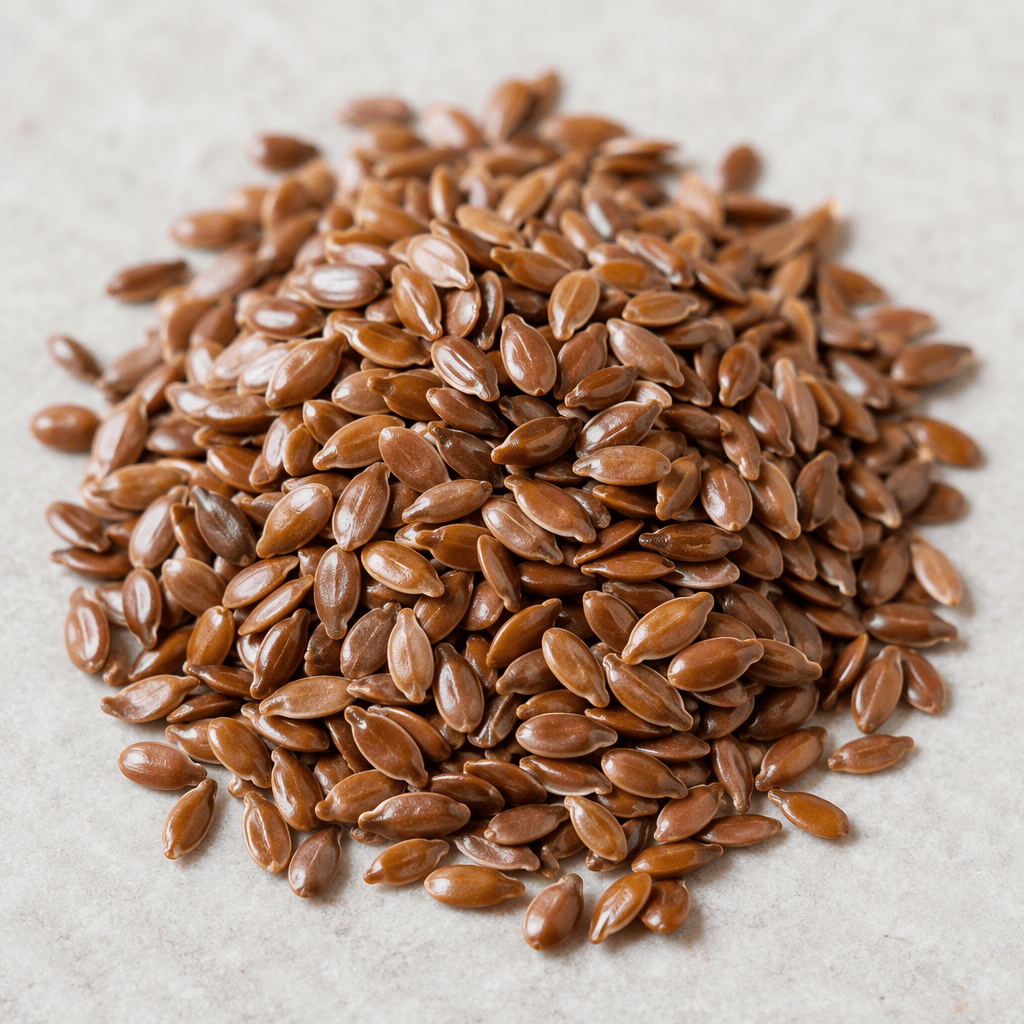
Flaxseed Calories
Omega-3, fiber, plant protein, mineral rich
In season: Spring · Summer · Autumn · Winter
CALORIES · 100 G
GI
POTASSIUM · 100 G
FIBER · 100 G
Quick answer
1 tablespoon (medium) of Flaxseed (10 g) has 53 calories. That works out to 534 calories per 100 g. It contains 2.9 g of carbs, 1.8 g of protein, 4.2 g of fat and 2.7 g of fiber. Its 0.2 mg of B1 covers 14% of the Daily Value. Its glycemic index is 35 (low), so it raises blood sugar slowly.
Flaxseed Nutrition Facts
Selected: 1 tablespoon (medium) · 10 g
53
KCAL / 10G
Carbs
2.9g
· 1% DV
Protein
1.8g
· 4% DV
Fat
4.2g
· 5% DV
Fiber
2.7g
· 10% DV
DV is the share of the daily value covered, on a 2,000 kcal reference diet.
Calories come from: Carbs 20% · Protein 13% · Fat 67%
Flaxseed nutrition facts table · 1 tablespoon (medium) (10 g)
| Nutrient | Amount | % DV |
|---|---|---|
| Calories | 53 kcal | |
| Total fat | 4.2 g | 5% |
| Saturated fat | 0.37 g | 2% |
| Trans fat | 0 g | |
| Sodium | 3 mg | 0% |
| Total carbohydrate | 2.9 g | 1% |
| Fiber | 2.7 g | 10% |
| Protein | 1.8 g | 4% |
Calories: Calories measure energy. Average daily need is 2,000 kcal. Excess calories are stored as fat, too few cause weight loss.
Carbs: Your body's primary energy source. The brain runs exclusively on carbs. Daily need: 275g.
Protein: Essential for muscle repair and cell growth. Daily need: 50g. Keeps you full and boosts metabolism.
Fat: Needed for hormone production and vitamin absorption. Daily need: 78g. Limit saturated fats, choose unsaturated.
Fiber: Critical for digestive health and satiety. Daily need: 28g. Stabilizes blood sugar, lowers cholesterol.

Log this food in EatBetter
100,000+ people use it
- Get your daily calorie target
- Snap your meal, log it in seconds
- See every vitamin and mineral

📸 Scan the code to get the app free.

How Many Calories in 1 Tablespoon of Flaxseed?
| Serving | Amount | Calories |
|---|---|---|
| 1 tablespoon (medium) | 10 g | 53 kcal |
| 1 teaspoon (small) | 3 g | 16 kcal |
| 1 tablespoon (small) | 7 g | 37 kcal |
| 1 tablespoon (large) | 15 g | 80 kcal |
| 2 tablespoon (large) | 20 g | 107 kcal |
| 1 serving (medium) | 30 g | 160 kcal |
| 1 piece (medium) | 50 g | 267 kcal |
| 100 g | 100 g | 534 kcal |
| 1 cup (large) | 150 g | 801 kcal |
| 1 pack (jumbo) | 250 g | 1335 kcal |
Calculated from 534 calories per 100 g.
Frequently Asked Questions About Flaxseed
How should you eat flaxseed?
Eat flaxseed ground, stirred into oatmeal, yogurt, smoothies, or baked goods. Grinding makes its nutrients easier to access because whole seeds can pass through the digestive tract largely intact. Add fluids when increasing your intake of this fiber-rich seed.
Is ground flaxseed better than whole flaxseed?
Ground flaxseed is generally more useful nutritionally because your body may not break down the hard outer coating of whole seeds. Grind small amounts as needed, or keep ground flaxseed sealed in the refrigerator to help it stay fresh.
How much flaxseed should you eat per day?
A commonly used amount for adults is one to two tablespoons of ground flaxseed a day. Start with a smaller amount if you are not used to high-fiber foods, increase gradually, and drink enough fluids.
Does flaxseed help with constipation?
Yes, flaxseed’s fiber can add bulk to stool and support regular bowel movements. Take it with plenty of fluid and increase your intake gradually, since a sudden increase in fiber may cause gas or bloating.
Should flaxseed be soaked before eating?
No, soaking is not essential, but flaxseed forms a gel when mixed with water. That gel can be added to recipes or eaten; grinding the seeds is still a useful way to make their nutrients more accessible.
Can you use flaxseed instead of eggs in baking?
Yes, ground flaxseed mixed with water can act as a binder in many baked goods. It works best in recipes such as muffins, pancakes, and cookies, but it does not rise or set exactly like an egg.
Can flaxseed help with weight loss?
Flaxseed may help meals feel more filling because it contains substantial fiber, but it does not cause weight loss on its own. Measure the amount you add, since seeds are energy-dense and portions can grow quickly.
Can you eat flaxseed raw?
Yes, flaxseed can be eaten without cooking, preferably ground for better access to its nutrients. Add it to foods such as cereal or yogurt; avoid eating large amounts of dry seed without adequate fluids.
How do you store flaxseed so it does not go rancid?
Store whole flaxseed in a cool, dry, dark place and keep ground flaxseed in a tightly sealed container in the refrigerator. Discard it if it develops a bitter taste or a paint-like, stale-oil smell.
Can flaxseed cause side effects?
Yes, large amounts of flaxseed can cause bloating, gas, or diarrhea, especially if you increase your fiber intake quickly. Introduce it gradually and drink enough water; its gel-forming fiber can also affect how some medicines are absorbed.
Flaxseed Vitamins & Minerals
Vitamins
B1
0.16mg · 13% DV
B6
0.05mg · 3% DV
Folate
8.7µg · 2% DV
B5
0.1mg · 2% DV
Minerals
Copper
0.11mg · 12% DV
Manganese
0.25mg · 11% DV
Magnesium
39mg · 9% DV
Phosphorus
64mg · 9% DV
Potassium ⭐
81mg · 2% DV
Sodium
3mg · 0% DV
Flaxseed Glycemic Index
GLYCEMIC INDEX
GLYCEMIC LOAD
Accounts for portion size — a more realistic measure than GI alone.
How to Burn Off Flaxseed
To burn the 53 calories in 1 tablespoon (medium) (10 g):
🚶
Walking (5 km/h)
🏃
Running (8 km/h)
🚴
Cycling
🏊
Swimming
Times are calculated with the MET equation for a 70 kg adult. Actual burn varies with your weight, age and pace.
What is Flaxseed?
Flaxseed comes from the flax plant and consists of small, flat seeds, usually golden or brown. It has a mild, nutty flavour and a crisp bite when whole; ground, it blends more easily into foods. In many kitchens it is stirred into porridge or yoghurt, sprinkled over salads, or added to bread and baking. In parts of the world where flax is familiar, it is also used in cereals and plant-based recipes as a simple way to add texture.
Flaxseed is rich in fibre, plant protein and omega-3 fats, and is energy-dense. Pair it with moist foods such as yoghurt or porridge, or grind it shortly before use so it mixes in smoothly. Whole seeds can also be used when you want a little crunch.
How Nutritious Is Flaxseed?
Nutrient density
Very high
How many vitamins, minerals and how much fiber this food carries per calorie. A high score means a lot of nutrition for few calories.
Satiety score
Medium
An EatBetter score computed from fiber, protein and calorie density. A high score means staying full longer on the same calories.
Both scores are calculated per 100 g and do not change with the selected portion. The satiety score is EatBetter's own calculation, not a clinical measure.
Is Flaxseed Processed?
NOVA 1
Unprocessed
1. Unprocessed
2. Minimally Processed
3. Processed
4. Ultra-Processed
NOVA classifies foods into 4 groups by industrial processing. NOVA 1 (unprocessed) is the healthiest.
Does Flaxseed Contain Allergens?
No known major allergens
Which Diets Is Flaxseed Good For?
Vegan
✓ Suitable
Vegetarian
✓ Suitable
Gluten-Free
✓ Suitable
Dairy-Free
— Not suitable
Mediterranean
✓ Suitable
Paleo
✓ Suitable
Whole30
— Not suitable
DASH
— Not suitable
Keto
✓ Suitable
Low FODMAP
— Not suitable
Flaxseed Fat Profile
SATURATED
0.37g
MONOUNSATURATED
0.75g
POLYUNSATURATED
2.87g
Omega 6:3 ratio 0.3:1
Below the ideal 4:1 — a good omega balance.
Compare Flaxseed
Foods Similar to Flaxseed
Have another question about Flaxseed?
Ask the AI nutrition coach — calories, portions, alternatives and more, answered in seconds in the app.

Scan calories with your camera
Instant AI nutrition analysis

Nutrition data compiled from USDA FoodData Central and scientific sources.