

Ready & Packaged Foods
All →Vegetables & Legumes
All →Desserts & Confectionery
All →Meat & Protein
All →Grains & Bakery
All →Beverages
All →Milk & Dairy
All →

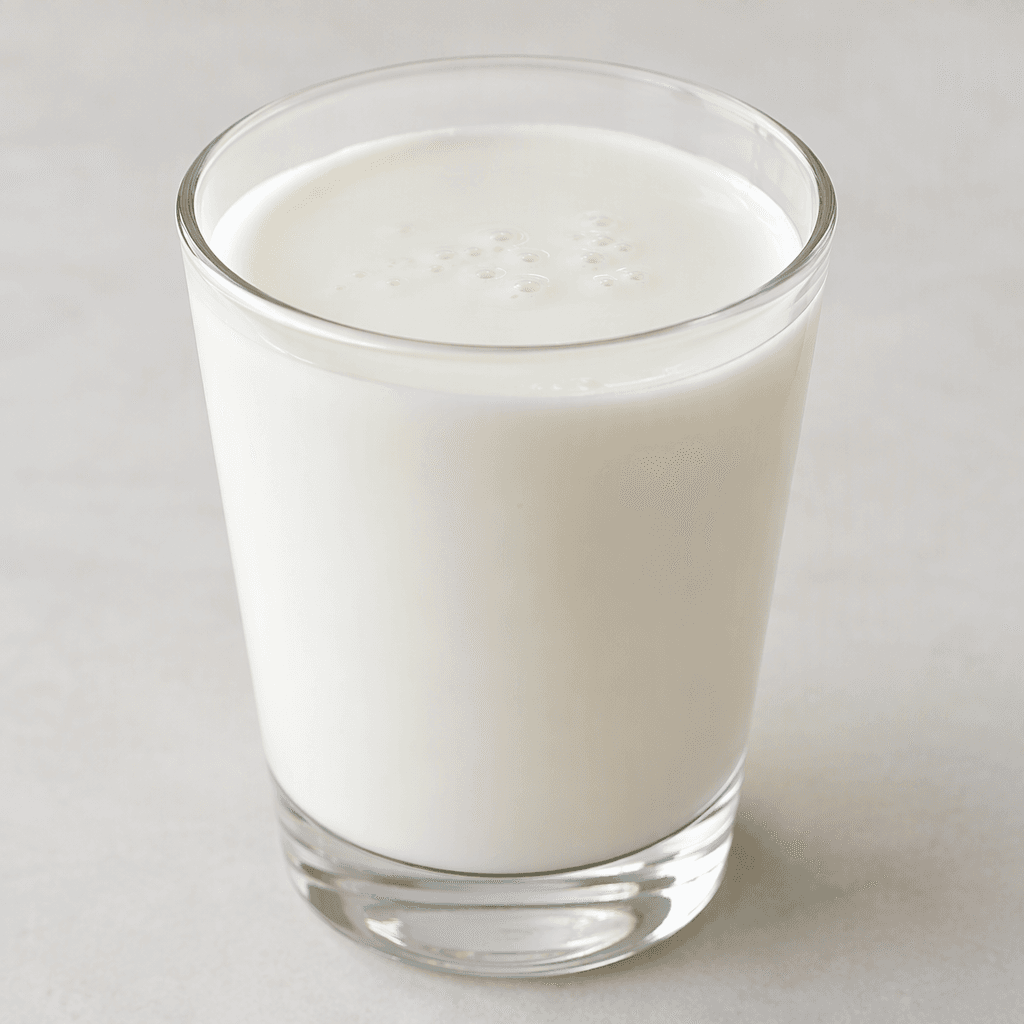
Lactose-Free Kefir Calories
Lactose-free, probiotic, fermented dairy drink
In season: Spring · Summer · Autumn · Winter
CALORIES
GI
POTASSIUM
FIBER
Quick answer
1 cup (medium) of Lactose-Free Kefir (200 g) has 90 calories. That works out to 45 calories per 100 g. It contains 9 g of carbs, 6.4 g of protein, 2 g of fat and 0 g of fiber. Its 0.8 µg of B12 covers 33% of the Daily Value. Its glycemic index is 30 (low), so it raises blood sugar slowly.
What is Lactose-Free Kefir?
Lactose-free kefir is milk fermented with kefir cultures, with the lactose broken down during production. Kefir has roots in the Caucasus, and this version offers its characteristic cultured-milk drink without lactose.
Its taste is gently tart and refreshing, while the texture is creamy but pourable, sometimes with a faint fizz. It is usually served chilled, by the glass, at breakfast or as a snack; people also blend it into smoothies or pour it over cereal. It provides protein and is a fermented dairy drink. Choose a plain version to avoid added sugar, or pair it with fruit and oats for a more filling snack.
Lactose-Free Kefir Nutrition Facts
Selected: 100 g
45
KCAL / 100G
Carbs
4.5g
· 2% DV
Protein
3.2g
· 6% DV
Fat
1g
· 1% DV
Fiber
0g
· 0% DV
DV is the share of the daily value covered, on a 2,000 kcal reference diet.
Calories come from: Carbs 45% · Protein 32% · Fat 23%
Lactose-Free Kefir Vitamins & Minerals
Vitamins
B12
0.4µg · 17% DV
B2
0.18mg · 14% DV
Biotin
2.5µg · 8% DV
B5
0.35mg · 7% DV
Minerals
Phosphorus
95mg · 14% DV
Calcium
120mg · 12% DV
Zinc
1mg · 9% DV
Iodine
12µg · 8% DV
How Nutritious Is Lactose-Free Kefir?
Nutrient density
High
How many vitamins, minerals and how much fiber this food carries per calorie. A high score means a lot of nutrition for few calories.
Satiety score
Medium
An EatBetter score computed from fiber, protein and calorie density. A high score means staying full longer on the same calories.
Both scores are calculated per 100 g and do not change with the selected portion. The satiety score is EatBetter's own calculation, not a clinical measure.
Lactose-Free Kefir Glycemic Index
GLYCEMIC INDEX
GLYCEMIC LOAD
Accounts for portion size — a more realistic measure than GI alone.
How to Burn Off Lactose-Free Kefir
To burn the 45 calories in 100 g:
🚶
Walking (5 km/h)
🏃
Running (8 km/h)
🚴
Cycling
🏊
Swimming
Times are calculated with the MET equation for a 70 kg adult. Actual burn varies with your weight, age and pace.
Is Lactose-Free Kefir Processed?
NOVA 2
Minimally Processed
1. Unprocessed
2. Minimally Processed
3. Processed
4. Ultra-Processed
NOVA classifies foods into 4 groups by industrial processing. NOVA 1 (unprocessed) is the healthiest.
Does Lactose-Free Kefir Contain Allergens?
Contains these allergens:
Which Diets Is Lactose-Free Kefir Good For?
Vegan
— Not suitable
Vegetarian
✓ Suitable
Gluten-Free
— Not suitable
Dairy-Free
— Not suitable
Mediterranean
— Not suitable
Paleo
— Not suitable
Whole30
— Not suitable
DASH
— Not suitable
Keto
— Not suitable
Low FODMAP
— Not suitable
Lactose-Free Kefir Fat Profile
SATURATED
0.65g
MONOUNSATURATED
0.25g
POLYUNSATURATED
0.05g
Omega 6:3 ratio 1.5:1
Below the ideal 4:1 — a good omega balance.
Compare Lactose-Free Kefir
Foods Similar to Lactose-Free Kefir
Frequently Asked Questions About Lactose-Free Kefir
What does lactose-free kefir mean?
Lactose-free kefir is fermented milk in which lactose has been broken down, usually with the enzyme lactase, or removed before fermentation. Kefir cultures can also use some lactose as they ferment the milk, but that alone does not guarantee a lactose-free product.
Can lactose-free kefir still cause bloating?
Yes, lactose-free kefir can still cause bloating in some people. Lactose is not the only possible trigger: the acidity, fermentation products, or sensitivity to dairy proteins may also cause symptoms, even when lactose has been broken down.
Does lactose-free kefir have the same probiotics as regular kefir?
It can have similar live kefir cultures if it is fermented and sold with those cultures still active. Lactose removal does not inherently remove the cultures, but heat treatment after fermentation can reduce or eliminate live microorganisms.
Why does lactose-free kefir taste sweeter than regular kefir?
Lactose-free kefir often tastes sweeter because lactase splits lactose into glucose and galactose, which taste sweeter to many people. That sweeter flavor does not necessarily mean sugar has been added; check the ingredients if you want to confirm.
Is lactose-free kefir different from lactose-free yogurt?
Yes, lactose-free kefir is usually thinner, tangier, and more drinkable than lactose-free yogurt. Kefir is fermented with a distinct culture mixture, while yogurt uses yogurt cultures, so the texture and flavor differ even when both are lactose-free.
Can you put lactose-free kefir in a smoothie?
Yes, lactose-free kefir works well as the liquid base for a smoothie and adds a tangy, creamy texture. Blend it with fruit, or pour it in after blending if you want to avoid over-processing the live cultures.
Can you heat lactose-free kefir without killing its cultures?
No, high heat can reduce or destroy the live cultures in lactose-free kefir. For a warm dish, stir it in after cooking and let the food cool somewhat first; use it cold if keeping the cultures is your priority.
Can lactose-free kefir be frozen?
Yes, lactose-free kefir can be frozen, but thawing may make it separate or turn grainy. Stir or shake it after thawing in the refrigerator; the texture may not return fully, so thawed kefir is often best in smoothies or cooking.
How can you tell if lactose-free kefir has spoiled?
Discard lactose-free kefir if you see mold, notice an unusual color, or smell a distinctly spoiled odor. Some separation and a tangy smell are normal for kefir; keep it refrigerated with the lid closed and follow the package’s guidance after opening.
Can lactose-free kefir replace buttermilk in baking?
Yes, lactose-free kefir can usually replace buttermilk in baking because its tang and acidity are similar. Its consistency may be thinner, so use it in the same amount initially and adjust the batter only if it looks unusually loose.
Have another question about Lactose-Free Kefir?
Ask the AI nutrition coach — calories, portions, alternatives and more, answered in seconds in the app.

Scan calories with your camera
Instant AI nutrition analysis

Nutrition data compiled from USDA FoodData Central and scientific sources.