

Ready & Packaged Foods
All →Vegetables & Legumes
All →Desserts & Confectionery
All →Meat & Protein
All →Grains & Bakery
All →Beverages
All →Milk & Dairy
All →

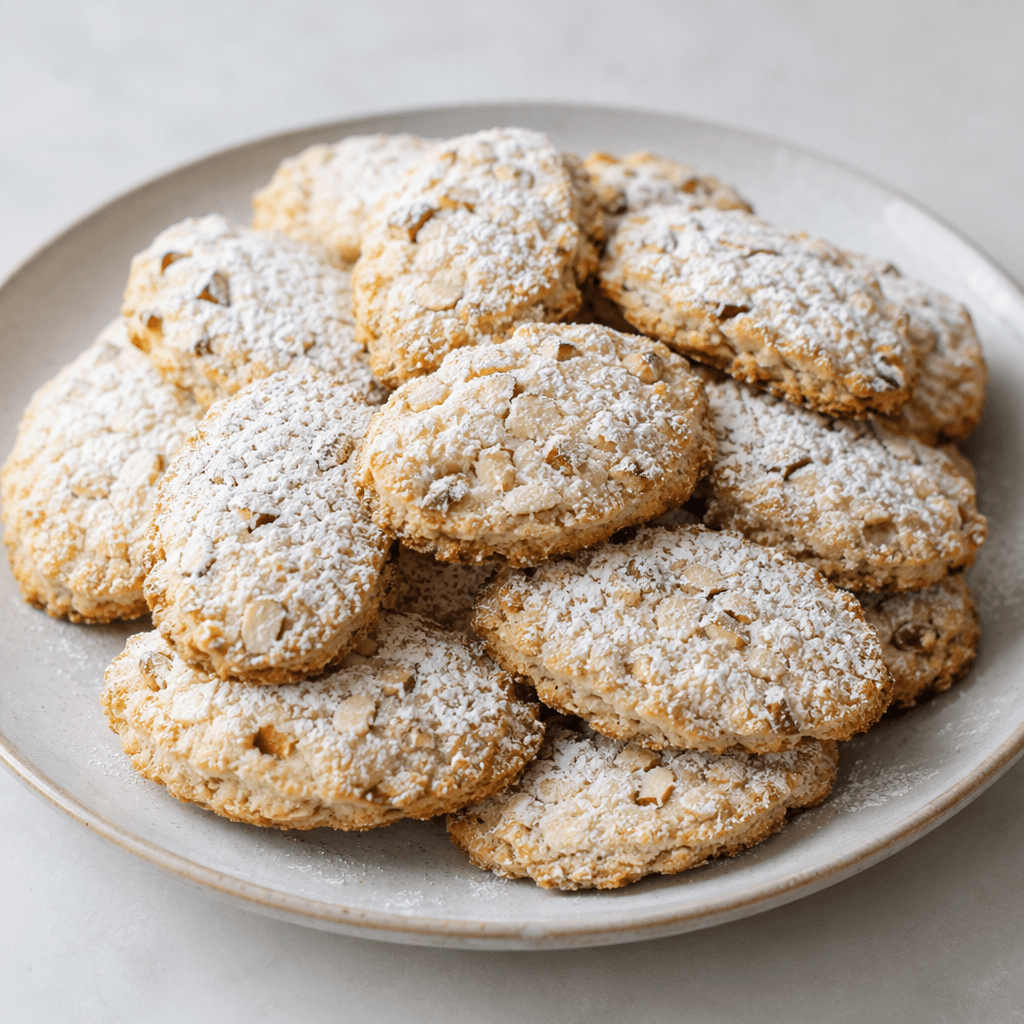
Kavala cookie Calories
Almond, powdered sugar, traditional Edirne cookie
In season: Autumn · Winter
CALORIES
GI
POTASSIUM
FIBER
Quick answer
1 piece (medium) of Kavala cookie (35 g) has 168 calories. That works out to 480 calories per 100 g. It contains 21 g of carbs, 2.8 g of protein, 7.7 g of fat and 1 g of fiber. Its 1 mg of Vitamin E covers 7% of the Daily Value. Its glycemic index is 65 (high), so it raises blood sugar quickly.
What is Kavala cookie?
Kavala cookie is a buttery, almond-studded biscuit associated with Edirne in north-western Turkey. The dough is shaped into pale, crumbly cookies, baked until the edges take on a little colour, then generously dusted with powdered sugar. Recipes vary, but toasted almonds give the classic version its distinctive nutty flavour.
It is commonly served with tea or coffee as a sweet bite, and is also a familiar gift from Turkish confectioners. Its flour, sugar and butter make it an energy-dense treat, while the almonds contribute some protein and fibre. Offer one with unsweetened tea or coffee for a simple pairing, or serve smaller pieces after a meal.
Kavala cookie Nutrition Facts
Selected: 100 g
480
KCAL / 100G
Carbs
60g
· 22% DV
Protein
8g
· 16% DV
Fat
22g
· 28% DV
Fiber
3g
· 11% DV
DV is the share of the daily value covered, on a 2,000 kcal reference diet.
Calories come from: Carbs 51% · Protein 7% · Fat 42%
Kavala cookie Vitamins & Minerals
Vitamins
Vitamin E
2.8mg · 19% DV
B2
0.12mg · 9% DV
B1
0.08mg · 7% DV
Biotin
2µg · 7% DV
Minerals
Phosphorus
90mg · 13% DV
Zinc
1mg · 9% DV
Magnesium
35mg · 8% DV
Calcium
70mg · 7% DV
How Nutritious Is Kavala cookie?
Nutrient density
Low
How many vitamins, minerals and how much fiber this food carries per calorie. A high score means a lot of nutrition for few calories.
Satiety score
Low
An EatBetter score computed from fiber, protein and calorie density. A high score means staying full longer on the same calories.
Both scores are calculated per 100 g and do not change with the selected portion. The satiety score is EatBetter's own calculation, not a clinical measure.
Kavala cookie Glycemic Index
GLYCEMIC INDEX
GLYCEMIC LOAD
Accounts for portion size — a more realistic measure than GI alone.
How to Burn Off Kavala cookie
To burn the 480 calories in 100 g:
🚶
Walking (5 km/h)
🏃
Running (8 km/h)
🚴
Cycling
🏊
Swimming
Times are calculated with the MET equation for a 70 kg adult. Actual burn varies with your weight, age and pace.
Is Kavala cookie Processed?
NOVA 3
Processed
1. Unprocessed
2. Minimally Processed
3. Processed
4. Ultra-Processed
NOVA classifies foods into 4 groups by industrial processing. NOVA 1 (unprocessed) is the healthiest.
Does Kavala cookie Contain Allergens?
Contains these allergens:
Which Diets Is Kavala cookie Good For?
Vegan
— Not suitable
Vegetarian
— Not suitable
Gluten-Free
— Not suitable
Dairy-Free
— Not suitable
Mediterranean
✓ Suitable
Paleo
— Not suitable
Whole30
— Not suitable
DASH
— Not suitable
Keto
— Not suitable
Low FODMAP
— Not suitable
Kavala cookie Fat Profile
SATURATED
5.2g
MONOUNSATURATED
11.5g
POLYUNSATURATED
3.1g
Omega 6:3 ratio 52:1
Above the ideal 4:1 (52:1).
Compare Kavala cookie
Foods Similar to Kavala cookie
Frequently Asked Questions About Kavala cookie
What is a Kavala cookie?
A Kavala cookie is a buttery, crumbly almond cookie dusted generously with powdered sugar. It is associated with the Greek city of Kavala and is also a familiar specialty in Edirne, Turkey.
Where does the Kavala cookie come from?
The Kavala cookie takes its name from Kavala, a city in Greece. It is also widely made and sold in Edirne, Turkey, so both places are commonly connected with the cookie.
What is in a Kavala cookie?
A Kavala cookie is typically made with flour, butter or another baking fat, almonds, and sugar, then coated in powdered sugar. Recipes vary, and some include flavorings such as vanilla.
How is a Kavala cookie traditionally made?
For a traditional-style Kavala cookie, flour is often toasted with butter before being combined with almonds and sugar into a dough. The shaped cookies are baked, cooled, and dusted or coated with powdered sugar.
Why are Kavala cookies shaped like crescents?
Crescent shapes are a traditional presentation for Kavala cookies, though oval versions are also common. The shape makes them easy to recognize, but it is not essential to the cookie’s flavor or texture.
How is a Kavala cookie different from a kourabiedes?
Both Kavala cookies and Greek kourabiedes are buttery, powdered-sugar-coated treats, and recipes can overlap. Kavala cookies are especially associated with almonds and toasted flour, while kourabiedes have many regional and family variations.
Why are Kavala cookies so crumbly?
Kavala cookies are meant to have a delicate, crumbly texture, helped by their buttery dough and almonds. Toasted flour contributes to their characteristic flavor; overworking the dough can make the finished cookies less tender.
How should you store Kavala cookies?
Let Kavala cookies cool completely, then keep them in an airtight container in a cool, dry place. Humidity can soften their crisp texture and make the powdered-sugar coating damp or patchy.
Can you freeze Kavala cookies?
Yes, Kavala cookies can be frozen in a tightly sealed freezer-safe container. Thaw them at room temperature before serving; condensation during thawing may affect the powdered-sugar coating.
What do you serve with Kavala cookies?
Serve Kavala cookies with Turkish coffee, tea, or another unsweetened drink to balance their buttery texture and sugary coating. They are commonly offered as a small sweet with coffee or at a tea table.
Have another question about Kavala cookie?
Ask the AI nutrition coach — calories, portions, alternatives and more, answered in seconds in the app.

Scan calories with your camera
Instant AI nutrition analysis

Nutrition data compiled from USDA FoodData Central and scientific sources.