

Ready & Packaged Foods
All →Vegetables & Legumes
All →Desserts & Confectionery
All →Meat & Protein
All →Grains & Bakery
All →Beverages
All →Milk & Dairy
All →

Psyllium Husk Calories
Very high fiber, digestive support, gluten-free
In season: Spring · Summer · Autumn · Winter
CALORIES
GI
POTASSIUM
FIBER
Quick answer
1 tablespoon (medium) of Psyllium Husk (5 g) has 18 calories. That works out to 355 calories per 100 g. It contains 4.4 g of carbs, 0.1 g of protein, 0 g of fat and 4 g of fiber. Its glycemic index is 0 (low), so it raises blood sugar slowly.
What is Psyllium Husk?
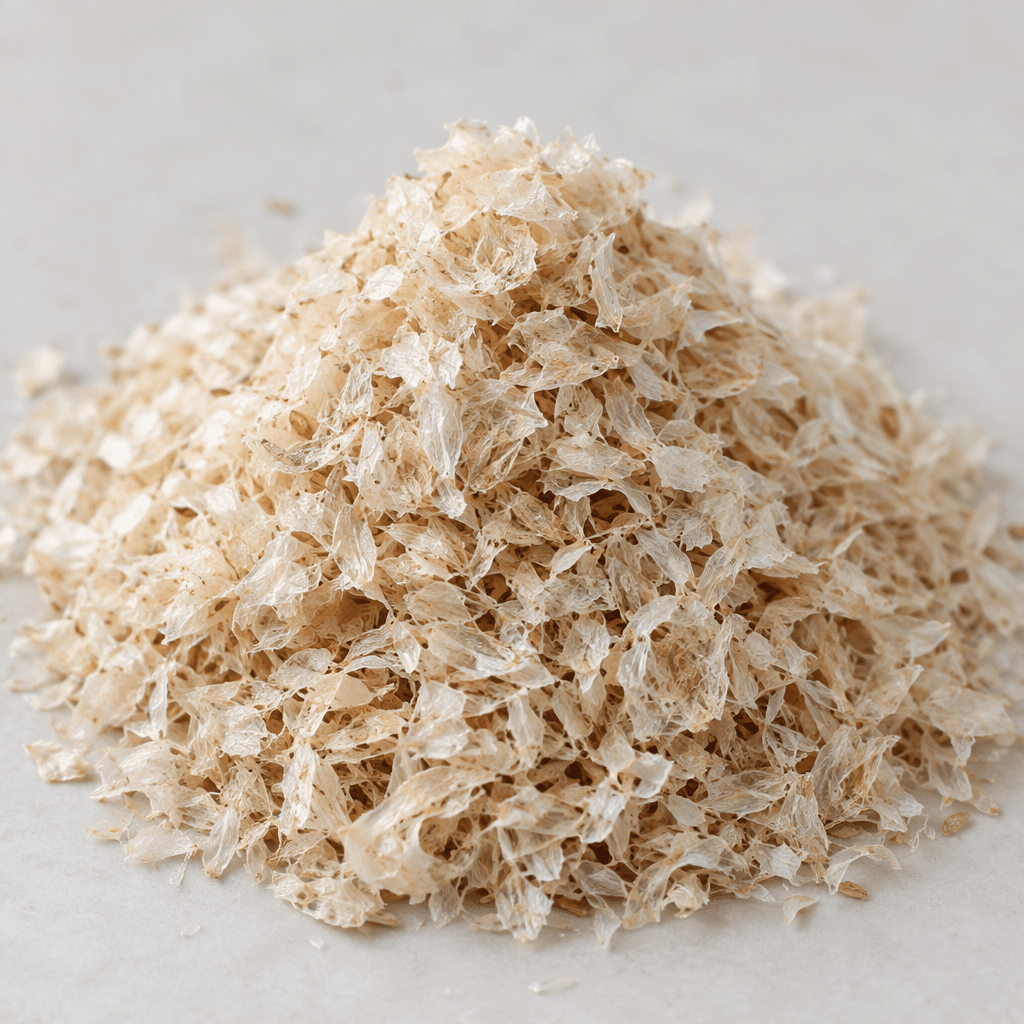
Psyllium husk is the outer covering of the seeds of Plantago ovata, a plant grown mainly in India. The pale, papery flakes absorb liquid and thicken into a soft gel, so a small amount can change the texture of a drink or recipe.
It has a mild, neutral taste and is commonly stirred into water, smoothies or yoghurt, or used in gluten-free baking as a binder. Psyllium husk is mostly fibre: it contains 80 g per 100 g. If you are new to it, start with a small amount and mix it well with plenty of liquid; it also works stirred into porridge.
Psyllium Husk Nutrition Facts
Selected: 100 g
355
KCAL / 100G
Carbs
88g
· 32% DV
Protein
2g
· 4% DV
Fat
0.6g
· 1% DV
Fiber
80g
· 286% DV
DV is the share of the daily value covered, on a 2,000 kcal reference diet.
Calories come from: Carbs 96% · Protein 2% · Fat 2%
Psyllium Husk Vitamins & Minerals
Vitamins
B1
0.05mg · 4% DV
Biotin
1µg · 3% DV
B2
0.03mg · 2% DV
B5
0.1mg · 2% DV
Minerals
Manganese
1mg · 43% DV
Iron
5mg · 28% DV
Magnesium
60mg · 14% DV
Zinc
1mg · 9% DV
How Nutritious Is Psyllium Husk?
Nutrient density
Very high
How many vitamins, minerals and how much fiber this food carries per calorie. A high score means a lot of nutrition for few calories.
Satiety score
Medium
An EatBetter score computed from fiber, protein and calorie density. A high score means staying full longer on the same calories.
Both scores are calculated per 100 g and do not change with the selected portion. The satiety score is EatBetter's own calculation, not a clinical measure.
Psyllium Husk Glycemic Index
GLYCEMIC INDEX
GLYCEMIC LOAD
Accounts for portion size — a more realistic measure than GI alone.
How to Burn Off Psyllium Husk
To burn the 355 calories in 100 g:
🚶
Walking (5 km/h)
🏃
Running (8 km/h)
🚴
Cycling
🏊
Swimming
Times are calculated with the MET equation for a 70 kg adult. Actual burn varies with your weight, age and pace.
Is Psyllium Husk Processed?
NOVA 2
Minimally Processed
1. Unprocessed
2. Minimally Processed
3. Processed
4. Ultra-Processed
NOVA classifies foods into 4 groups by industrial processing. NOVA 1 (unprocessed) is the healthiest.
Does Psyllium Husk Contain Allergens?
No known major allergens
Which Diets Is Psyllium Husk Good For?
Vegan
✓ Suitable
Vegetarian
✓ Suitable
Gluten-Free
✓ Suitable
Dairy-Free
— Not suitable
Mediterranean
✓ Suitable
Paleo
✓ Suitable
Whole30
— Not suitable
DASH
— Not suitable
Keto
✓ Suitable
Low FODMAP
— Not suitable
Psyllium Husk Fat Profile
SATURATED
0.1g
MONOUNSATURATED
0.1g
POLYUNSATURATED
0.3g
Omega 6:3 ratio 1.5:1
Below the ideal 4:1 — a good omega balance.
Compare Psyllium Husk
Foods Similar to Psyllium Husk
Frequently Asked Questions About Psyllium Husk
How do you take psyllium husk?
Mix psyllium husk thoroughly into a full glass of water and drink it promptly, before it thickens. Follow it with more water. Do not swallow the dry husk, since it can swell and become difficult to swallow.
Does psyllium husk help with constipation?
Yes, psyllium husk can ease constipation by absorbing water and adding bulk to stool. Take it with plenty of fluid, and allow time for it to work. Persistent constipation or severe pain needs medical attention.
Can psyllium husk lower cholesterol?
Yes, regular psyllium husk intake can help lower LDL cholesterol by binding some cholesterol in the digestive tract. It works as part of an overall heart-healthy eating pattern, not as a replacement for prescribed treatment.
Can psyllium husk help with weight loss?
Psyllium husk does not directly cause weight loss, but its water-absorbing fiber may help you feel fuller. It can be a useful addition to meals, though it cannot replace an eating pattern that supports your goals.
Can you take psyllium husk every day?
Yes, many adults can take psyllium husk daily if they follow the product directions and drink enough fluid. Starting with a smaller amount may reduce gas or bloating while your digestion adjusts.
Can psyllium husk be used for diarrhea?
Yes, psyllium husk can absorb water and help make loose stool more formed. Do not rely on it for severe or persistent diarrhea, or diarrhea with blood; those symptoms warrant medical care.
How long should you wait between psyllium husk and medicines?
Leave at least two hours between psyllium husk and most medicines because the fiber can affect absorption. Some medicines have different instructions, so follow their directions and ask a pharmacist about your specific prescription.
Can you use psyllium husk in baking?
Yes, psyllium husk is often added to gluten-free bread and other doughs because it absorbs water and helps bind the mixture. Use the recipe’s amount: adding extra can make baked goods dense or gummy.
Should psyllium husk be taken before or after meals?
Psyllium husk can be taken before or after meals; the timing matters less than taking it with plenty of water. If you use it to feel fuller, taking it before a meal may suit you better.
Can psyllium husk cause choking?
Yes, psyllium husk can swell and cause choking or a blockage if swallowed dry or with too little liquid. Always mix it into fluid and drink promptly; avoid it unless a clinician advises otherwise if you have trouble swallowing.
Have another question about Psyllium Husk?
Ask the AI nutrition coach — calories, portions, alternatives and more, answered in seconds in the app.

Scan calories with your camera
Instant AI nutrition analysis

Nutrition data compiled from USDA FoodData Central and scientific sources.