

Ready & Packaged Foods
All →Vegetables & Legumes
All →Desserts & Confectionery
All →Meat & Protein
All →Grains & Bakery
All →Beverages
All →Milk & Dairy
All →

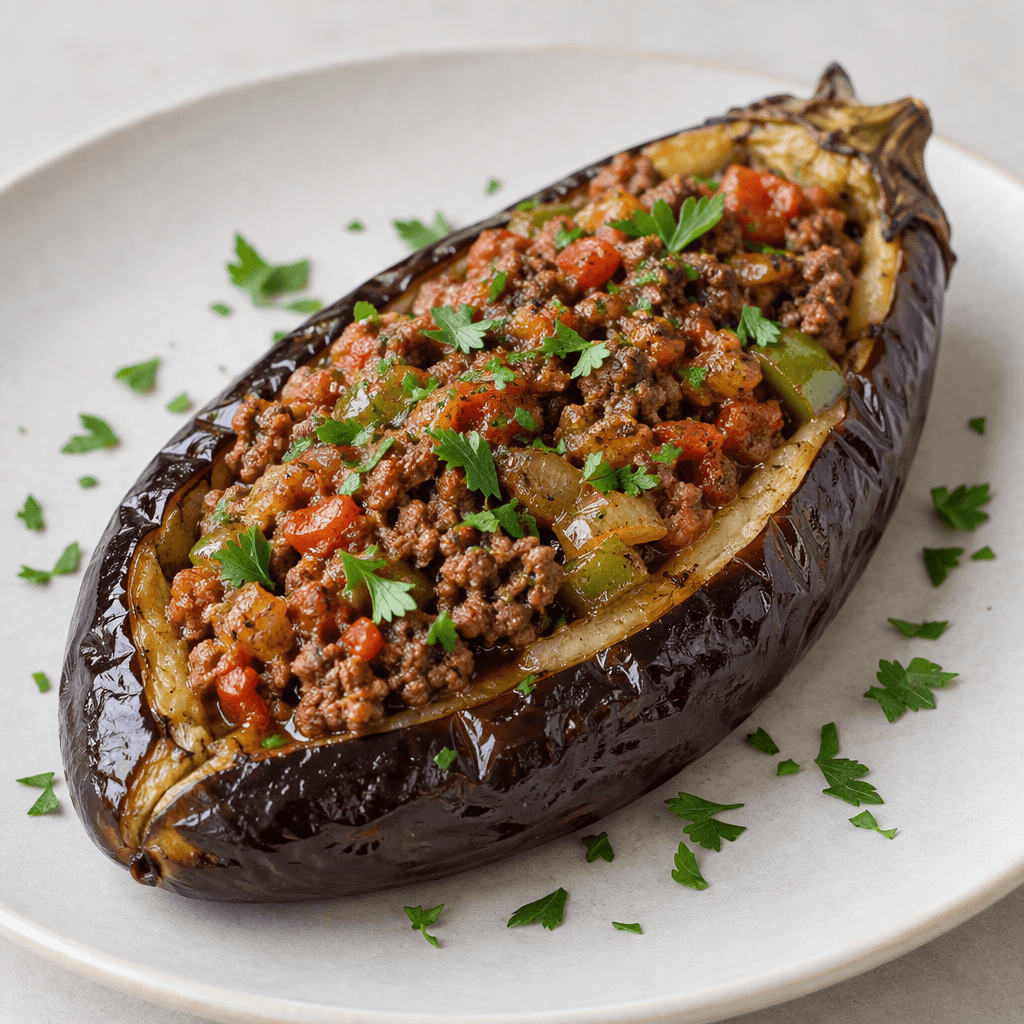
Karniyarik (Ground Beef) Calories
Classic Turkish stuffed eggplant with ground beef.
In season: Summer · Autumn
CALORIES
GI
POTASSIUM
FIBER
Quick answer
1 piece (medium) of Karniyarik (Ground Beef) (180 g) has 216 calories. That works out to 120 calories per 100 g. It contains 14.8 g of carbs, 11.7 g of protein, 12.1 g of fat and 4.7 g of fiber. Its 0.8 µg of B12 covers 34% of the Daily Value. Its glycemic index is 35 (low), so it raises blood sugar slowly.
What is Karniyarik (Ground Beef)?
Karniyarik (ground beef) is a Turkish home-style dish of eggplant split open and filled with ground beef cooked with onion, tomato and green pepper. The eggplant is often fried or roasted first, then baked or simmered with the filling until tender and saucy.
Its soft, silky eggplant contrasts with the savoury, gently sweet tomato-and-meat filling. In Turkey it is commonly served warm as a main course, often alongside rice pilaf and yoghurt or cacık; elsewhere, it also makes a satisfying centrepiece with bread or a simple salad. The beef contributes protein, while eggplant adds fibre. For a lighter version, roast the eggplants instead of frying them and choose lean ground beef.
Karniyarik (Ground Beef) Nutrition Facts
Selected: 100 g
120
KCAL / 100G
Carbs
8.2g
· 3% DV
Protein
6.5g
· 13% DV
Fat
6.7g
· 9% DV
Fiber
2.6g
· 9% DV
DV is the share of the daily value covered, on a 2,000 kcal reference diet.
Calories come from: Carbs 28% · Protein 22% · Fat 50%
Karniyarik (Ground Beef) Vitamins & Minerals
Vitamins
B12
0.45µg · 19% DV
B3
1.2mg · 8% DV
B6
0.13mg · 8% DV
Vitamin A
65µg · 7% DV
Minerals
Phosphorus
90mg · 13% DV
Selenium
6.5µg · 12% DV
Sodium
260mg · 11% DV
Zinc
1mg · 9% DV
How Nutritious Is Karniyarik (Ground Beef)?
Nutrient density
Medium
How many vitamins, minerals and how much fiber this food carries per calorie. A high score means a lot of nutrition for few calories.
Satiety score
Medium
An EatBetter score computed from fiber, protein and calorie density. A high score means staying full longer on the same calories.
Both scores are calculated per 100 g and do not change with the selected portion. The satiety score is EatBetter's own calculation, not a clinical measure.
Karniyarik (Ground Beef) Glycemic Index
GLYCEMIC INDEX
GLYCEMIC LOAD
Accounts for portion size — a more realistic measure than GI alone.
How to Burn Off Karniyarik (Ground Beef)
To burn the 120 calories in 100 g:
🚶
Walking (5 km/h)
🏃
Running (8 km/h)
🚴
Cycling
🏊
Swimming
Times are calculated with the MET equation for a 70 kg adult. Actual burn varies with your weight, age and pace.
Is Karniyarik (Ground Beef) Processed?
NOVA 2
Minimally Processed
1. Unprocessed
2. Minimally Processed
3. Processed
4. Ultra-Processed
NOVA classifies foods into 4 groups by industrial processing. NOVA 1 (unprocessed) is the healthiest.
Does Karniyarik (Ground Beef) Contain Allergens?
No known major allergens
Which Diets Is Karniyarik (Ground Beef) Good For?
Vegan
— Not suitable
Vegetarian
— Not suitable
Gluten-Free
— Not suitable
Dairy-Free
— Not suitable
Mediterranean
✓ Suitable
Paleo
— Not suitable
Whole30
— Not suitable
DASH
— Not suitable
Keto
— Not suitable
Low FODMAP
— Not suitable
Karniyarik (Ground Beef) Fat Profile
SATURATED
2.2g
MONOUNSATURATED
2.7g
POLYUNSATURATED
0.3g
Omega 6:3 ratio 2.6:1
Below the ideal 4:1 — a good omega balance.
Compare Karniyarik (Ground Beef)
Foods Similar to Karniyarik (Ground Beef)
Frequently Asked Questions About Karniyarik (Ground Beef)
What is karniyarik (ground beef)?
Karniyarik (ground beef) is a Turkish dish of eggplant split open and filled with seasoned ground beef, commonly cooked with onion, tomato, and pepper. The stuffed eggplants are baked or simmered until tender and are often served with rice.
How do you make karniyarik (ground beef)?
To make karniyarik (ground beef), soften whole eggplants by frying or roasting, then slit them lengthwise without cutting all the way through. Fill with cooked ground beef, onion, tomato, and pepper, add a little tomato sauce or water, and bake until tender.
Can you bake karniyarik (ground beef) without frying the eggplant first?
Yes, you can make karniyarik (ground beef) without frying the eggplant. Roast the whole eggplants until soft enough to open and fill, then bake them with the ground-beef mixture; this skips the pan-frying step.
What is the difference between karniyarik (ground beef) and imam bayildi?
Karniyarik (ground beef) is filled with a meat mixture, while imam bayildi is traditionally a meatless eggplant dish stuffed with onion, tomato, and other vegetables. Both use split eggplant, but their fillings and customary serving styles differ.
Which eggplants work best for karniyarik (ground beef)?
Medium-sized, firm eggplants with smooth, unbruised skin work well for karniyarik (ground beef). Choose ones that are not overly large, so they soften evenly and are easy to split and fill without the skin tearing.
Do you peel eggplant for karniyarik (ground beef)?
No, you generally do not need to peel eggplant for karniyarik (ground beef). Leaving the skin on helps each eggplant hold its shape while cooking; some cooks peel alternating strips for a traditional striped appearance.
What should you serve with karniyarik (ground beef)?
Rice pilaf is a classic accompaniment to karniyarik (ground beef), and bulgur, yogurt, or a crisp salad also work well. Choose a simple side so it complements the tomato-and-ground-beef filling rather than overpowering it.
Can you make karniyarik (ground beef) ahead of time?
Yes, you can prepare karniyarik (ground beef) ahead by cooking the filling and softening the eggplants separately, then assembling and baking them closer to mealtime. You can also cook the complete dish in advance and reheat it gently.
Can karniyarik (ground beef) be frozen?
Yes, cooked karniyarik (ground beef) can be frozen once fully cooled. Pack individual portions in airtight containers, thaw them in the refrigerator, and reheat until hot throughout; the eggplant may become softer after freezing.
Why does eggplant soak up so much oil when making karniyarik (ground beef)?
Eggplant’s porous flesh can absorb oil quickly during frying, which is why karniyarik (ground beef) may turn greasy if the eggplant is cooked in a crowded or insufficiently hot pan. Roasting the eggplants instead avoids that frying step.
Have another question about Karniyarik (Ground Beef)?
Ask the AI nutrition coach — calories, portions, alternatives and more, answered in seconds in the app.

Scan calories with your camera
Instant AI nutrition analysis

Nutrition data compiled from USDA FoodData Central and scientific sources.