

Ready & Packaged Foods
All →Vegetables & Legumes
All →Desserts & Confectionery
All →Meat & Protein
All →Grains & Bakery
All →Beverages
All →Milk & Dairy
All →

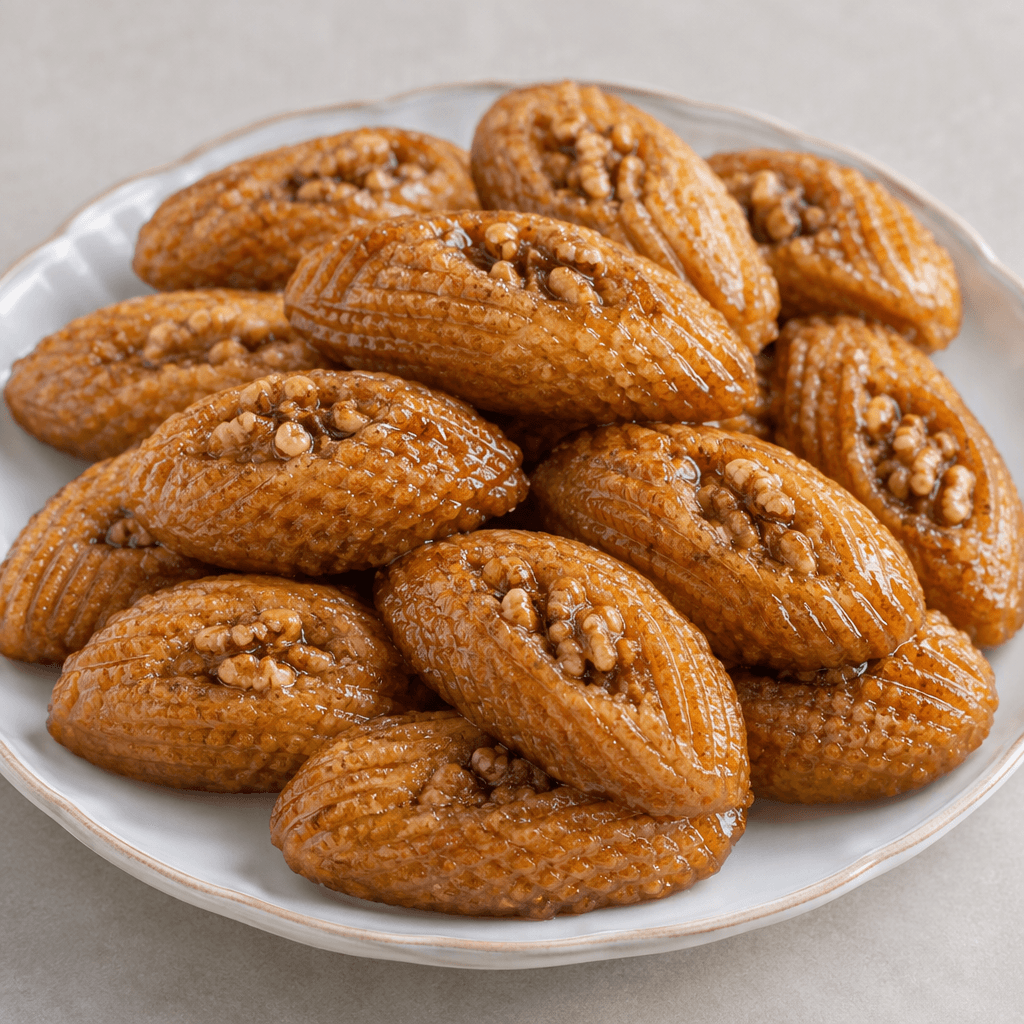
Kalburabasti Calories
Traditional Turkish syrup dessert, walnut-filled, pastry
In season: Autumn · Winter
CALORIES
GI
POTASSIUM
FIBER
Quick answer
1 piece (medium) of Kalburabasti (45 g) has 167 calories. That works out to 370 calories per 100 g. It contains 25.7 g of carbs, 1.9 g of protein, 6.1 g of fat and 0.9 g of fiber. Its 0.1 mg of Copper covers 7% of the Daily Value. Its glycemic index is 75 (high), so it raises blood sugar quickly.
What is Kalburabasti?
Kalburabasti is a traditional Turkish syrup-soaked pastry. Its name refers to the sieve or coarse strainer traditionally used to press ridges into the dough; walnut is tucked inside before the pastries are baked and soaked in syrup. The patterned surface helps catch the syrup, while the filling gives each piece a nutty centre.
The outside may retain a little bite, but the pastry becomes tender and glossy as it absorbs the syrup. In Turkey, kalburabasti is often served after a meal or offered to guests on festive occasions, commonly alongside tea. Made with pastry, syrup and walnuts, it is a rich, carbohydrate-forward sweet rather than an everyday snack. Its sweetness pairs well with unsweetened tea, and a modest piece is often satisfying.
Kalburabasti Nutrition Facts
Selected: 100 g
370
KCAL / 100G
Carbs
57g
· 21% DV
Protein
4.2g
· 8% DV
Fat
13.5g
· 17% DV
Fiber
2.1g
· 8% DV
DV is the share of the daily value covered, on a 2,000 kcal reference diet.
Calories come from: Carbs 62% · Protein 5% · Fat 33%
Kalburabasti Vitamins & Minerals
Vitamins
B1
0.07mg · 6% DV
Vitamin E
0.7mg · 5% DV
B2
0.05mg · 4% DV
B6
0.06mg · 4% DV
Minerals
Zinc
1mg · 9% DV
Phosphorus
65mg · 9% DV
Iron
1mg · 6% DV
Selenium
2.5µg · 5% DV
How Nutritious Is Kalburabasti?
Nutrient density
Low
How many vitamins, minerals and how much fiber this food carries per calorie. A high score means a lot of nutrition for few calories.
Satiety score
Low
An EatBetter score computed from fiber, protein and calorie density. A high score means staying full longer on the same calories.
Both scores are calculated per 100 g and do not change with the selected portion. The satiety score is EatBetter's own calculation, not a clinical measure.
Kalburabasti Glycemic Index
GLYCEMIC INDEX
GLYCEMIC LOAD
Accounts for portion size — a more realistic measure than GI alone.
How to Burn Off Kalburabasti
To burn the 370 calories in 100 g:
🚶
Walking (5 km/h)
🏃
Running (8 km/h)
🚴
Cycling
🏊
Swimming
Times are calculated with the MET equation for a 70 kg adult. Actual burn varies with your weight, age and pace.
Is Kalburabasti Processed?
NOVA 3
Processed
1. Unprocessed
2. Minimally Processed
3. Processed
4. Ultra-Processed
NOVA classifies foods into 4 groups by industrial processing. NOVA 1 (unprocessed) is the healthiest.
Does Kalburabasti Contain Allergens?
Contains these allergens:
Which Diets Is Kalburabasti Good For?
Vegan
— Not suitable
Vegetarian
— Not suitable
Gluten-Free
— Not suitable
Dairy-Free
— Not suitable
Mediterranean
✓ Suitable
Paleo
— Not suitable
Whole30
— Not suitable
DASH
— Not suitable
Keto
— Not suitable
Low FODMAP
— Not suitable
Kalburabasti Fat Profile
SATURATED
4.2g
MONOUNSATURATED
5.6g
POLYUNSATURATED
2.3g
Omega 6:3 ratio 17.1:1
Above the ideal 4:1 (17.1:1).
Compare Kalburabasti
Foods Similar to Kalburabasti
Frequently Asked Questions About Kalburabasti
What is Kalburabasti?
Kalburabasti is a traditional Turkish syrup-soaked pastry, usually filled with walnuts and pressed to create a ridged surface. Its name refers to the sieve-like tool traditionally used to shape the dough before baking.
How do you make Kalburabasti?
Mix a soft pastry dough, wrap small portions around a walnut filling, then press each piece against a sieve or coarse grater for its characteristic ridges. Bake until golden and pour cooled syrup over the hot pastries.
Why does Kalburabasti have ridges?
The ridges on Kalburabasti come from pressing the dough against a sieve, which gives the dessert its name and recognizable look. The textured surface also helps the syrup cling to the pastry.
Should Kalburabasti be hot or cold when you add the syrup?
Most recipes pour cooled syrup over freshly baked, hot Kalburabasti. The contrast helps the pastry absorb syrup without becoming overly soft; avoid using both boiling-hot syrup and piping-hot pastries.
What is inside Kalburabasti?
Walnuts are the classic filling in Kalburabasti, enclosed in a buttery or oil-based dough and soaked in sugar syrup after baking. Some home recipes use hazelnuts or almonds instead, but the ridged pastry remains characteristic.
How is Kalburabasti different from Turkish şekerpare?
Kalburabasti is typically walnut-filled and marked with sieve-like ridges, while şekerpare is usually an unfilled, smooth or lightly indented pastry. Both are baked Turkish sweets finished with syrup, but their shapes and fillings differ.
Can you make Kalburabasti without walnuts?
Yes. Replace the walnuts in Kalburabasti with finely chopped hazelnuts or almonds, keeping the filling dry enough to stay inside the dough. Seal the pastry well before shaping and baking so the filling does not leak out.
Why did my Kalburabasti turn out hard?
Kalburabasti can turn hard if the dough contains too much flour or the pastries bake too long. A soft dough and removing the pastries once golden help; let them absorb the syrup before serving.
How should you store Kalburabasti?
Keep Kalburabasti in a covered container in a cool, dry place. Refrigeration can make the pastry firmer, so if you do chill it, let it come back to room temperature before serving.
Can you freeze Kalburabasti?
Yes, Kalburabasti freezes best before it is soaked in syrup. Cool the baked pastries, pack them airtight, and thaw them before adding freshly made syrup; freezing an already syrup-soaked batch can soften its texture.
Have another question about Kalburabasti?
Ask the AI nutrition coach — calories, portions, alternatives and more, answered in seconds in the app.

Scan calories with your camera
Instant AI nutrition analysis

Nutrition data compiled from USDA FoodData Central and scientific sources.