

Ready & Packaged Foods
All →Vegetables & Legumes
All →Desserts & Confectionery
All →Meat & Protein
All →Grains & Bakery
All →Beverages
All →Milk & Dairy
All →

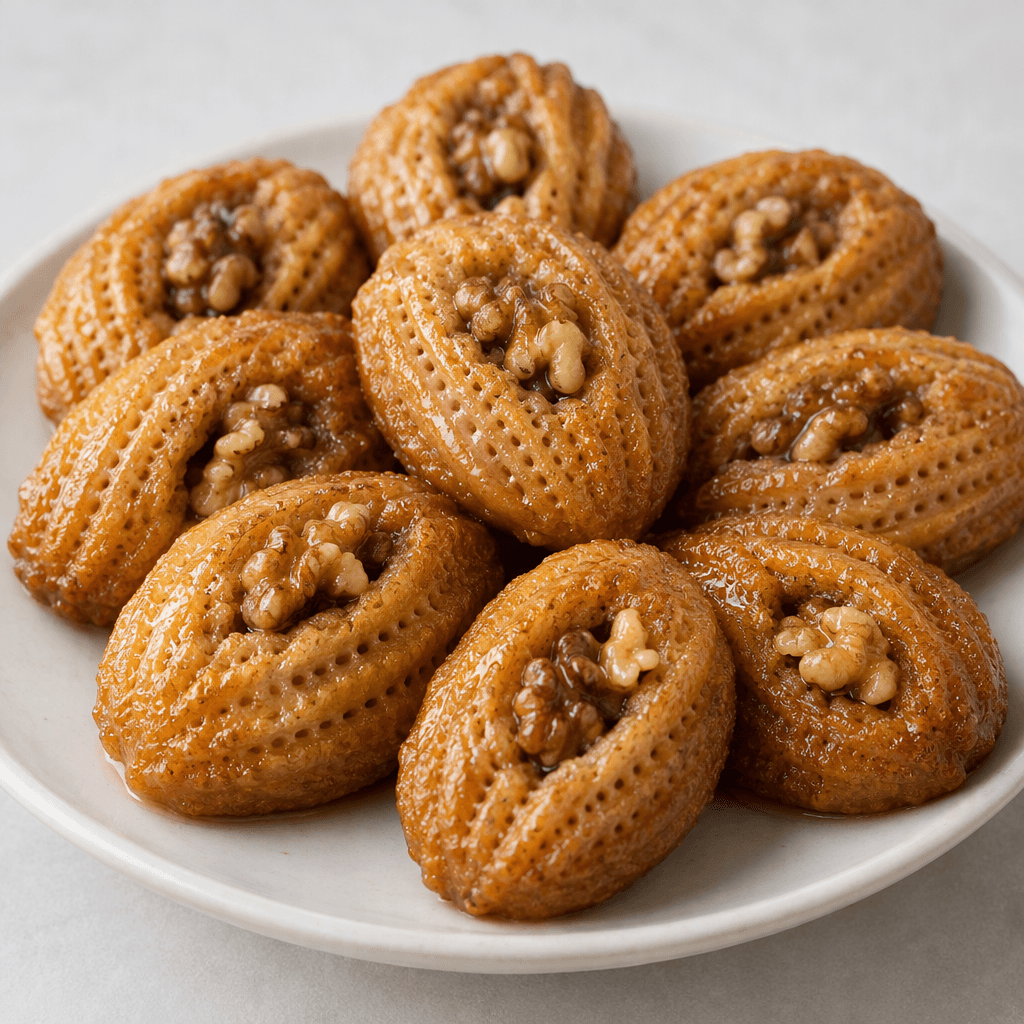
Kalbura bastı Calories
Traditional Turkish syrup-soaked dessert, semolina dough, walnut filling, soaked in syrup.
In season: Spring · Summer · Autumn · Winter
CALORIES
GI
POTASSIUM
FIBER
Quick answer
1 piece (medium) of Kalbura bastı (60 g) has 204 calories. That works out to 340 calories per 100 g. It contains 34.8 g of carbs, 2.5 g of protein, 6.3 g of fat and 1.3 g of fiber. Its 0.1 mg of Copper covers 9% of the Daily Value. Its glycemic index is 70 (high), so it raises blood sugar quickly.
What is Kalbura bastı?
Kalbura bastı is a traditional Turkish syrup-soaked pastry made from semolina dough, usually filled with walnuts. The dough is shaped by pressing it against a ridged or perforated surface, then baked until golden and soaked in syrup. Its patterned top is part of its familiar appearance.
The outside is lightly firm while the centre stays soft and nutty; the syrup gives each bite a moist, pronounced sweetness. In Turkey it is often served with tea or coffee, especially when welcoming guests or at festive meals. It is a carbohydrate- and energy-rich sweet, with walnuts adding some fat. A modest piece with unsweetened tea makes a satisfying treat without crowding out the rest of a meal.
Kalbura bastı Nutrition Facts
Selected: 100 g
340
KCAL / 100G
Carbs
58g
· 21% DV
Protein
4.2g
· 8% DV
Fat
10.5g
· 13% DV
Fiber
2.1g
· 8% DV
DV is the share of the daily value covered, on a 2,000 kcal reference diet.
Calories come from: Carbs 68% · Protein 5% · Fat 27%
Kalbura bastı Vitamins & Minerals
Vitamins
B1
0.09mg · 8% DV
B2
0.05mg · 4% DV
B3
0.6mg · 4% DV
B5
0.18mg · 4% DV
Minerals
Zinc
1mg · 9% DV
Phosphorus
48mg · 7% DV
Iron
1mg · 6% DV
Selenium
3.2µg · 6% DV
How Nutritious Is Kalbura bastı?
Nutrient density
Low
How many vitamins, minerals and how much fiber this food carries per calorie. A high score means a lot of nutrition for few calories.
Satiety score
Low
An EatBetter score computed from fiber, protein and calorie density. A high score means staying full longer on the same calories.
Both scores are calculated per 100 g and do not change with the selected portion. The satiety score is EatBetter's own calculation, not a clinical measure.
Kalbura bastı Glycemic Index
GLYCEMIC INDEX
GLYCEMIC LOAD
Accounts for portion size — a more realistic measure than GI alone.
How to Burn Off Kalbura bastı
To burn the 340 calories in 100 g:
🚶
Walking (5 km/h)
🏃
Running (8 km/h)
🚴
Cycling
🏊
Swimming
Times are calculated with the MET equation for a 70 kg adult. Actual burn varies with your weight, age and pace.
Is Kalbura bastı Processed?
NOVA 3
Processed
1. Unprocessed
2. Minimally Processed
3. Processed
4. Ultra-Processed
NOVA classifies foods into 4 groups by industrial processing. NOVA 1 (unprocessed) is the healthiest.
Does Kalbura bastı Contain Allergens?
Contains these allergens:
Which Diets Is Kalbura bastı Good For?
Vegan
— Not suitable
Vegetarian
— Not suitable
Gluten-Free
— Not suitable
Dairy-Free
— Not suitable
Mediterranean
✓ Suitable
Paleo
— Not suitable
Whole30
— Not suitable
DASH
— Not suitable
Keto
— Not suitable
Low FODMAP
— Not suitable
Kalbura bastı Fat Profile
SATURATED
2.8g
MONOUNSATURATED
4.1g
POLYUNSATURATED
2.3g
Omega 6:3 ratio 30:1
Above the ideal 4:1 (30:1).
Compare Kalbura bastı
Foods Similar to Kalbura bastı
Frequently Asked Questions About Kalbura bastı
What is kalbura bastı?
Kalbura bastı is a traditional Turkish syrup-soaked pastry made from a semolina dough, commonly filled with walnuts. Its ridged surface is pressed onto a sieve-like tool before baking, then the baked pastries absorb syrup.
How do you make kalbura bastı?
To make kalbura bastı, shape a soft semolina dough around a walnut filling and press each piece onto a grater or sieve to create ridges. Bake until golden, then pour cooled syrup over the hot pastries and let them soak.
Why is kalbura bastı called kalbura bastı?
The name refers to the pastry being pressed onto a kalbur, or sieve, to leave its characteristic ridged pattern. That textured top is not just decoration: it is the traditional way kalbura bastı is shaped before baking.
Should the syrup for kalbura bastı be hot or cold?
Most recipes pour cooled syrup over hot kalbura bastı straight from the oven. The contrast helps the pastries absorb the syrup while holding their shape; recipes vary, but pouring boiling syrup over them can make the pastry overly soft.
Why is my kalbura bastı not absorbing the syrup?
Kalbura bastı may not absorb syrup well if the syrup is too thick or the pastries have cooled before it is added. Pour the prepared syrup over the pastries while they are hot, then give them enough time to soak before serving.
How can you shape kalbura bastı without a special mold?
You can shape kalbura bastı without a special mold by pressing the dough against a clean box grater or sieve. Add the walnut filling, close the dough around it, and place the ridged side facing up on the baking tray.
Can you make kalbura bastı with a filling other than walnuts?
Yes, kalbura bastı can be filled with finely chopped hazelnuts if walnuts are unavailable. Walnuts are the traditional choice, but keep any substitute filling finely chopped so the dough can close securely without splitting during baking.
How should leftover kalbura bastı be stored?
Store leftover kalbura bastı in a covered container at a cool room temperature after it has fully cooled. Refrigeration can make the pastry firmer; keeping it covered also prevents the syrup-soaked pieces from drying out.
Can kalbura bastı be frozen?
Yes, kalbura bastı freezes best before the syrup is added. Freeze the baked pastries, thaw them, warm them if desired, and then pour over syrup; freezing them already soaked can leave the texture softer.
Is kalbura bastı served warm or cold?
Kalbura bastı is usually served at room temperature after the baked pastries have absorbed the syrup. It is commonly offered with Turkish tea, especially at gatherings and celebrations; serving it piping hot is not necessary.
Have another question about Kalbura bastı?
Ask the AI nutrition coach — calories, portions, alternatives and more, answered in seconds in the app.

Scan calories with your camera
Instant AI nutrition analysis

Nutrition data compiled from USDA FoodData Central and scientific sources.