

Ready & Packaged Foods
All →Vegetables & Legumes
All →Desserts & Confectionery
All →Meat & Protein
All →Grains & Bakery
All →Beverages
All →Milk & Dairy
All →

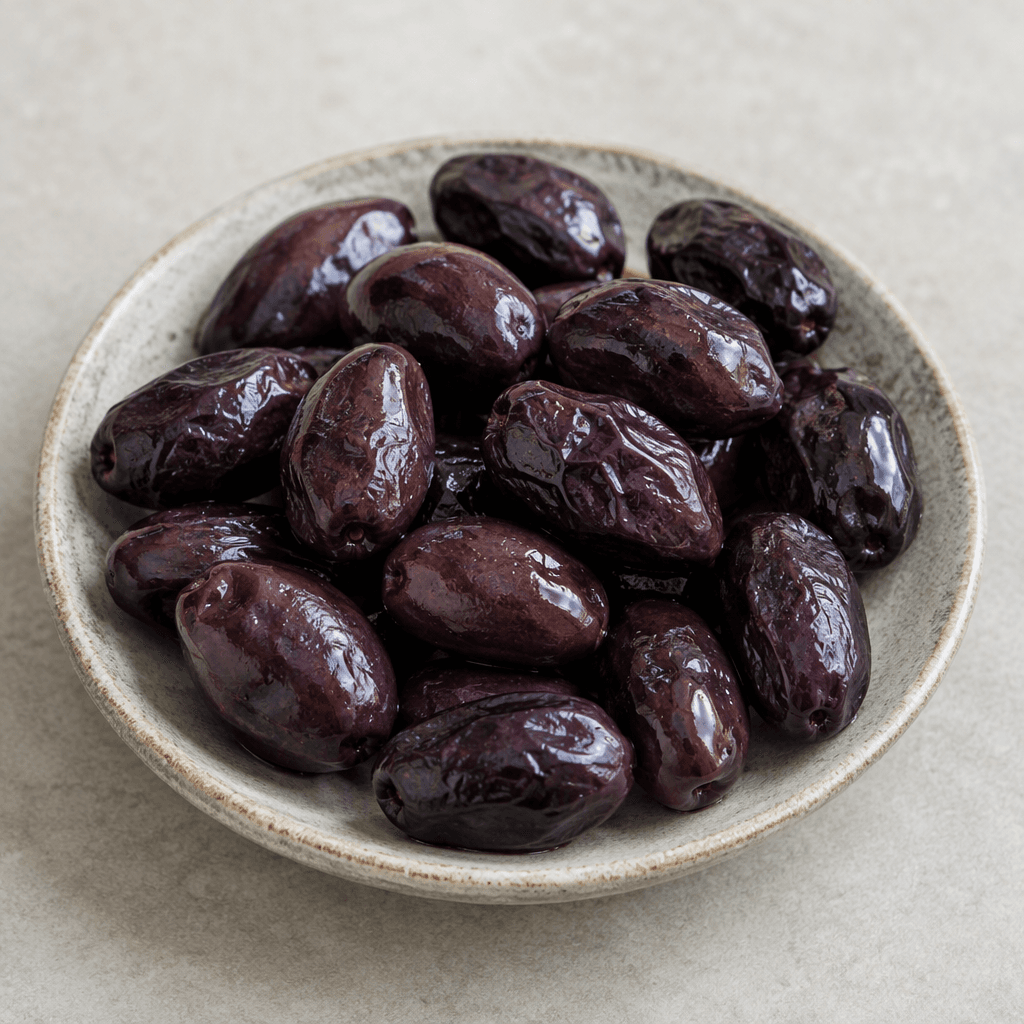
Kalamata olives Calories
Brined olives rich in monounsaturated fats and relatively high in sodium
In season: Spring · Summer · Autumn · Winter
CALORIES
GI
POTASSIUM
FIBER
Quick answer
5 piece (medium) of Kalamata olives (25 g) has 60 calories. That works out to 239 calories per 100 g. It contains 1.5 g of carbs, 0.5 g of protein, 6.1 g of fat and 0.8 g of fiber. Its 1.6 mg of Iron covers 9% of the Daily Value. Its glycemic index is 15 (low), so it raises blood sugar slowly.
What is Kalamata olives?
Kalamata olives are large, almond-shaped olives associated with the Kalamata region of southern Greece. Usually cured in brine, they turn deep purple to nearly black and have glossy, sometimes slightly wrinkled skins. Their flesh is substantial, with a distinctive fruity, tangy flavour and a pleasantly firm texture.
In Greece, they’re served at the table as part of a spread, alongside bread, cheese and other meze, and are also added to salads. Elsewhere, they work well in sandwiches, grain bowls or pasta, or simply as a savoury snack. They’re rich in fat, much of it monounsaturated, and relatively low in carbohydrates, but brining makes them salty. Rinsing them briefly can soften the saltiness; pair them with fresh vegetables for a balanced plate.
Kalamata olives Nutrition Facts
Selected: 100 g
239
KCAL / 100G
Carbs
6g
· 2% DV
Protein
1.8g
· 4% DV
Fat
24.3g
· 31% DV
Fiber
3.2g
· 11% DV
DV is the share of the daily value covered, on a 2,000 kcal reference diet.
Calories come from: Carbs 10% · Protein 3% · Fat 87%
Kalamata olives Vitamins & Minerals
Vitamins
Vitamin E
3.8mg · 25% DV
B2
0.09mg · 7% DV
Vitamin A
20µg · 2% DV
B1
0.02mg · 2% DV
Minerals
Iron
6mg · 33% DV
Sodium
735mg · 32% DV
Calcium
52mg · 5% DV
Magnesium
11mg · 3% DV
How Nutritious Is Kalamata olives?
Nutrient density
Medium
How many vitamins, minerals and how much fiber this food carries per calorie. A high score means a lot of nutrition for few calories.
Satiety score
Medium
An EatBetter score computed from fiber, protein and calorie density. A high score means staying full longer on the same calories.
Both scores are calculated per 100 g and do not change with the selected portion. The satiety score is EatBetter's own calculation, not a clinical measure.
Kalamata olives Glycemic Index
GLYCEMIC INDEX
GLYCEMIC LOAD
Accounts for portion size — a more realistic measure than GI alone.
How to Burn Off Kalamata olives
To burn the 239 calories in 100 g:
🚶
Walking (5 km/h)
🏃
Running (8 km/h)
🚴
Cycling
🏊
Swimming
Times are calculated with the MET equation for a 70 kg adult. Actual burn varies with your weight, age and pace.
Is Kalamata olives Processed?
NOVA 2
Minimally Processed
1. Unprocessed
2. Minimally Processed
3. Processed
4. Ultra-Processed
NOVA classifies foods into 4 groups by industrial processing. NOVA 1 (unprocessed) is the healthiest.
Does Kalamata olives Contain Allergens?
No known major allergens
Which Diets Is Kalamata olives Good For?
Vegan
✓ Suitable
Vegetarian
✓ Suitable
Gluten-Free
✓ Suitable
Dairy-Free
— Not suitable
Mediterranean
✓ Suitable
Paleo
✓ Suitable
Whole30
— Not suitable
DASH
— Not suitable
Keto
✓ Suitable
Low FODMAP
— Not suitable
Kalamata olives Fat Profile
SATURATED
3.2g
MONOUNSATURATED
17.9g
POLYUNSATURATED
2g
Omega 6:3 ratio 63.3:1
Above the ideal 4:1 (63.3:1).
Compare Kalamata olives
Foods Similar to Kalamata olives
Frequently Asked Questions About Kalamata olives
What are Kalamata olives?
Kalamata olives are Greek table olives, usually large, elongated and deep purple. They are commonly made from the Kalamon olive variety and sold cured, often in brine. The name is associated with the Greek region of Kalamata.
Why are Kalamata olives different from regular black olives?
Kalamata olives are typically larger and more elongated than many olives sold simply as black olives, and they have a deep purple color. Their flavor is often fruitier and more pronounced. “Black olives” is a broad label covering many varieties and curing styles.
What do Kalamata olives taste like?
Kalamata olives taste rich and fruity, with a tangy edge and a salty finish from their brine. Their firm, meaty texture makes them easy to notice in salads, pasta dishes and olive platters.
Why are Kalamata olives sometimes wrinkled?
Kalamata olives can look slightly wrinkled because of how they ripen and are cured, including moisture changes during processing. A few wrinkles are normal. Discard olives with unexpected fuzz, a rotten smell or other clear signs of spoilage.
Are Kalamata olives fermented?
Some Kalamata olives are fermented during brine curing, but fermentation is not guaranteed for every product. Curing methods vary, and brine itself does not prove that fermentation took place. The olives are typically cured before they are sold.
Do Kalamata olives have pits?
Yes, Kalamata olives are often sold with their pits, although pitted versions are also available. If you are serving whole olives, let guests know they may contain pits; for recipes, pitted olives are easier to chop and mix in.
Should you rinse Kalamata olives before eating them?
You can rinse Kalamata olives briefly under cold water to remove some brine and reduce their salty surface taste. Rinsing will not remove all the salt, and soaking them for longer can also soften their flavor.
How should you store Kalamata olives after opening?
Keep opened Kalamata olives refrigerated in a sealed container, covered with their brine. Use a clean utensil to take them out, and avoid leaving the jar at room temperature for extended periods. Follow any specific storage instructions on the package.
Can you freeze Kalamata olives?
Yes, you can freeze Kalamata olives, but thawing may make their texture softer. Drain them, place them in a freezer-safe airtight container, and thaw them in the refrigerator. They are usually best afterward in cooked dishes rather than on an olive platter.
What can you use instead of Kalamata olives?
Use Gaeta olives or another brined, dark Mediterranean olive when you need a substitute for Kalamata olives. The taste will not be identical, so choose a firm, flavorful variety and adjust the amount if it is noticeably saltier.
Have another question about Kalamata olives?
Ask the AI nutrition coach — calories, portions, alternatives and more, answered in seconds in the app.

Scan calories with your camera
Instant AI nutrition analysis

Nutrition data compiled from USDA FoodData Central and scientific sources.