

Ready & Packaged Foods
All →Vegetables & Legumes
All →Desserts & Confectionery
All →Meat & Protein
All →Grains & Bakery
All →Beverages
All →Milk & Dairy
All →

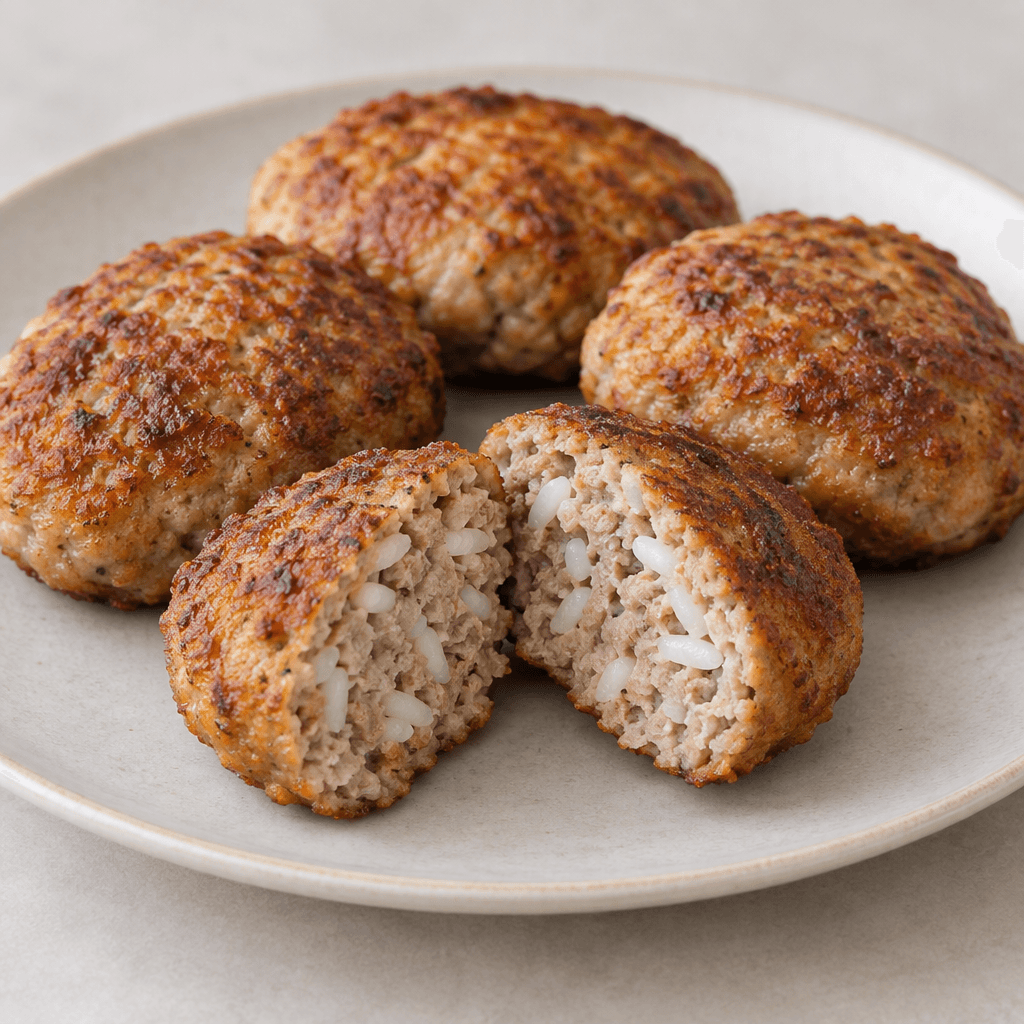
Kadinbudu meatballs Calories
Ground meat, rice, onion, egg, fried
In season: Spring · Summer · Autumn · Winter
CALORIES
GI
POTASSIUM
FIBER
Quick answer
2 piece (medium) of Kadinbudu meatballs (120 g) has 258 calories. That works out to 215 calories per 100 g. It contains 15.8 g of carbs, 16.2 g of protein, 15 g of fat and 1.3 g of fiber. Its 1.3 µg of B12 covers 55% of the Daily Value. Its glycemic index is 55 (medium), so it raises blood sugar at a moderate pace.
What is Kadinbudu meatballs?
Kadinbudu meatballs are a Turkish dish made with minced meat, rice and onion. The mixture is shaped into flattened ovals, coated in egg and fried; many traditional recipes cook part of the meat and the rice before combining them with the rest.
They have a crisp, golden exterior and a tender, savoury centre, with rice grains giving the filling a distinctive texture. In Turkey they are served as a main dish, often with salad and yoghurt, and are also enjoyable at room temperature. Turkish restaurants and home cooks abroad may serve them with a simple green salad or vegetables. They provide both protein and carbohydrates: a 100 g portion has 13.5 g of protein. For a lighter plate, pair them with fresh salad rather than another fried side.
Kadinbudu meatballs Nutrition Facts
Selected: 100 g
215
KCAL / 100G
Carbs
13.2g
· 5% DV
Protein
13.5g
· 27% DV
Fat
12.5g
· 16% DV
Fiber
1.1g
· 4% DV
DV is the share of the daily value covered, on a 2,000 kcal reference diet.
Calories come from: Carbs 24% · Protein 25% · Fat 51%
Kadinbudu meatballs Vitamins & Minerals
Vitamins
B12
1.1µg · 46% DV
B3
3.2mg · 20% DV
Biotin
4.5µg · 15% DV
B5
0.7mg · 14% DV
Minerals
Selenium
13µg · 24% DV
Phosphorus
145mg · 21% DV
Sodium
430mg · 19% DV
Zinc
2mg · 18% DV
How Nutritious Is Kadinbudu meatballs?
Nutrient density
Medium
How many vitamins, minerals and how much fiber this food carries per calorie. A high score means a lot of nutrition for few calories.
Satiety score
Medium
An EatBetter score computed from fiber, protein and calorie density. A high score means staying full longer on the same calories.
Both scores are calculated per 100 g and do not change with the selected portion. The satiety score is EatBetter's own calculation, not a clinical measure.
Kadinbudu meatballs Glycemic Index
GLYCEMIC INDEX
GLYCEMIC LOAD
Accounts for portion size — a more realistic measure than GI alone.
How to Burn Off Kadinbudu meatballs
To burn the 215 calories in 100 g:
🚶
Walking (5 km/h)
🏃
Running (8 km/h)
🚴
Cycling
🏊
Swimming
Times are calculated with the MET equation for a 70 kg adult. Actual burn varies with your weight, age and pace.
Is Kadinbudu meatballs Processed?
NOVA 3
Processed
1. Unprocessed
2. Minimally Processed
3. Processed
4. Ultra-Processed
NOVA classifies foods into 4 groups by industrial processing. NOVA 1 (unprocessed) is the healthiest.
Does Kadinbudu meatballs Contain Allergens?
Contains these allergens:
Which Diets Is Kadinbudu meatballs Good For?
Vegan
— Not suitable
Vegetarian
— Not suitable
Gluten-Free
— Not suitable
Dairy-Free
— Not suitable
Mediterranean
✓ Suitable
Paleo
— Not suitable
Whole30
— Not suitable
DASH
— Not suitable
Keto
— Not suitable
Low FODMAP
— Not suitable
Kadinbudu meatballs Fat Profile
SATURATED
4.3g
MONOUNSATURATED
5.1g
POLYUNSATURATED
1.1g
Omega 6:3 ratio 2.6:1
Below the ideal 4:1 — a good omega balance.
Compare Kadinbudu meatballs
Foods Similar to Kadinbudu meatballs
Frequently Asked Questions About Kadinbudu meatballs
What are Kadinbudu meatballs?
Kadinbudu meatballs are Turkish oval patties made with ground meat, rice and onion, coated in egg and usually fried. Their signature contrast is a crisp, golden exterior around a soft interior with visible rice grains.
What is in Kadinbudu meatballs?
Kadinbudu meatballs are typically made with ground meat, cooked rice, onion and egg. Many recipes cook part of the meat with onion and mix it with the remaining raw meat; the shaped patties are dipped in flour and beaten egg before frying.
How are Kadinbudu meatballs traditionally made?
To make Kadinbudu meatballs, mix cooked rice with ground meat and onion, shape the mixture into flattened ovals, then coat each one in flour and egg. Fry them in hot oil until browned and cooked through.
Why do Kadinbudu meatballs contain rice?
Rice gives Kadinbudu meatballs their characteristic soft, slightly textured center and helps bind the meat mixture. Use cooked, well-drained rice that has cooled before mixing so the patties are easier to shape.
Why do Kadinbudu meatballs fall apart during frying?
Kadinbudu meatballs can fall apart if the mixture is too wet, warm, or loosely shaped, or if they are turned before the coating sets. Drain the rice well, chill the mixture, and let each side brown before flipping.
How do you keep Kadinbudu meatballs from breaking apart?
To keep Kadinbudu meatballs intact, knead the mixture until cohesive, chill it, and shape firm patties. Coat them in flour and beaten egg, then fry in properly heated oil without crowding the pan.
What do you serve with Kadinbudu meatballs?
Serve Kadinbudu meatballs with rice pilaf, salad, yogurt, or cacık, a Turkish yogurt-and-cucumber dish. A fresh, tangy side helps balance the richness of the fried coating.
Can you bake Kadinbudu meatballs instead of frying them?
Yes, you can bake Kadinbudu meatballs, though the coating will usually be less crisp than when fried. Arrange them on a lined baking tray, brush lightly with oil, and bake until browned and cooked through.
Can you freeze Kadinbudu meatballs?
Yes, Kadinbudu meatballs freeze well before frying. Freeze the shaped patties in a single layer so they do not stick together, then transfer them to a sealed container; thaw them in the refrigerator before coating and cooking.
How should you store and reheat Kadinbudu meatballs?
Store cooked Kadinbudu meatballs in a covered container in the refrigerator and eat them within a few days. Reheat them in an oven or skillet to bring back some crispness; microwaving tends to soften the coating.
Have another question about Kadinbudu meatballs?
Ask the AI nutrition coach — calories, portions, alternatives and more, answered in seconds in the app.

Scan calories with your camera
Instant AI nutrition analysis

Nutrition data compiled from USDA FoodData Central and scientific sources.