

Ready & Packaged Foods
All →Vegetables & Legumes
All →Desserts & Confectionery
All →Meat & Protein
All →Grains & Bakery
All →Beverages
All →Milk & Dairy
All →

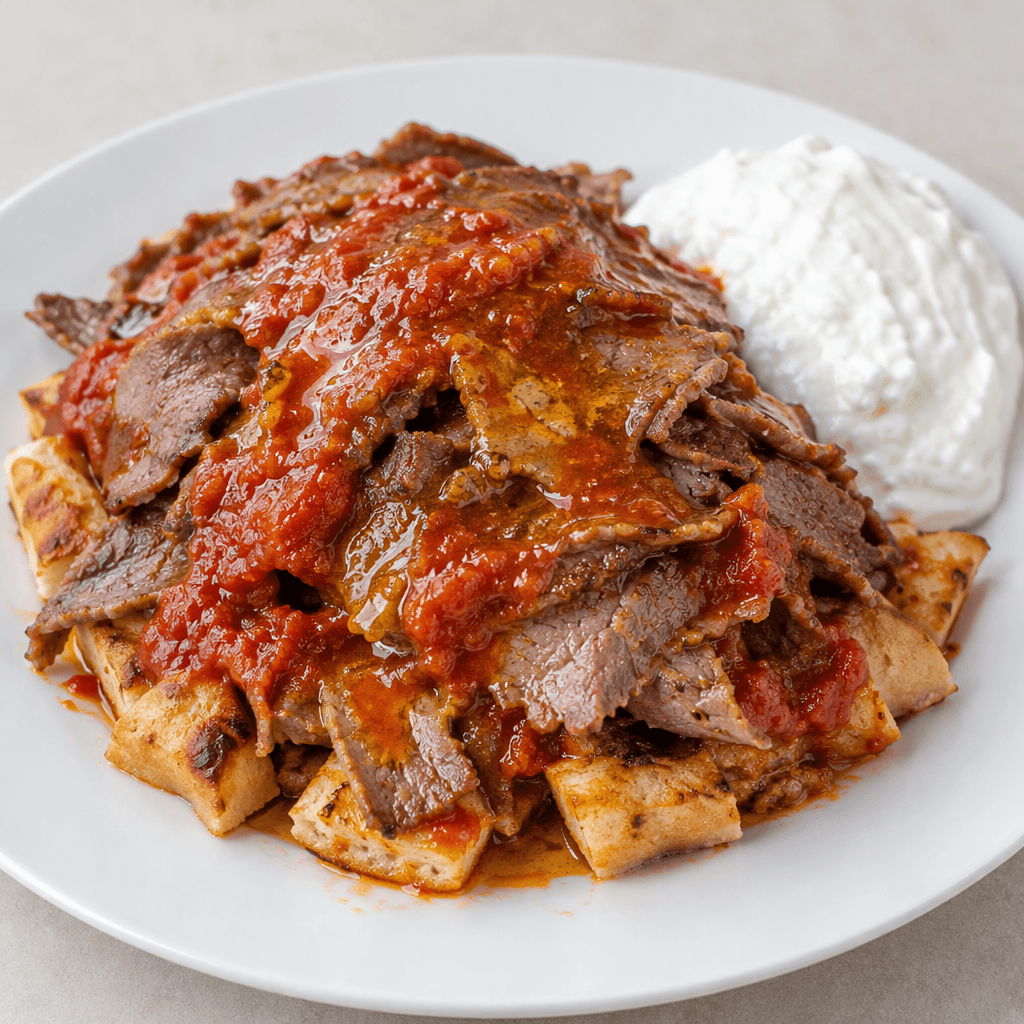
Iskender Kebab Calories
Traditional Turkish kebab with döner meat, butter, yogurt, and pita bread
In season: Spring · Summer · Autumn · Winter
CALORIES
GI
POTASSIUM
FIBER
Quick answer
1 serving (medium) of Iskender Kebab (350 g) has 718 calories. That works out to 205 calories per 100 g. It contains 56.7 g of carbs, 40.3 g of protein, 37.8 g of fat and 4.2 g of fiber. Its 2.4 µg of B12 covers 102% of the Daily Value. Its glycemic index is 60 (medium), so it raises blood sugar at a moderate pace.
What is Iskender Kebab?
Iskender Kebab comes from Bursa, Turkey. It is made with thin slices of layered döner meat, usually lamb and beef, served over pieces of toasted pide bread. Tomato sauce is spooned over the top, followed by hot melted butter, with thick yogurt alongside.
The meat is tender, the bread soaks up the savory sauce, and the cool yogurt balances the buttery richness. In Turkey it is commonly served as a substantial main meal; a salad or ayran makes a refreshing accompaniment. It provides protein, but the bread and butter also make it a filling, energy-dense plate. For a lighter serving, ask for less butter and bread, or add extra salad.
Iskender Kebab Nutrition Facts
Selected: 100 g
205
KCAL / 100G
Carbs
16.2g
· 6% DV
Protein
11.5g
· 23% DV
Fat
10.8g
· 14% DV
Fiber
1.2g
· 4% DV
DV is the share of the daily value covered, on a 2,000 kcal reference diet.
Calories come from: Carbs 31% · Protein 22% · Fat 47%
Iskender Kebab Vitamins & Minerals
Vitamins
B12
0.7µg · 29% DV
B3
2.1mg · 13% DV
B5
0.6mg · 12% DV
B2
0.13mg · 10% DV
Minerals
Zinc
2mg · 18% DV
Sodium
410mg · 18% DV
Phosphorus
110mg · 16% DV
Selenium
7.5µg · 14% DV
How Nutritious Is Iskender Kebab?
Nutrient density
Medium
How many vitamins, minerals and how much fiber this food carries per calorie. A high score means a lot of nutrition for few calories.
Satiety score
Medium
An EatBetter score computed from fiber, protein and calorie density. A high score means staying full longer on the same calories.
Both scores are calculated per 100 g and do not change with the selected portion. The satiety score is EatBetter's own calculation, not a clinical measure.
Iskender Kebab Glycemic Index
GLYCEMIC INDEX
GLYCEMIC LOAD
Accounts for portion size — a more realistic measure than GI alone.
How to Burn Off Iskender Kebab
To burn the 205 calories in 100 g:
🚶
Walking (5 km/h)
🏃
Running (8 km/h)
🚴
Cycling
🏊
Swimming
Times are calculated with the MET equation for a 70 kg adult. Actual burn varies with your weight, age and pace.
Is Iskender Kebab Processed?
NOVA 3
Processed
1. Unprocessed
2. Minimally Processed
3. Processed
4. Ultra-Processed
NOVA classifies foods into 4 groups by industrial processing. NOVA 1 (unprocessed) is the healthiest.
Does Iskender Kebab Contain Allergens?
Contains these allergens:
Which Diets Is Iskender Kebab Good For?
Vegan
— Not suitable
Vegetarian
— Not suitable
Gluten-Free
— Not suitable
Dairy-Free
— Not suitable
Mediterranean
✓ Suitable
Paleo
— Not suitable
Whole30
— Not suitable
DASH
— Not suitable
Keto
— Not suitable
Low FODMAP
— Not suitable
Iskender Kebab Fat Profile
SATURATED
4.2g
MONOUNSATURATED
4.1g
POLYUNSATURATED
1.1g
Omega 6:3 ratio 3.1:1
Below the ideal 4:1 — a good omega balance.
Compare Iskender Kebab
Foods Similar to Iskender Kebab
Frequently Asked Questions About Iskender Kebab
What is Iskender Kebab?
Iskender Kebab is a Turkish dish of thinly sliced döner meat served over toasted pide bread, with tomato sauce and melted butter poured on top. It is typically accompanied by yogurt, and often by grilled tomato and pepper.
How do you make Iskender Kebab at home?
To make Iskender Kebab at home, warm thin slices of döner meat, toast cubes of pide, and arrange the meat over the bread. Add tomato sauce and melted butter, then serve yogurt on the side. The bread should be toasted but not dried out.
What meat is used in Iskender Kebab?
Traditional Iskender Kebab uses döner made with lamb and beef, sliced thinly after cooking on a vertical rotisserie. The exact blend varies by restaurant and recipe, but the meat is served over pide with tomato sauce, butter, and yogurt.
Where did Iskender Kebab originate?
Iskender Kebab originated in Bursa, Turkey, and is named after İskender Efendi, who is credited with developing this style of serving döner in the 19th century. Bursa remains closely associated with the dish, although it is now served throughout Turkey and abroad.
Is Iskender Kebab the same as döner kebab?
No. Döner describes meat cooked on a rotating vertical spit and sliced thinly; Iskender Kebab is a particular dish made with döner served over pide, topped with tomato sauce and melted butter, and accompanied by yogurt.
Is Iskender Kebab spicy?
Iskender Kebab is usually savory rather than hot-spicy; its tomato sauce is generally mild. Heat can vary between restaurants, so ask for chili or hot pepper on the side if you want more spice.
What kind of bread is used for Iskender Kebab?
Iskender Kebab is traditionally served over pide, a soft Turkish flatbread cut into small pieces and lightly toasted. The bread catches the tomato sauce and butter, while staying substantial enough to sit beneath the sliced döner.
Why is melted butter poured over Iskender Kebab?
Melted butter is a defining finishing touch in Iskender Kebab, adding richness and flavor to the döner and sauce-soaked pide. It is poured over the dish just before serving; using less butter at home makes the plate lighter but less traditional.
What is served with Iskender Kebab?
Iskender Kebab is commonly served with plain yogurt, which contrasts with the hot meat and buttery tomato sauce. Grilled tomato and green pepper are also frequent accompaniments, while the pide underneath the meat is part of the dish itself.
How long does leftover Iskender Kebab keep?
Refrigerate leftover Iskender Kebab promptly in a covered container and eat it within 3–4 days. Store the yogurt separately if possible, reheat the meat, bread, and sauce until thoroughly hot, then add the yogurt cold.
Have another question about Iskender Kebab?
Ask the AI nutrition coach — calories, portions, alternatives and more, answered in seconds in the app.

Scan calories with your camera
Instant AI nutrition analysis

Nutrition data compiled from USDA FoodData Central and scientific sources.