

Ready & Packaged Foods
All →Vegetables & Legumes
All →Desserts & Confectionery
All →Meat & Protein
All →Grains & Bakery
All →Beverages
All →Milk & Dairy
All →

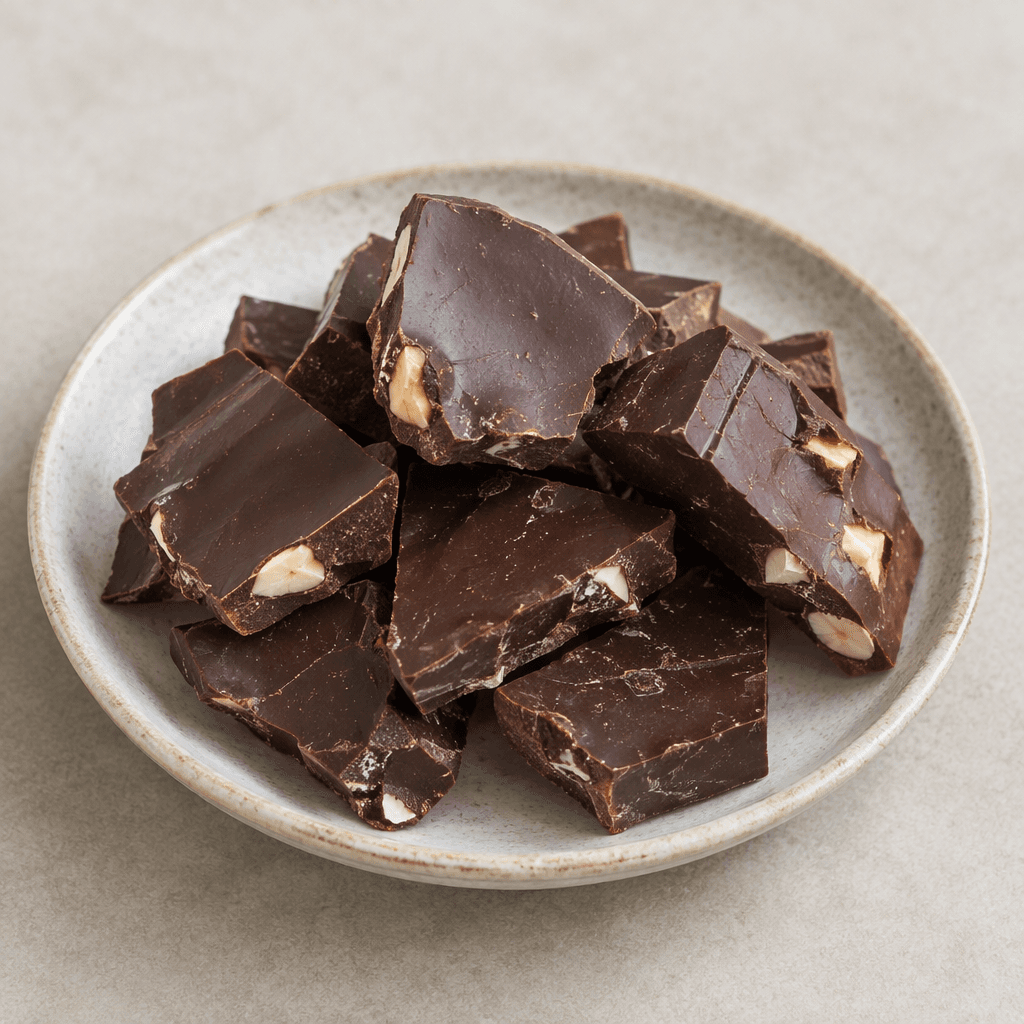
Homemade sugar-free chocolate Calories
Homemade chocolate without refined sugar. Typically made with cocoa, cocoa butter, and natural sweeteners.
In season: Winter · Autumn · Spring · Summer
CALORIES
GI
POTASSIUM
FIBER
Quick answer
1 piece (medium) of Homemade sugar-free chocolate (20 g) has 96 calories. That works out to 480 calories per 100 g. It contains 4.6 g of carbs, 1.3 g of protein, 8.2 g of fat and 2.2 g of fiber. Its 0.3 mg of Copper covers 38% of the Daily Value. Its glycemic index is 15 (low), so it raises blood sugar slowly.
What is Homemade sugar-free chocolate?
Homemade sugar-free chocolate is a small-batch chocolate-style treat, typically made by combining cocoa with cocoa butter and a natural sweetener instead of refined sugar. Recipes vary, and chopped nuts may be added for crunch. It is not necessarily free of all sugars, since the sweetener used can affect the final ingredients and taste.
Expect a deep cocoa flavour and a smooth, firm texture that softens in the mouth. It works as a little after-dinner sweet, with coffee or tea, or chopped over porridge and desserts. Cocoa butter makes it energy-dense and relatively high in fat, despite the absence of refined sugar. Keep the portion modest, especially if you are pairing it with another rich treat.
Homemade sugar-free chocolate Nutrition Facts
Selected: 100 g
480
KCAL / 100G
Carbs
23g
· 8% DV
Protein
6.5g
· 13% DV
Fat
41g
· 53% DV
Fiber
11g
· 39% DV
DV is the share of the daily value covered, on a 2,000 kcal reference diet.
Calories come from: Carbs 19% · Protein 5% · Fat 76%
Homemade sugar-free chocolate Vitamins & Minerals
Vitamins
Vitamin E
2.1mg · 14% DV
B2
0.12mg · 9% DV
B3
1.2mg · 8% DV
Biotin
2.5µg · 8% DV
Minerals
Copper
2mg · 222% DV
Manganese
2mg · 87% DV
Iron
8mg · 44% DV
Magnesium
180mg · 43% DV
How Nutritious Is Homemade sugar-free chocolate?
Nutrient density
Medium
How many vitamins, minerals and how much fiber this food carries per calorie. A high score means a lot of nutrition for few calories.
Satiety score
Medium
An EatBetter score computed from fiber, protein and calorie density. A high score means staying full longer on the same calories.
Both scores are calculated per 100 g and do not change with the selected portion. The satiety score is EatBetter's own calculation, not a clinical measure.
Homemade sugar-free chocolate Glycemic Index
GLYCEMIC INDEX
GLYCEMIC LOAD
Accounts for portion size — a more realistic measure than GI alone.
How to Burn Off Homemade sugar-free chocolate
To burn the 480 calories in 100 g:
🚶
Walking (5 km/h)
🏃
Running (8 km/h)
🚴
Cycling
🏊
Swimming
Times are calculated with the MET equation for a 70 kg adult. Actual burn varies with your weight, age and pace.
Is Homemade sugar-free chocolate Processed?
NOVA 2
Minimally Processed
1. Unprocessed
2. Minimally Processed
3. Processed
4. Ultra-Processed
NOVA classifies foods into 4 groups by industrial processing. NOVA 1 (unprocessed) is the healthiest.
Does Homemade sugar-free chocolate Contain Allergens?
No known major allergens
Which Diets Is Homemade sugar-free chocolate Good For?
Vegan
✓ Suitable
Vegetarian
✓ Suitable
Gluten-Free
✓ Suitable
Dairy-Free
— Not suitable
Mediterranean
✓ Suitable
Paleo
✓ Suitable
Whole30
— Not suitable
DASH
— Not suitable
Keto
— Not suitable
Low FODMAP
— Not suitable
Homemade sugar-free chocolate Fat Profile
SATURATED
25g
MONOUNSATURATED
12g
POLYUNSATURATED
2.5g
Omega 6:3 ratio 5.6:1
Above the ideal 4:1 (5.6:1).
Compare Homemade sugar-free chocolate
Foods Similar to Homemade sugar-free chocolate
Frequently Asked Questions About Homemade sugar-free chocolate
How do you make homemade sugar-free chocolate?
Homemade sugar-free chocolate is made by gently melting cocoa butter, then stirring in cocoa powder and a chosen sweetener. Pour the smooth mixture into a mold and chill until firm; chopped nuts can be stirred in before molding.
Which sweeteners work best in homemade sugar-free chocolate?
Powdered erythritol, stevia, or monk fruit sweetener can be used in homemade sugar-free chocolate. Powdered forms blend more smoothly than coarse crystals, while liquid sweeteners may change the texture because they add moisture.
Why does homemade sugar-free chocolate taste bitter?
Homemade sugar-free chocolate can taste bitter when the cocoa is intense or the sweetener does not balance it. Add sweetener gradually and taste as you go; some alternatives also leave a cooling or lingering aftertaste.
How do you stop homemade sugar-free chocolate from going grainy?
To keep homemade sugar-free chocolate from going grainy, use finely powdered sweetener and sift it into the cocoa mixture. Stir thoroughly while the cocoa butter is melted, and keep water and steam out of the bowl.
Can you make homemade sugar-free chocolate without cocoa butter?
Yes, homemade sugar-free chocolate can be made with coconut oil instead of cocoa butter, but it will melt more readily and have a softer, less traditional snap. Keep it refrigerated and let it soften briefly before serving.
How should homemade sugar-free chocolate be stored?
Store homemade sugar-free chocolate in an airtight container in a cool, dry place; refrigerate it if your kitchen is warm. Bring it toward room temperature before eating so the flavor is less muted and the texture is not overly hard.
Can homemade sugar-free chocolate be used in baking?
Yes, homemade sugar-free chocolate can be chopped and added to cookies or other baked goods. It may melt differently from commercial baking chocolate because its sweetener and cocoa-butter proportions vary, so expect changes in sweetness and texture.
Is homemade sugar-free chocolate safe for dogs?
No, homemade sugar-free chocolate is not safe for dogs. Cocoa contains theobromine, which is toxic to dogs, and some sugar-free recipes may also use sweeteners that are dangerous to pets; keep the chocolate well out of reach.
Can people with diabetes eat homemade sugar-free chocolate?
Some people with diabetes can include homemade sugar-free chocolate, but “sugar-free” does not mean carbohydrate-free or guaranteed not to affect blood glucose. The cocoa and sweetener matter, so discuss portions and ingredients with your clinician or dietitian if you need individualized guidance.
Does homemade sugar-free chocolate help with weight loss?
Homemade sugar-free chocolate is not a weight-loss food simply because it contains no refined sugar. Cocoa butter makes it energy-dense, so a modest piece is more useful for keeping portions in check than eating extra because it is sugar-free.
Have another question about Homemade sugar-free chocolate?
Ask the AI nutrition coach — calories, portions, alternatives and more, answered in seconds in the app.

Scan calories with your camera
Instant AI nutrition analysis

Nutrition data compiled from USDA FoodData Central and scientific sources.