

Ready & Packaged Foods
All →Vegetables & Legumes
All →Desserts & Confectionery
All →Meat & Protein
All →Grains & Bakery
All →Beverages
All →Milk & Dairy
All →

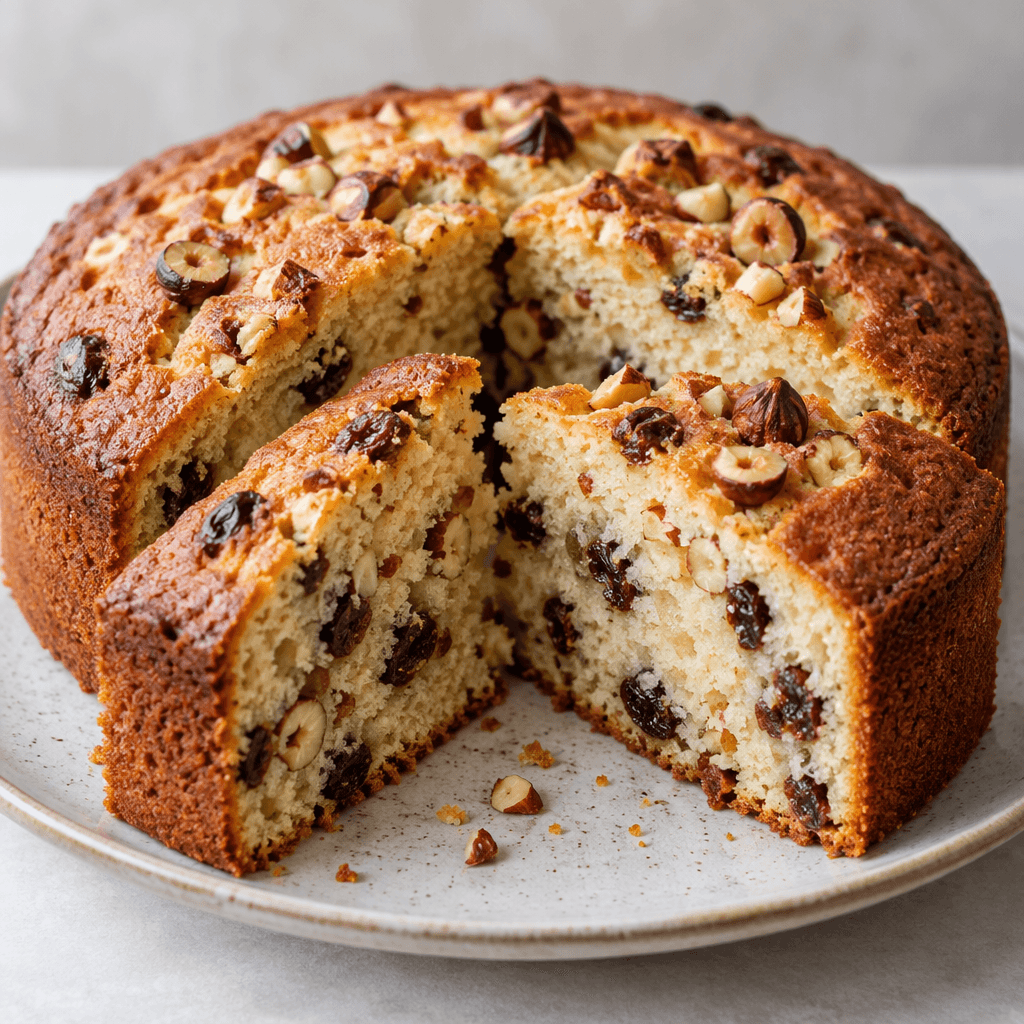
Homemade Raisin Hazelnut Cake Calories
Contains hazelnuts, raisins, and energy
In season: Spring · Summer · Autumn · Winter
CALORIES · 100 G
GI
POTASSIUM · 100 G
FIBER · 100 G
Quick answer
1 slice (medium) of Homemade Raisin Hazelnut Cake (70 g) has 279 calories. That works out to 398 calories per 100 g. It contains 37.2 g of carbs, 4.5 g of protein, 12.7 g of fat and 2.2 g of fiber. Its 0.2 mg of Copper covers 23% of the Daily Value. Its glycemic index is 62 (medium), so it raises blood sugar at a moderate pace.
Homemade Raisin Hazelnut Cake Nutrition Facts
Selected: 1 slice (medium) · 70 g
279
KCAL / 70G
Carbs
37.2g
· 14% DV
Protein
4.5g
· 9% DV
Fat
12.7g
· 16% DV
Fiber
2.2g
· 8% DV
DV is the share of the daily value covered, on a 2,000 kcal reference diet.
Calories come from: Carbs 53% · Protein 6% · Fat 41%
Homemade Raisin Hazelnut Cake nutrition facts table · 1 slice (medium) (70 g)
| Nutrient | Amount | % DV |
|---|---|---|
| Calories | 279 kcal | |
| Total fat | 12.7 g | 16% |
| Saturated fat | 3.57 g | 18% |
| Trans fat | 0.08 g | |
| Sodium | 186 mg | 8% |
| Total carbohydrate | 37.2 g | 14% |
| Fiber | 2.2 g | 8% |
| Protein | 4.5 g | 9% |
Calories: Calories measure energy. Average daily need is 2,000 kcal. Excess calories are stored as fat, too few cause weight loss.
Carbs: Your body's primary energy source. The brain runs exclusively on carbs. Daily need: 275g.
Protein: Essential for muscle repair and cell growth. Daily need: 50g. Keeps you full and boosts metabolism.
Fat: Needed for hormone production and vitamin absorption. Daily need: 78g. Limit saturated fats, choose unsaturated.
Fiber: Critical for digestive health and satiety. Daily need: 28g. Stabilizes blood sugar, lowers cholesterol.

Log this food in EatBetter
100,000+ people use it
- Get your daily calorie target
- Snap your meal, log it in seconds
- See every vitamin and mineral

📸 Scan the code to get the app free.

How Many Calories in 1 Slice of Homemade Raisin Hazelnut Cake?
| Serving | Amount | Calories |
|---|---|---|
| 1 slice (medium) | 70 g | 279 kcal |
| 1 slice (thin) | 35 g | 139 kcal |
| 1 slice (small) | 55 g | 219 kcal |
| 100 g | 100 g | 398 kcal |
| 1 slice (thick) | 100 g | 398 kcal |
| 1 piece (large) | 120 g | 478 kcal |
| 1 serving (double) | 140 g | 557 kcal |
| 1 piece (extra large) | 180 g | 716 kcal |
| 1 serving (triple) | 210 g | 836 kcal |
Calculated from 398 calories per 100 g.
Frequently Asked Questions About Homemade Raisin Hazelnut Cake
How do you make Homemade Raisin Hazelnut Cake?
Homemade Raisin Hazelnut Cake is made by mixing the wet and dry ingredients separately, then folding in raisins and chopped hazelnuts. Coat the raisins lightly with flour to help them stay distributed, transfer the batter to a pan, and bake until a tester comes out clean.
Why do raisins sink in Homemade Raisin Hazelnut Cake?
Raisins sink in Homemade Raisin Hazelnut Cake when the batter is too thin or the fruit is especially heavy or damp. Pat the raisins dry, toss them with a little flour, and fold them into the batter just before baking.
Should you soak raisins for Homemade Raisin Hazelnut Cake?
You can soak raisins for Homemade Raisin Hazelnut Cake if they are unusually dry or firm; soaking makes them plumper in the baked cake. Drain and dry them well before adding, since excess liquid can affect the batter and make the fruit sink.
How do you keep Homemade Raisin Hazelnut Cake moist?
To keep Homemade Raisin Hazelnut Cake moist, avoid overbaking it and stop mixing once the flour is incorporated. Check the center near the end of baking, then cool the cake before wrapping or storing it so trapped steam does not make the crust soggy.
Can you use whole hazelnuts in Homemade Raisin Hazelnut Cake?
Chopped hazelnuts work better than whole ones in Homemade Raisin Hazelnut Cake because they distribute through the crumb and are easier to bite. Toasting them briefly before adding can deepen their flavor; cool them first so they do not warm the batter.
What can you use instead of hazelnuts in Homemade Raisin Hazelnut Cake?
Walnuts or almonds can replace hazelnuts in Homemade Raisin Hazelnut Cake, although the flavor and texture will change. If you need to avoid nuts, leave them out rather than assuming another ingredient is an allergy-safe substitute.
How long does Homemade Raisin Hazelnut Cake last?
Homemade Raisin Hazelnut Cake keeps for a few days in an airtight container in a cool, dry place. Refrigerate it in warm or humid conditions to reduce the risk of mold, and let chilled slices come to room temperature for a softer texture.
Can Homemade Raisin Hazelnut Cake be frozen?
Yes, Homemade Raisin Hazelnut Cake freezes well when completely cool. Wrap individual slices tightly and place them in a freezer-safe container; thaw them while still wrapped to help prevent the cake from drying out.
What goes well with Homemade Raisin Hazelnut Cake?
Homemade Raisin Hazelnut Cake pairs well with black tea, coffee, or a glass of milk. Its raisins and hazelnuts already provide a sweet, nutty flavor, so it can be served plain or with fresh fruit rather than a rich frosting.
Can people with diabetes eat Homemade Raisin Hazelnut Cake?
Homemade Raisin Hazelnut Cake contains flour and sugar, and raisins also contribute natural sugars, so it can raise blood glucose. If you have diabetes, ask your clinician or dietitian how a slice fits your individual meal plan and glucose targets.
Homemade Raisin Hazelnut Cake Vitamins & Minerals
Vitamins
Vitamin E
2.17mg · 14% DV
Biotin
3.57µg · 12% DV
B1
0.13mg · 11% DV
B2
0.11mg · 8% DV
Minerals
Copper
0.2mg · 22% DV
Manganese
0.43mg · 19% DV
Selenium
9.24µg · 17% DV
Phosphorus
99mg · 14% DV
Sodium
186mg · 8% DV
Potassium ⭐
172mg · 5% DV
Homemade Raisin Hazelnut Cake Glycemic Index
GLYCEMIC INDEX
GLYCEMIC LOAD
Accounts for portion size — a more realistic measure than GI alone.
How to Burn Off Homemade Raisin Hazelnut Cake
To burn the 279 calories in 1 slice (medium) (70 g):
🚶
Walking (5 km/h)
🏃
Running (8 km/h)
🚴
Cycling
🏊
Swimming
Times are calculated with the MET equation for a 70 kg adult. Actual burn varies with your weight, age and pace.
What is Homemade Raisin Hazelnut Cake?
Homemade raisin hazelnut cake is a sweet, home-baked cake with raisins and chopped or crushed hazelnuts folded into the batter. Recipes vary from kitchen to kitchen: some distribute the fruit and nuts throughout, while others add them on top. It is a familiar style of homemade bake rather than a single fixed recipe.
The crumb is soft, with bursts of sweetness from the raisins and a gently toasted, nutty taste. Serve a slice with tea or coffee as an afternoon treat, or offer it after a meal. It is an energy-dense sweet with plenty of carbohydrate and some fibre from the fruit and nuts. A modest slice alongside an unsweetened drink makes a simple, less-heavy serving.
How Nutritious Is Homemade Raisin Hazelnut Cake?
Nutrient density
Low
How many vitamins, minerals and how much fiber this food carries per calorie. A high score means a lot of nutrition for few calories.
Satiety score
Low
An EatBetter score computed from fiber, protein and calorie density. A high score means staying full longer on the same calories.
Both scores are calculated per 100 g and do not change with the selected portion. The satiety score is EatBetter's own calculation, not a clinical measure.
Is Homemade Raisin Hazelnut Cake Processed?
NOVA 3
Processed
1. Unprocessed
2. Minimally Processed
3. Processed
4. Ultra-Processed
NOVA classifies foods into 4 groups by industrial processing. NOVA 1 (unprocessed) is the healthiest.
Does Homemade Raisin Hazelnut Cake Contain Allergens?
Contains these allergens:
Which Diets Is Homemade Raisin Hazelnut Cake Good For?
Vegan
— Not suitable
Vegetarian
✓ Suitable
Gluten-Free
— Not suitable
Dairy-Free
— Not suitable
Mediterranean
— Not suitable
Paleo
— Not suitable
Whole30
— Not suitable
DASH
— Not suitable
Keto
— Not suitable
Low FODMAP
— Not suitable
Homemade Raisin Hazelnut Cake Fat Profile
SATURATED
3.57g
MONOUNSATURATED
5.74g
POLYUNSATURATED
2.1g
Omega 6:3 ratio 33.3:1
Above the ideal 4:1 (33.3:1).
Compare Homemade Raisin Hazelnut Cake
Foods Similar to Homemade Raisin Hazelnut Cake
Have another question about Homemade Raisin Hazelnut Cake?
Ask the AI nutrition coach — calories, portions, alternatives and more, answered in seconds in the app.

Scan calories with your camera
Instant AI nutrition analysis

Nutrition data compiled from USDA FoodData Central and scientific sources.