

Ready & Packaged Foods
All →Vegetables & Legumes
All →Desserts & Confectionery
All →Meat & Protein
All →Grains & Bakery
All →Beverages
All →Milk & Dairy
All →

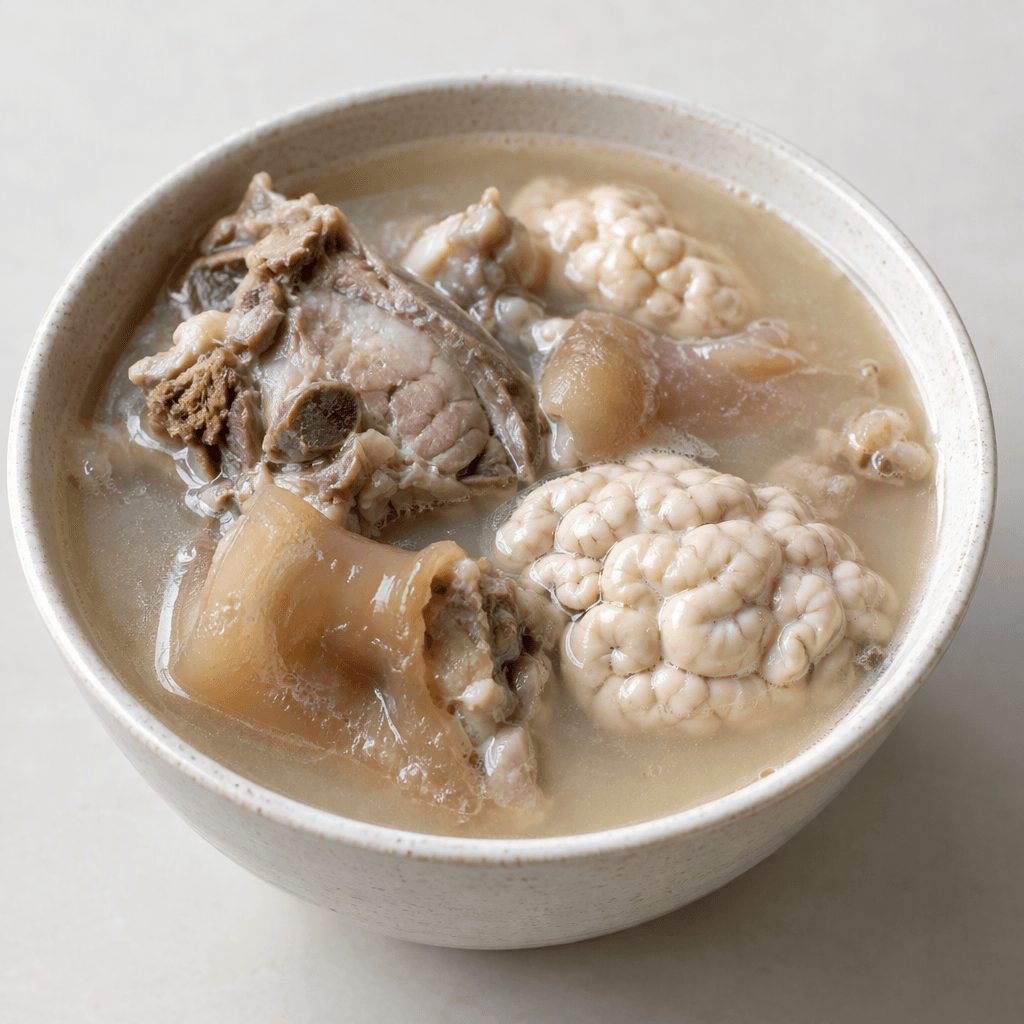
Head and trotter soup with brain Calories
Collagen-rich offal soup with brain, protein and minerals
In season: Spring · Summer · Autumn · Winter
CALORIES · 100 G
GI
POTASSIUM · 100 G
FIBER · 100 G
Quick answer
1 bottle (medium) of Head and trotter soup with brain (250 g) has 230 calories. That works out to 92 calories per 100 g. It contains 4 g of carbs, 21.8 g of protein, 14.5 g of fat and 0 g of fiber. Its 6 µg of B12 covers 250% of the Daily Value. Its glycemic index is 5 (low), so it raises blood sugar slowly.
Head and trotter soup with brain Nutrition Facts
Selected: 1 bottle (medium) · 250 g
230
KCAL / 250G
Carbs
4g
· 1% DV
Protein
21.8g
· 44% DV
Fat
14.5g
· 19% DV
Fiber
0g
· 0% DV
DV is the share of the daily value covered, on a 2,000 kcal reference diet.
Calories come from: Carbs 7% · Protein 37% · Fat 56%
Head and trotter soup with brain nutrition facts table · 1 bottle (medium) (250 g)
| Nutrient | Amount | % DV |
|---|---|---|
| Calories | 230 kcal | |
| Total fat | 14.5 g | 19% |
| Saturated fat | 4.75 g | 24% |
| Trans fat | 0.13 g | |
| Sodium | 800 mg | 35% |
| Total carbohydrate | 4 g | 1% |
| Fiber | 0 g | 0% |
| Protein | 21.8 g | 44% |
Calories: Calories measure energy. Average daily need is 2,000 kcal. Excess calories are stored as fat, too few cause weight loss.
Carbs: Your body's primary energy source. The brain runs exclusively on carbs. Daily need: 275g.
Protein: Essential for muscle repair and cell growth. Daily need: 50g. Keeps you full and boosts metabolism.
Fat: Needed for hormone production and vitamin absorption. Daily need: 78g. Limit saturated fats, choose unsaturated.
Fiber: Critical for digestive health and satiety. Daily need: 28g. Stabilizes blood sugar, lowers cholesterol.

Log this food in EatBetter
100,000+ people use it
- Get your daily calorie target
- Snap your meal, log it in seconds
- See every vitamin and mineral

📸 Scan the code to get the app free.

How Many Calories in 1 Bottle of Head and trotter soup with brain?
| Serving | Amount | Calories |
|---|---|---|
| 1 bottle (medium) | 250 g | 230 kcal |
| 1 tablespoon (whole) | 15 g | 14 kcal |
| 1 piece (small) | 35 g | 32 kcal |
| 100 g | 100 g | 92 kcal |
| 1 cup (small) | 180 g | 166 kcal |
| 1 cup (medium) | 250 g | 230 kcal |
| 1 serving (large) | 300 g | 276 kcal |
| 1 bottle (large) | 400 g | 368 kcal |
| 1 bottle (extra large) | 500 g | 460 kcal |
Calculated from 92 calories per 100 g.
Frequently Asked Questions About Head and trotter soup with brain
What is head and trotter soup with brain?
Head and trotter soup with brain is a traditional offal soup made by slowly cooking an animal’s head and feet, then adding brain. Recipes vary, but the long-cooked meat and connective tissue give the broth a rich, gelatinous texture.
What cuts are used in head and trotter soup with brain?
Head and trotter soup with brain is made with parts of the head and feet, such as meat, skin, and connective tissue, plus brain. The exact cuts depend on the butcher and regional recipe; it is not the same as tripe soup.
How is head and trotter soup with brain traditionally cooked?
Head and trotter soup with brain is traditionally simmered slowly until the meat softens and separates from the bones. The broth is strained and combined with the picked meat, while the brain is added near the end or cooked separately before serving.
What does head and trotter soup with brain taste like?
Head and trotter soup with brain has a rich, savory, meaty flavor and a broth that can feel gelatinous from the slowly cooked connective tissue. The brain is soft and mild-tasting; garlic, vinegar, or lemon often add brightness.
How do you serve head and trotter soup with brain?
Head and trotter soup with brain is served hot, often with garlic vinegar, lemon, or chili on the side. Add the sharp, acidic condiments to your bowl to balance the broth’s richness, rather than seasoning the whole pot if serving a group.
Is the brain in head and trotter soup with brain safe to eat?
Yes, when it comes from a properly inspected source and is thoroughly cooked. Buy brain and other offal from a reputable supplier, keep them refrigerated before cooking, and avoid eating brain that is raw, undercooked, or has been stored improperly.
Does head and trotter soup with brain contain collagen?
Yes, the head and feet can contribute collagen from skin, cartilage, and connective tissue to the broth, especially after prolonged cooking. The amount varies by recipe and the parts used, so the soup should not be treated as a measured collagen supplement.
Can you freeze head and trotter soup with brain?
Yes. Cool head and trotter soup with brain promptly, divide it into airtight meal-sized containers, and freeze. Thaw it in the refrigerator and reheat it thoroughly; freezing can slightly change the texture of the broth and brain.
How long does head and trotter soup with brain last in the refrigerator?
Head and trotter soup with brain keeps for about 3–4 days in a covered container in the refrigerator when cooled promptly after cooking. Reheat only the portion you plan to eat, and discard it if it was left at room temperature for too long.
How is head and trotter soup with brain different from tripe soup?
Head and trotter soup with brain uses parts of the head and feet, sometimes with brain, while tripe soup is made primarily from the stomach lining. Their textures and flavors differ: tripe is distinctly chewy, while head-and-trotter broth is often gelatinous.
Head and trotter soup with brain Vitamins & Minerals
Vitamins
B12
6µg · 250% DV
B3
5.25mg · 33% DV
B2
0.4mg · 31% DV
B5
1.38mg · 28% DV
Minerals
Selenium
25µg · 45% DV
Sodium
800mg · 35% DV
Phosphorus
205mg · 29% DV
Zinc
2.75mg · 25% DV
Potassium ⭐
363mg · 11% DV
Head and trotter soup with brain Glycemic Index
GLYCEMIC INDEX
GLYCEMIC LOAD
Accounts for portion size — a more realistic measure than GI alone.
How to Burn Off Head and trotter soup with brain
To burn the 230 calories in 1 bottle (medium) (250 g):
🚶
Walking (5 km/h)
🏃
Running (8 km/h)
🚴
Cycling
🏊
Swimming
Times are calculated with the MET equation for a 70 kg adult. Actual burn varies with your weight, age and pace.
What is Head and trotter soup with brain?
Head and trotter soup with brain is a Turkish offal soup made by slowly simmering the head and feet until the broth is rich and gelatinous, then adding brain for a softer, silkier texture. It has a deep savoury flavour and a substantial, warming feel rather than the lightness of a clear broth.
In Turkey it is served piping hot, often with garlic vinegar, lemon or chilli on the side; you may find it at soup shops as a hearty meal, particularly in cold weather or late at night. Turkish restaurants abroad sometimes serve it in the same way. It provides protein and is relatively rich in fat, with 8.7 g of protein per 100 g. For a lighter bowl, skim off some of the surface fat and add lemon.
How Nutritious Is Head and trotter soup with brain?
Nutrient density
High
How many vitamins, minerals and how much fiber this food carries per calorie. A high score means a lot of nutrition for few calories.
Satiety score
Medium
An EatBetter score computed from fiber, protein and calorie density. A high score means staying full longer on the same calories.
Both scores are calculated per 100 g and do not change with the selected portion. The satiety score is EatBetter's own calculation, not a clinical measure.
Is Head and trotter soup with brain Processed?
NOVA 2
Minimally Processed
1. Unprocessed
2. Minimally Processed
3. Processed
4. Ultra-Processed
NOVA classifies foods into 4 groups by industrial processing. NOVA 1 (unprocessed) is the healthiest.
Does Head and trotter soup with brain Contain Allergens?
No known major allergens
Which Diets Is Head and trotter soup with brain Good For?
Vegan
— Not suitable
Vegetarian
— Not suitable
Gluten-Free
— Not suitable
Dairy-Free
— Not suitable
Mediterranean
— Not suitable
Paleo
✓ Suitable
Whole30
— Not suitable
DASH
— Not suitable
Keto
— Not suitable
Low FODMAP
— Not suitable
Head and trotter soup with brain Fat Profile
SATURATED
4.75g
MONOUNSATURATED
5.5g
POLYUNSATURATED
1.5g
Omega 6:3 ratio 5.3:1
Above the ideal 4:1 (5.3:1).
Compare Head and trotter soup with brain
Foods Similar to Head and trotter soup with brain
Have another question about Head and trotter soup with brain?
Ask the AI nutrition coach — calories, portions, alternatives and more, answered in seconds in the app.

Scan calories with your camera
Instant AI nutrition analysis

Nutrition data compiled from USDA FoodData Central and scientific sources.