

Ready & Packaged Foods
All →Vegetables & Legumes
All →Desserts & Confectionery
All →Meat & Protein
All →Grains & Bakery
All →Beverages
All →Milk & Dairy
All →

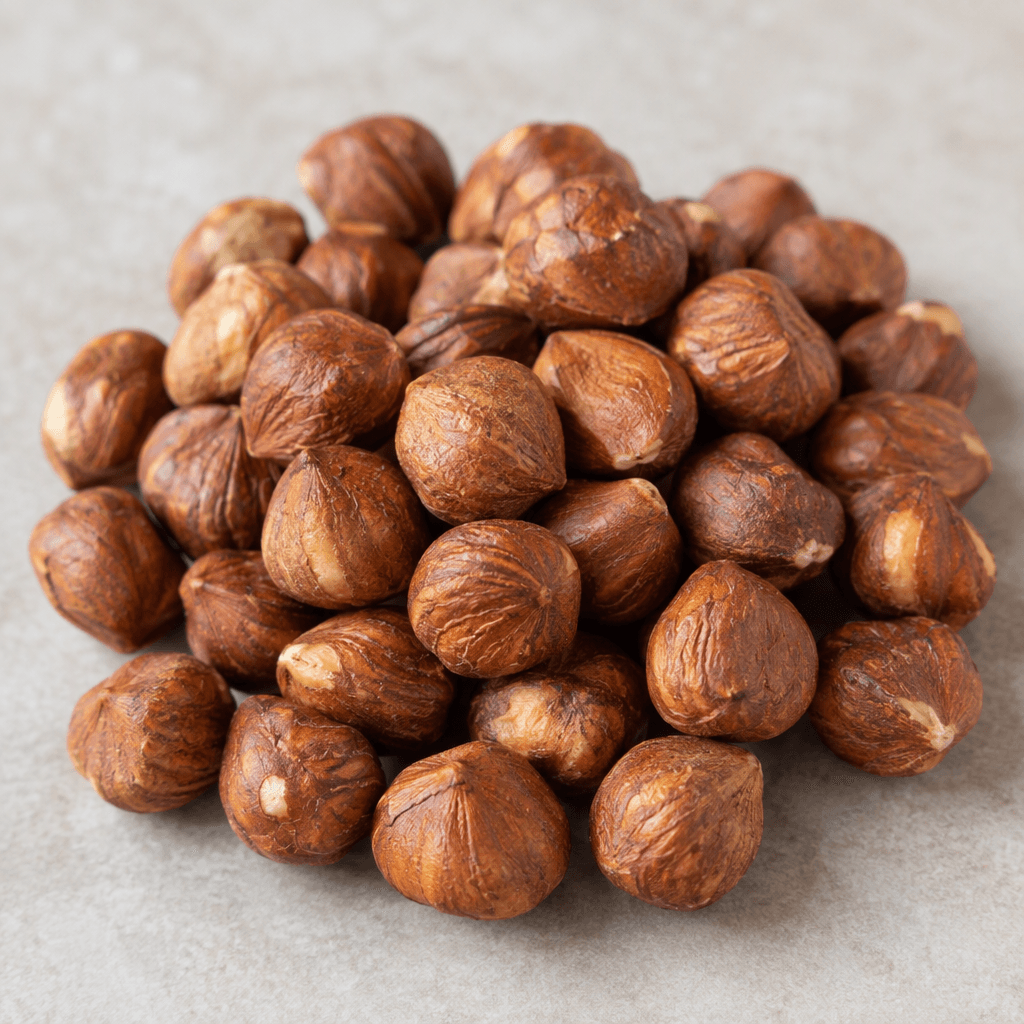
Hazelnuts, roasted, unsalted Calories
High in healthy fats, vitamin E, and fiber
In season: Autumn · Winter
CALORIES
GI
POTASSIUM
FIBER
Quick answer
1 ounce (medium) of Hazelnuts, roasted, unsalted (28 g) has 181 calories. That works out to 646 calories per 100 g. It contains 4.8 g of carbs, 4.2 g of protein, 17.6 g of fat and 2.8 g of fiber. Its 1.7 mg of Manganese covers 75% of the Daily Value. Its glycemic index is 15 (low), so it raises blood sugar slowly.
What is Hazelnuts, roasted, unsalted?
Roasted, unsalted hazelnuts are the kernels of hazel trees, dry-roasted without added salt. They are grown widely around the Black Sea, including in Turkey, and are also familiar in European and other cuisines. You can eat them by the handful or use them in baking, chocolate, sauces and breakfast mixes.
Roasting brings out their fragrant, toasty flavour, while the kernels stay crisp. They make an easy snack, and are often chopped over porridge or folded into cakes and cookies. Hazelnuts are rich in fats and fibre, and are energy-dense: 100 g provides 63 g of fat. Their lack of added salt makes them handy when you want to control salt in a snack; pair a small handful with fresh fruit or yoghurt.
Hazelnuts, roasted, unsalted Nutrition Facts
Selected: 100 g
646
KCAL / 100G
Carbs
17g
· 6% DV
Protein
15g
· 30% DV
Fat
63g
· 81% DV
Fiber
10g
· 36% DV
DV is the share of the daily value covered, on a 2,000 kcal reference diet.
Calories come from: Carbs 10% · Protein 9% · Fat 81%
Hazelnuts, roasted, unsalted Vitamins & Minerals
Vitamins
Vitamin E
15mg · 100% DV
Biotin
20µg · 67% DV
B6
0.6mg · 35% DV
Folate
113µg · 28% DV
Minerals
Manganese
6mg · 261% DV
Copper
2mg · 222% DV
Phosphorus
290mg · 41% DV
Magnesium
163mg · 39% DV
How Nutritious Is Hazelnuts, roasted, unsalted?
Nutrient density
Very high
How many vitamins, minerals and how much fiber this food carries per calorie. A high score means a lot of nutrition for few calories.
Satiety score
Medium
An EatBetter score computed from fiber, protein and calorie density. A high score means staying full longer on the same calories.
Both scores are calculated per 100 g and do not change with the selected portion. The satiety score is EatBetter's own calculation, not a clinical measure.
Hazelnuts, roasted, unsalted Glycemic Index
GLYCEMIC INDEX
GLYCEMIC LOAD
Accounts for portion size — a more realistic measure than GI alone.
How to Burn Off Hazelnuts, roasted, unsalted
To burn the 646 calories in 100 g:
🚶
Walking (5 km/h)
🏃
Running (8 km/h)
🚴
Cycling
🏊
Swimming
Times are calculated with the MET equation for a 70 kg adult. Actual burn varies with your weight, age and pace.
Is Hazelnuts, roasted, unsalted Processed?
NOVA 2
Minimally Processed
1. Unprocessed
2. Minimally Processed
3. Processed
4. Ultra-Processed
NOVA classifies foods into 4 groups by industrial processing. NOVA 1 (unprocessed) is the healthiest.
Does Hazelnuts, roasted, unsalted Contain Allergens?
Contains these allergens:
Which Diets Is Hazelnuts, roasted, unsalted Good For?
Vegan
✓ Suitable
Vegetarian
✓ Suitable
Gluten-Free
✓ Suitable
Dairy-Free
— Not suitable
Mediterranean
✓ Suitable
Paleo
✓ Suitable
Whole30
— Not suitable
DASH
— Not suitable
Keto
✓ Suitable
Low FODMAP
— Not suitable
Hazelnuts, roasted, unsalted Fat Profile
SATURATED
4.5g
MONOUNSATURATED
46.6g
POLYUNSATURATED
7.9g
Omega 6:3 ratio 97.5:1
Above the ideal 4:1 (97.5:1).
Compare Hazelnuts, roasted, unsalted
Foods Similar to Hazelnuts, roasted, unsalted
Frequently Asked Questions About Hazelnuts, roasted, unsalted
Are roasted unsalted hazelnuts good for you?
Yes, roasted unsalted hazelnuts provide vitamin E, fiber, and mostly unsaturated fats. They make a nourishing snack, but their energy density means a small, measured portion is more practical than eating straight from a large container.
Do roasted unsalted hazelnuts cause weight gain?
Roasted unsalted hazelnuts do not cause weight gain on their own, but portions can add up quickly because they are energy-dense. Pre-portioning a small handful can help you enjoy them without mindless snacking.
How should you store roasted unsalted hazelnuts?
Store roasted unsalted hazelnuts in an airtight container in a cool, dry, dark place. Heat, light, and air can make their natural oils turn rancid, so refrigerate them if your kitchen is warm or you need to keep them longer.
Can you freeze roasted unsalted hazelnuts?
Yes, roasted unsalted hazelnuts freeze well. Seal them in an airtight freezer-safe bag or container, then thaw only the amount you need at room temperature; keeping them protected from moisture helps preserve their crisp texture.
Can you eat the skins on roasted unsalted hazelnuts?
Yes, the thin brown skins on roasted unsalted hazelnuts are edible. They can taste slightly bitter, so rub them off in a clean towel after roasting if you want a milder flavor for baking or making hazelnut butter.
How do you roast hazelnuts at home?
Roast hazelnuts in a single layer in the oven or in a dry skillet over medium heat, stirring often. Take them off the heat when fragrant and lightly browned, then cool before storing so trapped warmth does not soften them.
Are roasted unsalted hazelnuts better than raw hazelnuts?
Neither is universally better: roasting gives hazelnuts a deeper flavor and crunch, while raw hazelnuts have a milder taste. Roasting can reduce some heat-sensitive nutrients, so choose based on flavor and how you plan to use them.
How can you use roasted unsalted hazelnuts in recipes?
Roasted unsalted hazelnuts work well chopped over oatmeal, salads, and roasted vegetables, or blended into nut butter and sauces. Their toasted flavor also pairs with chocolate, pears, and coffee in desserts.
How can you tell if roasted unsalted hazelnuts have gone rancid?
Rancid roasted unsalted hazelnuts may smell sour, stale, or like paint, and can taste bitter or unpleasant. Fresh ones smell pleasantly toasted; discard them if their odor or flavor seems off rather than trying to mask it in a recipe.
Can people with diabetes eat roasted unsalted hazelnuts?
Roasted unsalted hazelnuts can fit into many diabetes-friendly eating patterns as a small snack, but portion size and what you eat alongside them matter. If you use glucose-lowering medication or need individualized meal guidance, ask your clinician or dietitian.
Have another question about Hazelnuts, roasted, unsalted?
Ask the AI nutrition coach — calories, portions, alternatives and more, answered in seconds in the app.

Scan calories with your camera
Instant AI nutrition analysis

Nutrition data compiled from USDA FoodData Central and scientific sources.