

Ready & Packaged Foods
All →Vegetables & Legumes
All →Desserts & Confectionery
All →Meat & Protein
All →Grains & Bakery
All →Beverages
All →Milk & Dairy
All →

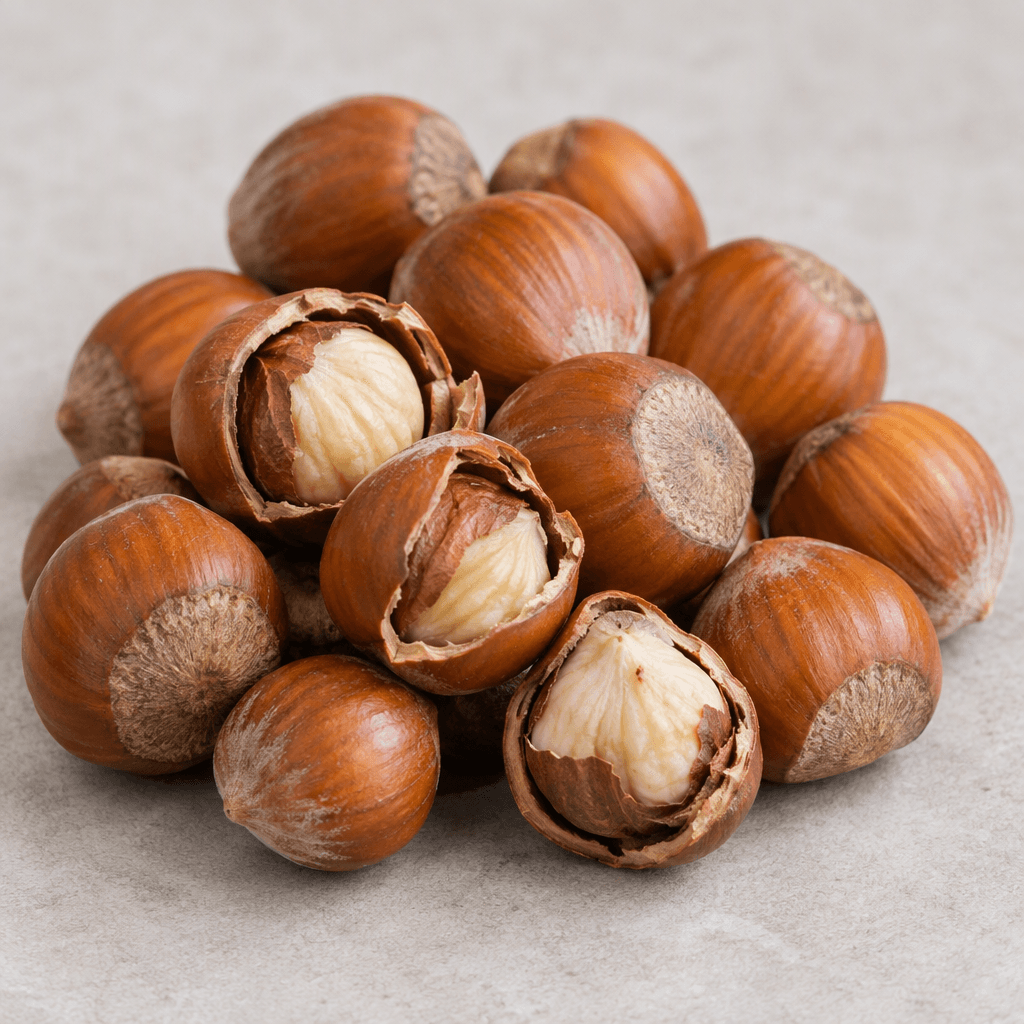
Hazelnut Calories
Healthy fats, vitamin E, magnesium, fiber
In season: Autumn
CALORIES
GI
POTASSIUM
FIBER
Quick answer
1 ounce (medium) of Hazelnut (28 g) has 176 calories. That works out to 628 calories per 100 g. It contains 4.8 g of carbs, 4.2 g of protein, 17.1 g of fat and 2.8 g of fiber. Its 1.7 mg of Manganese covers 75% of the Daily Value. Its glycemic index is 15 (low), so it raises blood sugar slowly.
What is Hazelnut?
Hazelnuts are the edible kernels of hazel trees, commonly grown around the Black Sea as well as in parts of Europe and western Asia. Their firm, mildly sweet flesh is often eaten raw or roasted; roasting brings out a deeper, toastier flavour. They’re familiar in chocolate and praline, but also work well in everyday cooking, scattered over porridge, yoghurt or salads, or folded into cakes and biscuits.
Hazelnuts are rich in fats and fibre and provide plant protein, making them a satisfying snack or a useful addition to meals. For a simple option, pair a small handful with fruit, or use chopped nuts to add crunch to breakfast. Their concentrated energy makes modest portions easy to enjoy.
Hazelnut Nutrition Facts
Selected: 100 g
628
KCAL / 100G
Carbs
17g
· 6% DV
Protein
15g
· 30% DV
Fat
61g
· 78% DV
Fiber
10g
· 36% DV
DV is the share of the daily value covered, on a 2,000 kcal reference diet.
Calories come from: Carbs 10% · Protein 9% · Fat 81%
Hazelnut Vitamins & Minerals
Vitamins
Vitamin E
15mg · 100% DV
Biotin
20µg · 67% DV
B6
0.6mg · 35% DV
Folate
113µg · 28% DV
Minerals
Manganese
6mg · 261% DV
Copper
2mg · 222% DV
Phosphorus
290mg · 41% DV
Magnesium
163mg · 39% DV
How Nutritious Is Hazelnut?
Nutrient density
Very high
How many vitamins, minerals and how much fiber this food carries per calorie. A high score means a lot of nutrition for few calories.
Satiety score
Medium
An EatBetter score computed from fiber, protein and calorie density. A high score means staying full longer on the same calories.
Both scores are calculated per 100 g and do not change with the selected portion. The satiety score is EatBetter's own calculation, not a clinical measure.
Hazelnut Glycemic Index
GLYCEMIC INDEX
GLYCEMIC LOAD
Accounts for portion size — a more realistic measure than GI alone.
How to Burn Off Hazelnut
To burn the 628 calories in 100 g:
🚶
Walking (5 km/h)
🏃
Running (8 km/h)
🚴
Cycling
🏊
Swimming
Times are calculated with the MET equation for a 70 kg adult. Actual burn varies with your weight, age and pace.
Is Hazelnut Processed?
NOVA 1
Unprocessed
1. Unprocessed
2. Minimally Processed
3. Processed
4. Ultra-Processed
NOVA classifies foods into 4 groups by industrial processing. NOVA 1 (unprocessed) is the healthiest.
Does Hazelnut Contain Allergens?
Contains these allergens:
Which Diets Is Hazelnut Good For?
Vegan
✓ Suitable
Vegetarian
✓ Suitable
Gluten-Free
✓ Suitable
Dairy-Free
— Not suitable
Mediterranean
✓ Suitable
Paleo
✓ Suitable
Whole30
— Not suitable
DASH
— Not suitable
Keto
✓ Suitable
Low FODMAP
— Not suitable
Hazelnut Fat Profile
SATURATED
4.5g
MONOUNSATURATED
46g
POLYUNSATURATED
7.8g
Omega 6:3 ratio 86.7:1
Above the ideal 4:1 (86.7:1).
Compare Hazelnut
Foods Similar to Hazelnut
Frequently Asked Questions About Hazelnut
How do you roast hazelnuts at home?
Spread hazelnuts in a single layer on a baking sheet and roast them in a preheated oven, stirring occasionally. Take them out when they smell fragrant and their skins begin to darken; let them cool before storing.
How do you remove the skins from hazelnuts?
Roast the hazelnuts, then wrap them in a clean kitchen towel and rub them together. Most of the papery skins will loosen and come off; a few remaining patches are harmless and edible.
How should you store hazelnuts?
Keep hazelnuts in an airtight container in a cool, dry, dark place. Shelled nuts are more exposed to air and warmth, so refrigerate them if you want to keep them fresh for longer.
Can you freeze hazelnuts?
Yes, hazelnuts freeze well. Seal them in an airtight freezer-safe container to protect them from moisture and odors, and take out only what you need; avoid repeatedly thawing and refreezing the same batch.
Can you eat raw hazelnuts?
Yes, raw hazelnuts can be eaten as they are. Roasting is mainly a way to deepen their flavor and make them crunchier, not a required step before eating.
How do you make hazelnut butter?
Blend hazelnuts in a food processor until they turn into a smooth, spreadable butter. Pause occasionally to scrape down the sides; roasting the nuts first can make the flavor more pronounced.
What is the difference between a hazelnut and a filbert?
The names are often used for the same kind of nut, though “filbert” can refer to particular cultivated varieties. In everyday recipes, hazelnuts and filberts are generally interchangeable.
Where do hazelnuts grow?
Hazelnuts grow on hazel trees and shrubs in temperate regions. Turkey is a major producer, and the nuts are also grown in countries including Italy, the United States, and Spain.
Are hazelnuts healthy to eat?
Yes, hazelnuts can be a nutritious part of meals and snacks. They provide unsaturated fats, fiber, vitamin E, and magnesium; choose plain nuts more often than versions coated with added sugar or salt.
Can dogs eat hazelnuts?
Hazelnuts are not considered toxic to dogs, but they are a poor treat choice: whole nuts can cause choking, and large amounts may upset a dog’s stomach. Avoid salted, chocolate-covered, or otherwise coated hazelnuts.
Have another question about Hazelnut?
Ask the AI nutrition coach — calories, portions, alternatives and more, answered in seconds in the app.

Scan calories with your camera
Instant AI nutrition analysis

Nutrition data compiled from USDA FoodData Central and scientific sources.