

Ready & Packaged Foods
All →Vegetables & Legumes
All →Desserts & Confectionery
All →Meat & Protein
All →Grains & Bakery
All →Beverages
All →Milk & Dairy
All →

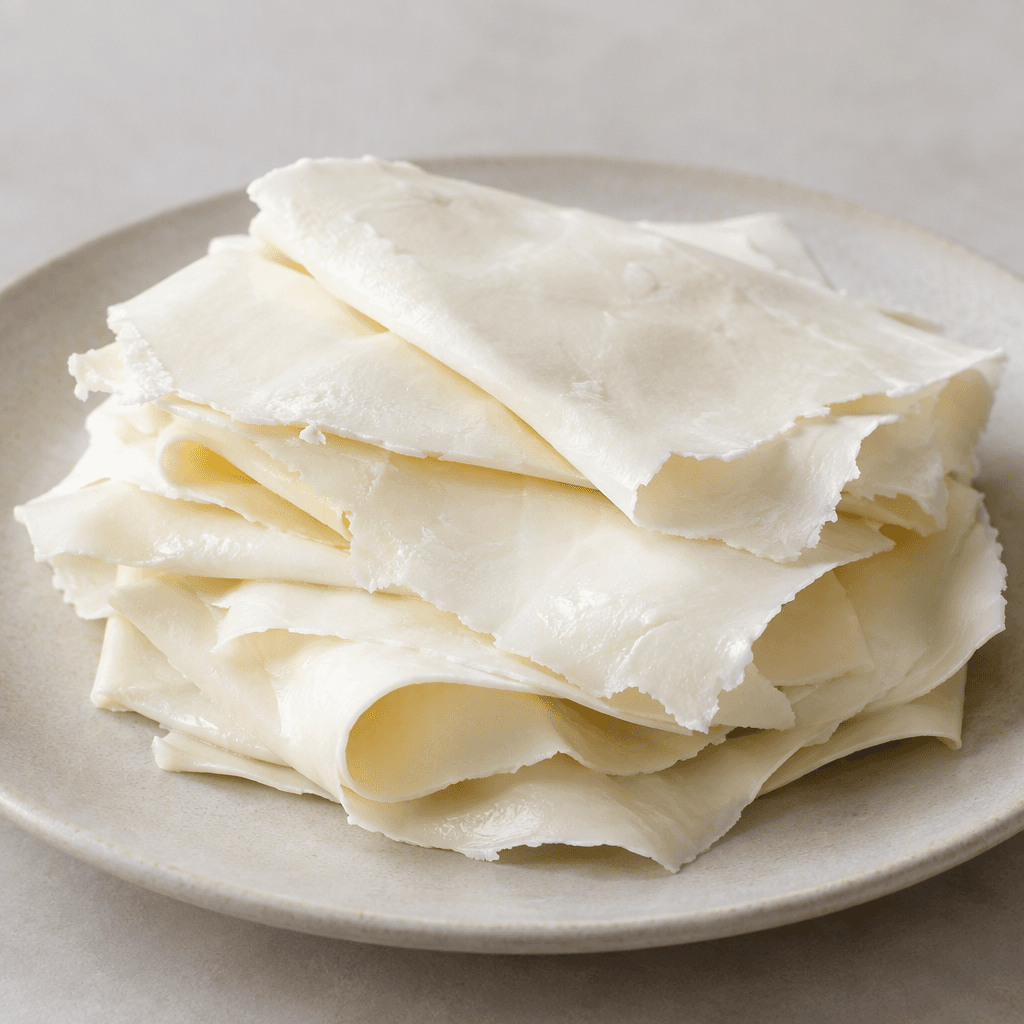
Hatay lavaş cheese Calories
Salty, semi-hard, traditional Hatay cheese
In season: Spring · Summer · Autumn · Winter
CALORIES
GI
POTASSIUM
FIBER
Quick answer
1 slice (medium) of Hatay lavaş cheese (30 g) has 96 calories. That works out to 320 calories per 100 g. It contains 0.6 g of carbs, 6 g of protein, 7.8 g of fat and 0 g of fiber. Its 210 mg of Calcium covers 21% of the Daily Value. Its glycemic index is 0 (low), so it raises blood sugar slowly.
What is Hatay lavaş cheese?
Hatay lavaş cheese is a traditional salty, semi-hard cheese from Hatay in southern Turkey. It is shaped into thin, soft sheets that fold into loose layers, with a slightly moist surface and a texture that is tender rather than crumbly.
In Hatay, it is commonly served at breakfast with bread, olives, tomatoes and herbs; the thin sheets also work well folded into sandwiches or used in pastries. Its savoury saltiness means a little goes a long way. It provides protein as well as substantial fat, so pair a modest portion with fresh vegetables or other unsalted foods for a more balanced plate.
Hatay lavaş cheese Nutrition Facts
Selected: 100 g
320
KCAL / 100G
Carbs
2g
· 1% DV
Protein
20g
· 40% DV
Fat
26g
· 33% DV
Fiber
0g
· 0% DV
DV is the share of the daily value covered, on a 2,000 kcal reference diet.
Calories come from: Carbs 2% · Protein 25% · Fat 73%
Hatay lavaş cheese Vitamins & Minerals
Vitamins
B12
1.2µg · 50% DV
Vitamin A
270µg · 30% DV
B2
0.35mg · 27% DV
B5
0.4mg · 8% DV
Minerals
Calcium
700mg · 70% DV
Phosphorus
420mg · 60% DV
Sodium
1200mg · 52% DV
Zinc
3mg · 27% DV
How Nutritious Is Hatay lavaş cheese?
Nutrient density
Medium
How many vitamins, minerals and how much fiber this food carries per calorie. A high score means a lot of nutrition for few calories.
Satiety score
Medium
An EatBetter score computed from fiber, protein and calorie density. A high score means staying full longer on the same calories.
Both scores are calculated per 100 g and do not change with the selected portion. The satiety score is EatBetter's own calculation, not a clinical measure.
Hatay lavaş cheese Glycemic Index
GLYCEMIC INDEX
GLYCEMIC LOAD
Accounts for portion size — a more realistic measure than GI alone.
How to Burn Off Hatay lavaş cheese
To burn the 320 calories in 100 g:
🚶
Walking (5 km/h)
🏃
Running (8 km/h)
🚴
Cycling
🏊
Swimming
Times are calculated with the MET equation for a 70 kg adult. Actual burn varies with your weight, age and pace.
Is Hatay lavaş cheese Processed?
NOVA 2
Minimally Processed
1. Unprocessed
2. Minimally Processed
3. Processed
4. Ultra-Processed
NOVA classifies foods into 4 groups by industrial processing. NOVA 1 (unprocessed) is the healthiest.
Does Hatay lavaş cheese Contain Allergens?
Contains these allergens:
Which Diets Is Hatay lavaş cheese Good For?
Vegan
— Not suitable
Vegetarian
✓ Suitable
Gluten-Free
— Not suitable
Dairy-Free
— Not suitable
Mediterranean
✓ Suitable
Paleo
— Not suitable
Whole30
— Not suitable
DASH
— Not suitable
Keto
— Not suitable
Low FODMAP
— Not suitable
Hatay lavaş cheese Fat Profile
SATURATED
16g
MONOUNSATURATED
7g
POLYUNSATURATED
0.4g
Omega 6:3 ratio 3.1:1
Below the ideal 4:1 — a good omega balance.
Compare Hatay lavaş cheese
Foods Similar to Hatay lavaş cheese
Frequently Asked Questions About Hatay lavaş cheese
What is Hatay lavaş cheese?
Hatay lavaş cheese is a traditional salty, semi-hard cheese from Hatay, Turkey, formed into thin, soft layers. Despite the word “lavaş” in its name, it is cheese, not lavash flatbread.
How do you eat Hatay lavaş cheese?
Hatay lavaş cheese is commonly eaten as it is, with bread and fresh breakfast foods, or added to cooked dishes. Its thin layers can be peeled apart or folded, and its salty flavor often needs no extra seasoning.
Is Hatay lavaş cheese the same as künefe cheese?
No, Hatay lavaş cheese is not automatically the same as künefe cheese. Lavaş cheese is salty and layered, while cheese intended for künefe is usually less salty and chosen for its stretchy texture when heated.
Does Hatay lavaş cheese melt well?
Hatay lavaş cheese softens when heated, but it may not melt into the smooth, stretchy layer expected from mozzarella or künefe cheese. Its thin sheets can separate, so it works best folded into a dish rather than used as a uniform melting cheese.
How can you make Hatay lavaş cheese less salty?
To reduce the salt in Hatay lavaş cheese, soak a portion briefly in cold water and taste it. Replace the water and continue only if needed; a long soak can weaken the cheese’s flavor and texture.
How should Hatay lavaş cheese be stored?
Keep Hatay lavaş cheese refrigerated in a sealed container. If it was sold in brine, store it in that brine; take out only what you plan to eat and avoid leaving the cheese at room temperature for extended periods.
Can Hatay lavaş cheese be used in künefe?
Hatay lavaş cheese can be used in künefe, but it may not give the same stretchy result as cheese made for künefe. Because it is salty, taste it first and soak it briefly if necessary before layering it into the dessert.
Can you freeze Hatay lavaş cheese?
Yes, Hatay lavaş cheese can be frozen, but thawing may make its thin layers more fragile or crumbly. Use thawed cheese in cooked dishes where texture matters less, rather than expecting it to look and feel freshly sliced.
Can Hatay lavaş cheese be used in a toastie or grilled sandwich?
Yes, Hatay lavaş cheese can go in a toastie or grilled sandwich. It softens with heat, though it may not stretch like mozzarella; pair it with ingredients that balance its salty flavor and avoid adding extra salt.
Is Hatay lavaş cheese suitable for people with high blood pressure?
People with high blood pressure should be mindful of Hatay lavaş cheese because it is salty. If you have been advised to limit sodium, ask your doctor or dietitian how it can fit into your eating plan.
Have another question about Hatay lavaş cheese?
Ask the AI nutrition coach — calories, portions, alternatives and more, answered in seconds in the app.

Scan calories with your camera
Instant AI nutrition analysis

Nutrition data compiled from USDA FoodData Central and scientific sources.