

Ready & Packaged Foods
All →Vegetables & Legumes
All →Desserts & Confectionery
All →Meat & Protein
All →Grains & Bakery
All →Beverages
All →Milk & Dairy
All →

Haribo Candy Calories
Colorful, chewy, gelatin-based candy
In season: Spring · Summer · Autumn · Winter
CALORIES
GI
POTASSIUM
FIBER
Quick answer
10 piece (medium) of Haribo Candy (40 g) has 136 calories. That works out to 340 calories per 100 g. It contains 30.8 g of carbs, 2.6 g of protein, 0.1 g of fat and 0 g of fiber. Its glycemic index is 80 (high), so it raises blood sugar quickly.
What is Haribo Candy?
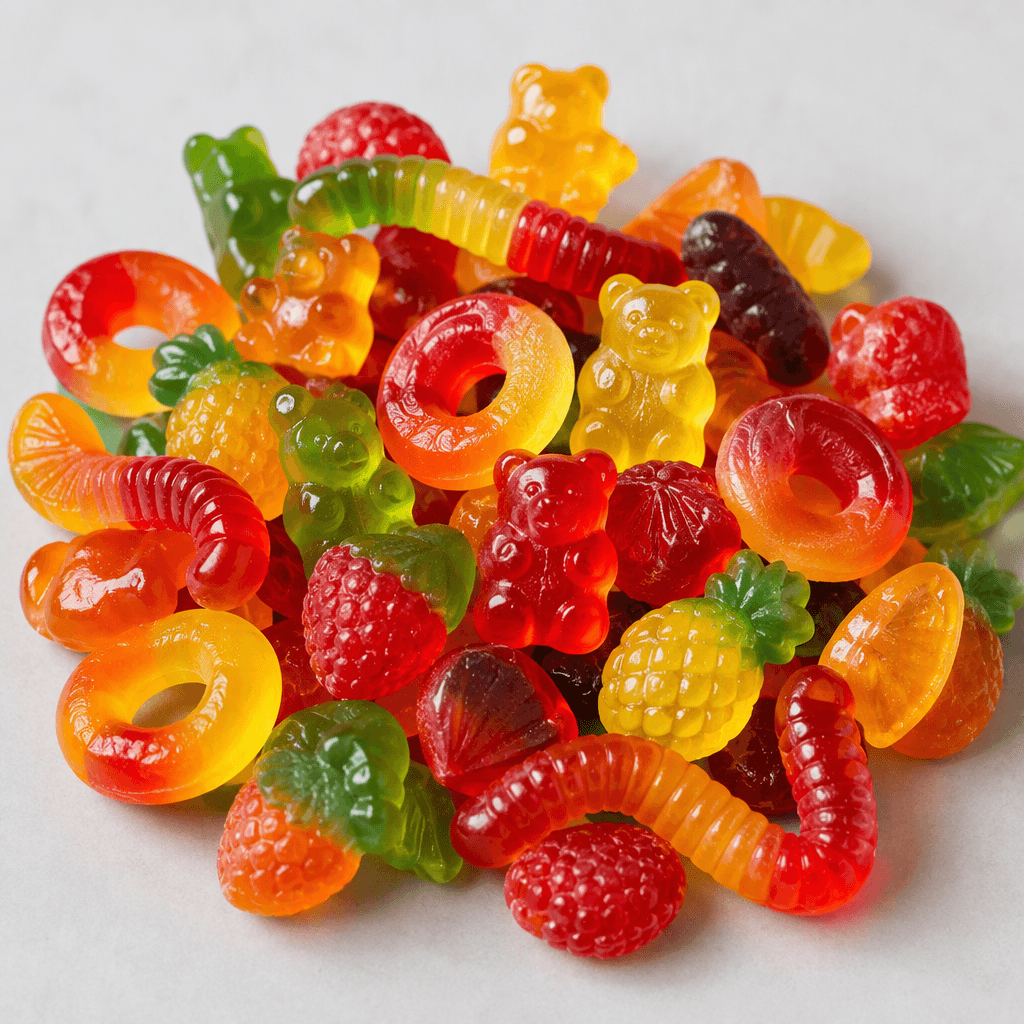
Haribo Candy refers to the German confectionery maker’s colourful, chewy sweets, often sold in shapes such as bears, worms, rings and fruit. The assortment pictured is typically fruit-flavoured and gelatin-based, with a springy bite and a shiny, soft surface.
People snack on them straight from the bag, share them at gatherings or add a few to a lunchbox; they are also an easy sweet to keep on hand for a film night. Their flavour is distinctly sweet, and the texture is more yielding than hard candy but chewier than a soft jelly dessert. They are mostly carbohydrate, with very little fat. For a less sugary-feeling snack, enjoy a small handful alongside fresh fruit rather than making them the whole snack.
Haribo Candy Nutrition Facts
Selected: 100 g
340
KCAL / 100G
Carbs
77g
· 28% DV
Protein
6.5g
· 13% DV
Fat
0.2g
· 0% DV
Fiber
0g
· 0% DV
DV is the share of the daily value covered, on a 2,000 kcal reference diet.
Calories come from: Carbs 92% · Protein 8% · Fat 0%
Haribo Candy Vitamins & Minerals
Vitamins
Vitamin A
0µg · 0% DV
B1
0mg · 0% DV
B2
0mg · 0% DV
B3
0mg · 0% DV
Minerals
Sodium
50mg · 2% DV
Calcium
10mg · 1% DV
Phosphorus
10mg · 1% DV
Iron
0mg · 0% DV
How Nutritious Is Haribo Candy?
Nutrient density
Low
How many vitamins, minerals and how much fiber this food carries per calorie. A high score means a lot of nutrition for few calories.
Satiety score
Low
An EatBetter score computed from fiber, protein and calorie density. A high score means staying full longer on the same calories.
Both scores are calculated per 100 g and do not change with the selected portion. The satiety score is EatBetter's own calculation, not a clinical measure.
Haribo Candy Glycemic Index
GLYCEMIC INDEX
GLYCEMIC LOAD
Accounts for portion size — a more realistic measure than GI alone.
How to Burn Off Haribo Candy
To burn the 340 calories in 100 g:
🚶
Walking (5 km/h)
🏃
Running (8 km/h)
🚴
Cycling
🏊
Swimming
Times are calculated with the MET equation for a 70 kg adult. Actual burn varies with your weight, age and pace.
Is Haribo Candy Processed?
NOVA 4
Ultra-Processed
1. Unprocessed
2. Minimally Processed
3. Processed
4. Ultra-Processed
NOVA classifies foods into 4 groups by industrial processing. NOVA 1 (unprocessed) is the healthiest.
Does Haribo Candy Contain Allergens?
Contains these allergens:
Which Diets Is Haribo Candy Good For?
Vegan
— Not suitable
Vegetarian
— Not suitable
Gluten-Free
— Not suitable
Dairy-Free
— Not suitable
Mediterranean
— Not suitable
Paleo
— Not suitable
Whole30
— Not suitable
DASH
— Not suitable
Keto
— Not suitable
Low FODMAP
— Not suitable
Haribo Candy Fat Profile
SATURATED
0.1g
MONOUNSATURATED
0.05g
POLYUNSATURATED
0.05g
Compare Haribo Candy
Foods Similar to Haribo Candy
Frequently Asked Questions About Haribo Candy
Is Haribo candy halal?
Some Haribo candy is halal-certified, but halal status varies by product and country. Look for a halal mark on the specific package; the brand name alone does not confirm that a product meets halal requirements.
Does Haribo candy contain pork gelatin?
Some Haribo candy uses animal gelatin, and its source can differ between products and markets. If the package does not identify the animal source, check the manufacturer’s information for that exact product.
Is Haribo candy vegan?
Most classic Haribo gummies are not vegan because they contain animal-derived gelatin. Some products are made without gelatin, so look for a clearly identified vegan variety rather than assuming all Haribo candy has the same recipe.
Why are Haribo gummy bears so chewy?
Haribo gummy bears get their springy, chewy texture from gelling ingredients, commonly gelatin. The recipe and texture can vary by product, so not every Haribo candy has the same firmness.
Does Haribo candy expire?
Yes, Haribo candy has a best-before date, and its texture and flavor can decline over time. Keep it sealed in a cool, dry place and use the date printed on the package as your guide.
Can you freeze Haribo candy?
Yes, you can freeze Haribo candy in a tightly sealed, freezer-safe bag, although freezing can make the gummies firmer. Let them return to room temperature before eating, and keep moisture out of the package.
Can Haribo candy melt in a hot car?
Yes, Haribo candy can soften, stick together, or lose its shape in a hot car. Keep the package out of direct sun and away from heat, especially during warm weather.
Are Haribo gummy bears different in the US and Europe?
Yes, recipes and ingredient choices for Haribo gummy bears can differ between markets. Flavors, sweeteners, and textures may vary, so compare the package for the country where your candy was made or sold.
Can toddlers eat Haribo candy?
Haribo candy can be a choking hazard for toddlers because gummy pieces are chewy and may be difficult to manage. Consider the child’s age and chewing ability, and supervise closely if they are eating it.
Can eating too much Haribo candy upset your stomach?
Yes, a large amount of Haribo candy may cause stomach discomfort or changes in bowel movements for some people. Its concentrated sweetness and chewy texture make frequent, large servings easy to overdo.
Have another question about Haribo Candy?
Ask the AI nutrition coach — calories, portions, alternatives and more, answered in seconds in the app.

Scan calories with your camera
Instant AI nutrition analysis

Nutrition data compiled from USDA FoodData Central and scientific sources.