

Ready & Packaged Foods
All →Vegetables & Legumes
All →Desserts & Confectionery
All →Meat & Protein
All →Grains & Bakery
All →Beverages
All →Milk & Dairy
All →

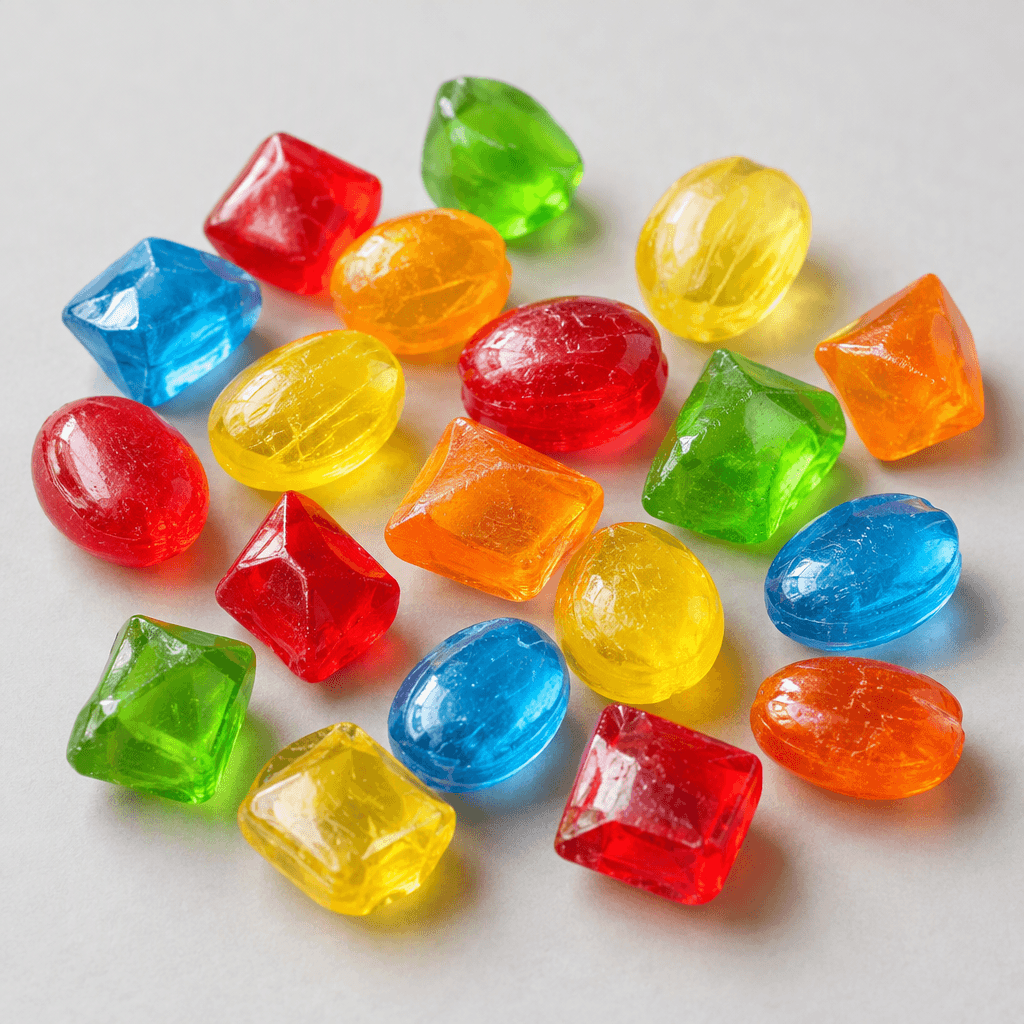
Hard candy Calories
Mostly sugar, low nutrient, high calorie sweet
CALORIES
GI
POTASSIUM
FIBER
Quick answer
1 piece (medium) of Hard candy (6 g) has 23 calories. That works out to 390 calories per 100 g. It contains 5.9 g of carbs, 0 g of protein, 0 g of fat and 0 g of fiber. Its glycemic index is 90 (high), so it raises blood sugar quickly.
What is Hard candy?
Hard candy is made by boiling sugar syrup and letting it cool into firm, glossy pieces. It is often brightly coloured and fruit-flavoured, with shapes ranging from rounded drops to small angular pieces. The name covers a familiar style of confection rather than one specific recipe.
It is usually enjoyed as an occasional sweet, slowly sucked until it dissolves, or offered from a bowl after a meal or alongside tea. Its texture is smooth and brittle, and it is mostly sugar, with little nutritional value beyond energy; a 100 g portion contains 98 g of carbohydrates. For a small treat, take one piece and pair it with unsweetened tea or coffee.
Hard candy Nutrition Facts
Selected: 100 g
390
KCAL / 100G
Carbs
98g
· 36% DV
Protein
0g
· 0% DV
Fat
0g
· 0% DV
Fiber
0g
· 0% DV
DV is the share of the daily value covered, on a 2,000 kcal reference diet.
Calories come from: Carbs 100% · Protein 0% · Fat 0%
Hard candy Vitamins & Minerals
Vitamins
Vitamin A
0µg · 0% DV
B1
0mg · 0% DV
B2
0mg · 0% DV
B3
0mg · 0% DV
Minerals
Calcium
1mg · 0% DV
Iron
0mg · 0% DV
Magnesium
0mg · 0% DV
Zinc
0mg · 0% DV
How Nutritious Is Hard candy?
Nutrient density
Low
How many vitamins, minerals and how much fiber this food carries per calorie. A high score means a lot of nutrition for few calories.
Satiety score
Low
An EatBetter score computed from fiber, protein and calorie density. A high score means staying full longer on the same calories.
Both scores are calculated per 100 g and do not change with the selected portion. The satiety score is EatBetter's own calculation, not a clinical measure.
Hard candy Glycemic Index
GLYCEMIC INDEX
GLYCEMIC LOAD
Accounts for portion size — a more realistic measure than GI alone.
How to Burn Off Hard candy
To burn the 390 calories in 100 g:
🚶
Walking (5 km/h)
🏃
Running (8 km/h)
🚴
Cycling
🏊
Swimming
Times are calculated with the MET equation for a 70 kg adult. Actual burn varies with your weight, age and pace.
Is Hard candy Processed?
NOVA 4
Ultra-Processed
1. Unprocessed
2. Minimally Processed
3. Processed
4. Ultra-Processed
NOVA classifies foods into 4 groups by industrial processing. NOVA 1 (unprocessed) is the healthiest.
Does Hard candy Contain Allergens?
No known major allergens
Which Diets Is Hard candy Good For?
Vegan
✓ Suitable
Vegetarian
✓ Suitable
Gluten-Free
— Not suitable
Dairy-Free
— Not suitable
Mediterranean
— Not suitable
Paleo
— Not suitable
Whole30
— Not suitable
DASH
— Not suitable
Keto
— Not suitable
Low FODMAP
— Not suitable
Hard candy Fat Profile
SATURATED
0g
MONOUNSATURATED
0g
POLYUNSATURATED
0g
Compare Hard candy
Foods Similar to Hard candy
Frequently Asked Questions About Hard candy
What is hard candy made of?
Hard candy is made mainly from sugar and water; commercial recipes may also use glucose or corn syrup to control texture, plus flavourings and colours. Ingredients vary between brands and flavours.
How is hard candy made?
Hard candy is made by boiling sugar syrup until it reaches a hard, glassy consistency, then adding flavour and colour and letting it cool in moulds. Hot syrup can cause severe burns, so home cooks should handle it carefully.
Why does hard candy crystallize?
Hard candy crystallizes when sugar crystals form in the syrup and spread through it instead of cooling into a smooth, clear candy. For homemade batches, avoid stirring after the sugar dissolves and wash any sugar crystals from the pan sides.
Why does hard candy get sticky?
Hard candy gets sticky when it absorbs moisture from humid air. Keep pieces in an airtight container in a cool, dry place, and avoid leaving them exposed on a counter or storing them somewhere damp.
How should you store hard candy, and does it go bad?
Store hard candy in a sealed container in a cool, dry place. Moisture can make it sticky and affect its texture; discard pieces if they develop an unusual smell or show signs of contamination.
Can you melt hard candy?
Yes, you can melt hard candy gently in a saucepan or microwave-safe bowl, stirring or checking it frequently as it softens. Use low heat to reduce scorching, and remember that melted sugar becomes extremely hot.
Is it better to suck or chew hard candy?
Sucking hard candy avoids biting down on a hard piece, but keeps sugar in contact with your teeth for longer. Chewing can put damaging pressure on teeth, so let the candy dissolve rather than crunching it.
Does hard candy cause cavities?
Yes, hard candy can contribute to cavities because mouth bacteria turn its sugar into acids that damage tooth enamel. Sucking a piece slowly prolongs sugar exposure; drinking water afterward and keeping up with brushing can help protect your teeth.
Is hard candy safe for toddlers?
No, hard candy is a choking hazard for toddlers because it is hard and can block the airway. Do not give it to children under four; older children should eat it seated and under adult supervision.
Can people with diabetes eat hard candy?
People with diabetes should be cautious with hard candy because its sugar can raise blood glucose quickly. Whether it fits a meal plan depends on the individual, so ask your doctor or dietitian how to account for it.
Have another question about Hard candy?
Ask the AI nutrition coach — calories, portions, alternatives and more, answered in seconds in the app.

Scan calories with your camera
Instant AI nutrition analysis

Nutrition data compiled from USDA FoodData Central and scientific sources.