

Ready & Packaged Foods
All →Vegetables & Legumes
All →Desserts & Confectionery
All →Meat & Protein
All →Grains & Bakery
All →Beverages
All →Milk & Dairy
All →

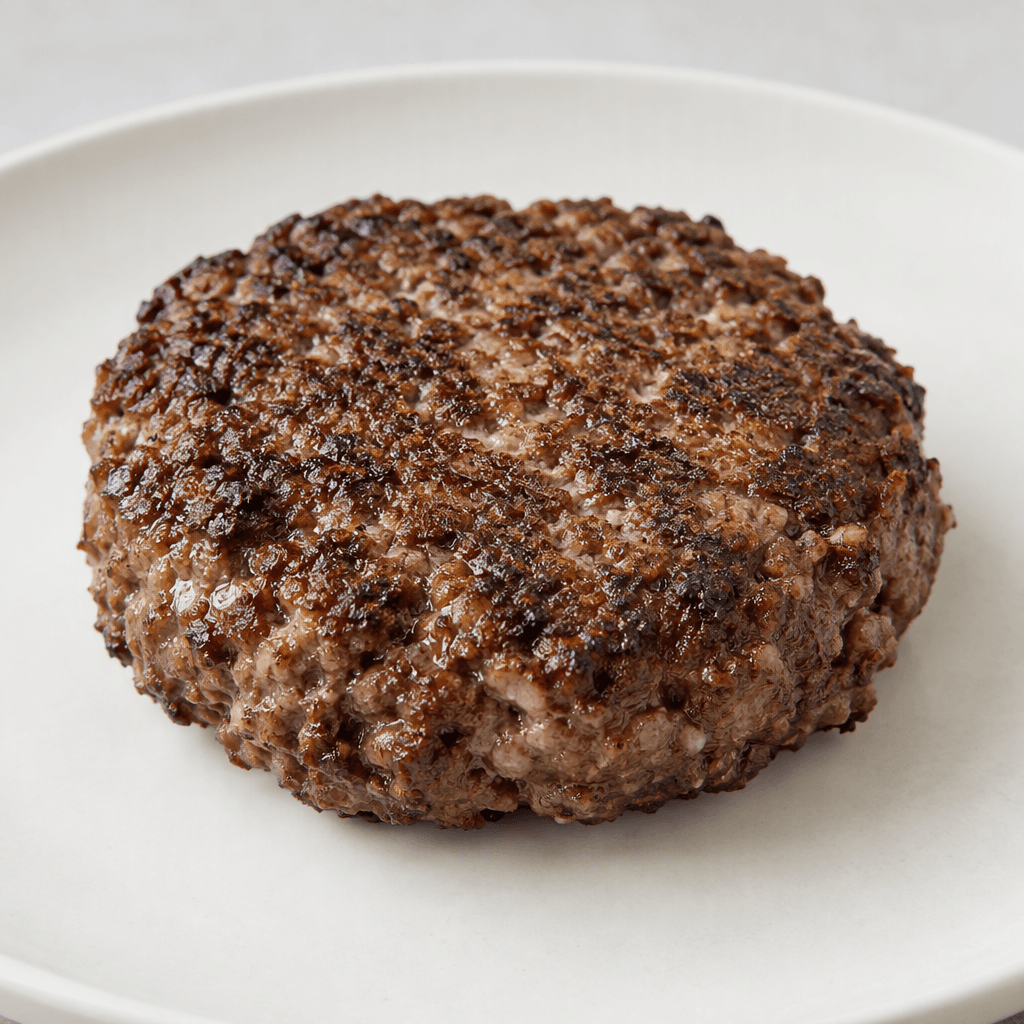
Hamburger Patty Calories
Classic hamburger patty made from ground beef
In season: Spring · Summer · Autumn · Winter
CALORIES
GI
POTASSIUM
FIBER
Quick answer
1 piece (medium) of Hamburger Patty (90 g) has 225 calories. That works out to 250 calories per 100 g. It contains 0.5 g of carbs, 16.2 g of protein, 18 g of fat and 0 g of fiber. Its 1.9 µg of B12 covers 79% of the Daily Value. Its glycemic index is 0 (low), so it raises blood sugar slowly.
What is Hamburger Patty?
A Hamburger Patty is ground beef shaped into a flat, round portion for a burger. It is associated with the American-style hamburger and is usually grilled or pan-seared until browned, with the centre cooked to preference. The outside develops a savoury crust, while the inside can stay juicy; coarser mince gives it a more crumbly bite. Serve it in a bun with familiar toppings such as lettuce, tomato, pickles, onion and sauce, or alongside potatoes. For a lighter plate, skip the bun and pair the patty with salad or grilled vegetables. It is a protein-containing choice, though its fat content depends on the mince used.
Hamburger Patty Nutrition Facts
Selected: 100 g
250
KCAL / 100G
Carbs
0.5g
· 0% DV
Protein
18g
· 36% DV
Fat
20g
· 26% DV
Fiber
0g
· 0% DV
DV is the share of the daily value covered, on a 2,000 kcal reference diet.
Calories come from: Carbs 1% · Protein 28% · Fat 71%
Hamburger Patty Vitamins & Minerals
Vitamins
B12
2.1µg · 88% DV
B3
4.5mg · 28% DV
B6
0.3mg · 18% DV
B2
0.18mg · 14% DV
Minerals
Zinc
5mg · 45% DV
Phosphorus
180mg · 26% DV
Selenium
14µg · 25% DV
Iron
2mg · 11% DV
How Nutritious Is Hamburger Patty?
Nutrient density
High
How many vitamins, minerals and how much fiber this food carries per calorie. A high score means a lot of nutrition for few calories.
Satiety score
Medium
An EatBetter score computed from fiber, protein and calorie density. A high score means staying full longer on the same calories.
Both scores are calculated per 100 g and do not change with the selected portion. The satiety score is EatBetter's own calculation, not a clinical measure.
Hamburger Patty Glycemic Index
GLYCEMIC INDEX
GLYCEMIC LOAD
Accounts for portion size — a more realistic measure than GI alone.
How to Burn Off Hamburger Patty
To burn the 250 calories in 100 g:
🚶
Walking (5 km/h)
🏃
Running (8 km/h)
🚴
Cycling
🏊
Swimming
Times are calculated with the MET equation for a 70 kg adult. Actual burn varies with your weight, age and pace.
Is Hamburger Patty Processed?
NOVA 2
Minimally Processed
1. Unprocessed
2. Minimally Processed
3. Processed
4. Ultra-Processed
NOVA classifies foods into 4 groups by industrial processing. NOVA 1 (unprocessed) is the healthiest.
Does Hamburger Patty Contain Allergens?
No known major allergens
Which Diets Is Hamburger Patty Good For?
Vegan
— Not suitable
Vegetarian
— Not suitable
Gluten-Free
✓ Suitable
Dairy-Free
— Not suitable
Mediterranean
✓ Suitable
Paleo
✓ Suitable
Whole30
— Not suitable
DASH
— Not suitable
Keto
✓ Suitable
Low FODMAP
— Not suitable
Hamburger Patty Fat Profile
SATURATED
8.5g
MONOUNSATURATED
8.2g
POLYUNSATURATED
0.7g
Omega 6:3 ratio 1.9:1
Below the ideal 4:1 — a good omega balance.
Compare Hamburger Patty
Foods Similar to Hamburger Patty
Frequently Asked Questions About Hamburger Patty
How do you make a hamburger patty?
Make a hamburger patty by gently shaping ground beef into a round, even disc and seasoning the outside with salt and pepper. Avoid kneading or compressing the meat, which can make the cooked patty dense; chill shaped patties briefly before cooking.
What is the best beef-to-fat ratio for a hamburger patty?
A hamburger patty is usually juicier when made with ground beef that contains some fat rather than very lean beef. Around 80/20 beef is a common choice for burgers; leaner meat tends to cook up firmer and drier.
When should you season a hamburger patty?
Season a hamburger patty just before cooking, or shortly before it goes on the grill. Salt draws moisture to the surface and can make the texture firmer if mixed into the ground beef well in advance, so avoid working it deeply into the meat.
Why does a hamburger patty shrink when cooked?
A hamburger patty shrinks because heat tightens its proteins and renders out water and fat. Start with a patty slightly wider than the bun, avoid pressing it with a spatula, and make a shallow dimple in the center to help it cook more evenly.
How do you keep a hamburger patty from falling apart?
Keep the ground beef cold, shape the hamburger patty gently, and chill it before cooking. A patty often breaks when the meat is overworked, too wet, or turned before its first side has browned and released from the cooking surface.
How do you cook a hamburger patty on the stove?
Cook a hamburger patty in a preheated skillet over medium-high heat, turning it once the first side is browned and releases easily. Don’t press down on it; that squeezes out juices. Cook the second side until the center reaches a safe temperature.
How do you grill a hamburger patty without it sticking?
To keep a hamburger patty from sticking, preheat and clean the grill grates, then lightly oil them before adding the meat. Let the patty brown and release naturally before flipping; trying to turn it too soon can tear the surface.
What temperature should a hamburger patty reach?
A hamburger patty made from ground beef should reach 160°F (71°C) internally for food safety. Check the center with a food thermometer, since browning on the outside or the color of the juices does not reliably show that ground beef is fully cooked.
Can you freeze hamburger patties?
Yes, hamburger patties can be frozen. Separate them with parchment or wax paper, seal them in a freezer-safe package, and thaw them in the refrigerator before cooking. Don’t refreeze raw patties after they have thawed unless you cook them first.
How long do hamburger patties last in the fridge?
Raw hamburger patties keep in the refrigerator for one to two days; cooked patties keep for three to four days. Store them covered and refrigerate cooked leftovers promptly rather than leaving them at room temperature.
Have another question about Hamburger Patty?
Ask the AI nutrition coach — calories, portions, alternatives and more, answered in seconds in the app.

Scan calories with your camera
Instant AI nutrition analysis

Nutrition data compiled from USDA FoodData Central and scientific sources.