

Ready & Packaged Foods
All →Vegetables & Legumes
All →Desserts & Confectionery
All →Meat & Protein
All →Grains & Bakery
All →Beverages
All →Milk & Dairy
All →

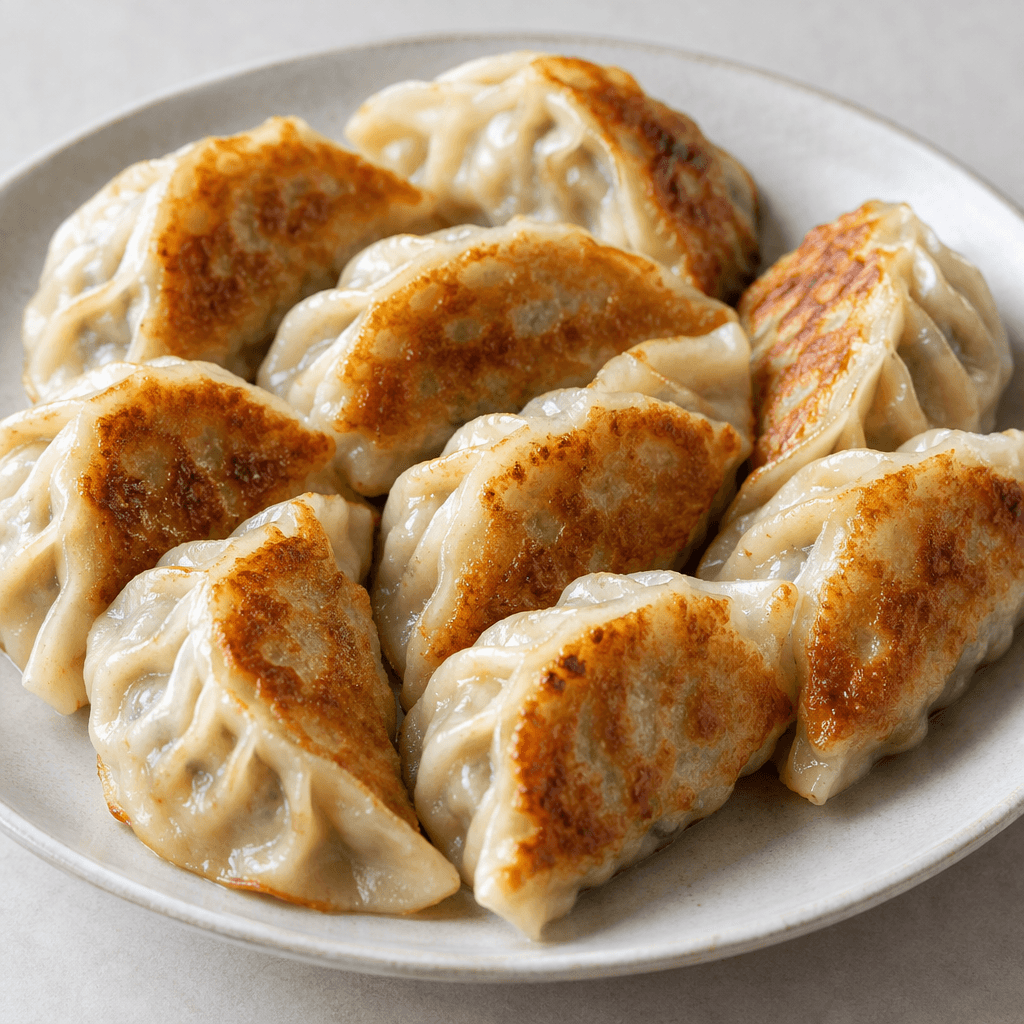
Gyoza Calories
Japanese dumpling, vegetable and/or meat filling, pan-fried or steamed
In season: Spring · Summer · Autumn · Winter
CALORIES
GI
POTASSIUM
FIBER
Quick answer
5 piece (medium) of Gyoza (90 g) has 167 calories. That works out to 185 calories per 100 g. It contains 23 g of carbs, 6.8 g of protein, 5.6 g of fat and 1.9 g of fiber. Its 378 mg of Sodium covers 16% of the Daily Value. Its glycemic index is 65 (medium), so it raises blood sugar at a moderate pace.
What is Gyoza?
Gyoza are Japanese dumplings adapted from Chinese jiaozi. A thin wrapper is folded around a filling, often minced meat with cabbage or other vegetables, though vegetarian versions are common too. They’re frequently cooked by searing the bottoms in a pan, then adding a little water to steam the tops; they can also be steamed on their own.
The wrapper turns tender while the browned base stays crisp, and the savoury filling is usually served hot with a soy-and-vinegar dipping sauce. In Japan, gyoza are a popular side dish with ramen or rice; elsewhere, they work well as a starter or a light meal with a salad. They provide carbohydrates from the wrapper alongside some protein. For a lighter option, choose steamed rather than pan-seared gyoza, or pair a modest portion with vegetables.
Gyoza Nutrition Facts
Selected: 100 g
185
KCAL / 100G
Carbs
25.5g
· 9% DV
Protein
7.5g
· 15% DV
Fat
6.2g
· 8% DV
Fiber
2.1g
· 8% DV
DV is the share of the daily value covered, on a 2,000 kcal reference diet.
Calories come from: Carbs 54% · Protein 16% · Fat 30%
Gyoza Vitamins & Minerals
Vitamins
B12
0.37µg · 15% DV
B1
0.13mg · 11% DV
B3
1.5mg · 9% DV
B2
0.09mg · 7% DV
Minerals
Sodium
420mg · 18% DV
Selenium
6µg · 11% DV
Phosphorus
72mg · 10% DV
Zinc
1mg · 9% DV
How Nutritious Is Gyoza?
Nutrient density
Medium
How many vitamins, minerals and how much fiber this food carries per calorie. A high score means a lot of nutrition for few calories.
Satiety score
Medium
An EatBetter score computed from fiber, protein and calorie density. A high score means staying full longer on the same calories.
Both scores are calculated per 100 g and do not change with the selected portion. The satiety score is EatBetter's own calculation, not a clinical measure.
Gyoza Glycemic Index
GLYCEMIC INDEX
GLYCEMIC LOAD
Accounts for portion size — a more realistic measure than GI alone.
How to Burn Off Gyoza
To burn the 185 calories in 100 g:
🚶
Walking (5 km/h)
🏃
Running (8 km/h)
🚴
Cycling
🏊
Swimming
Times are calculated with the MET equation for a 70 kg adult. Actual burn varies with your weight, age and pace.
Is Gyoza Processed?
NOVA 3
Processed
1. Unprocessed
2. Minimally Processed
3. Processed
4. Ultra-Processed
NOVA classifies foods into 4 groups by industrial processing. NOVA 1 (unprocessed) is the healthiest.
Does Gyoza Contain Allergens?
Contains these allergens:
Which Diets Is Gyoza Good For?
Vegan
— Not suitable
Vegetarian
— Not suitable
Gluten-Free
— Not suitable
Dairy-Free
— Not suitable
Mediterranean
✓ Suitable
Paleo
— Not suitable
Whole30
— Not suitable
DASH
— Not suitable
Keto
— Not suitable
Low FODMAP
— Not suitable
Gyoza Fat Profile
SATURATED
1.7g
MONOUNSATURATED
2.2g
POLYUNSATURATED
1.1g
Omega 6:3 ratio 5.4:1
Above the ideal 4:1 (5.4:1).
Compare Gyoza
Foods Similar to Gyoza
Frequently Asked Questions About Gyoza
What is gyoza?
Gyoza are Japanese dumplings, usually filled with meat or vegetables and wrapped in thin dough. They are often pan-fried on the bottom, then steamed in the same pan, giving them a crisp base and tender top.
What is the difference between gyoza and potstickers?
Gyoza are the Japanese version of dumplings closely related to Chinese jiaozi, while “potsticker” is an English name commonly used for pan-fried Chinese-style dumplings. Their fillings and wrappers can be similar, but recipes and seasonings vary.
How do you get crispy-bottomed gyoza?
For crispy-bottomed gyoza, brown them in a lightly oiled hot pan before adding water and covering it. Let the water evaporate, then uncover the pan and leave the dumplings briefly so their bases crisp up again.
What is gyoza dipping sauce made of?
Gyoza dipping sauce is commonly made with soy sauce and rice vinegar. Add chili oil for heat or a little sesame oil for a richer flavor; the vinegar balances the saltiness of the soy sauce.
Can you cook gyoza straight from frozen?
Yes, frozen gyoza can be cooked without thawing. Arrange them in a hot pan, brown the bottoms, then add water and cover until the filling is thoroughly heated. Leave space between dumplings so they do not stick together.
What is usually inside Japanese gyoza?
Japanese gyoza often contain minced pork mixed with finely chopped cabbage, garlic, ginger, and green onion. Vegetable-only fillings are also common, and ingredients vary by recipe, so the filling can be adapted to what you have.
How do you keep gyoza wrappers from tearing?
Keep gyoza wrappers covered while you work so they do not dry out, and avoid overfilling them. Moisten the edge lightly with water, press out trapped air, and seal the wrapper firmly before cooking.
Can you steam gyoza instead of pan-frying them?
Yes, gyoza can be steamed without pan-frying. Steaming gives them a soft wrapper and no browned base; leave space between them in the steamer and line it so the wrappers do not stick.
How are you supposed to eat gyoza?
Gyoza are usually picked up with chopsticks, dipped lightly in sauce, and eaten in a bite or two. They are often served as a side dish or shared plate alongside ramen, rice, or other Japanese dishes.
How long do cooked gyoza last in the fridge?
Cooked gyoza keep in a covered container in the refrigerator for about 3–4 days. Reheat them in a pan to restore a crisp base, and make sure the filling is hot throughout before serving.
Have another question about Gyoza?
Ask the AI nutrition coach — calories, portions, alternatives and more, answered in seconds in the app.

Scan calories with your camera
Instant AI nutrition analysis

Nutrition data compiled from USDA FoodData Central and scientific sources.