

Ready & Packaged Foods
All →Vegetables & Legumes
All →Desserts & Confectionery
All →Meat & Protein
All →Grains & Bakery
All →Beverages
All →Milk & Dairy
All →

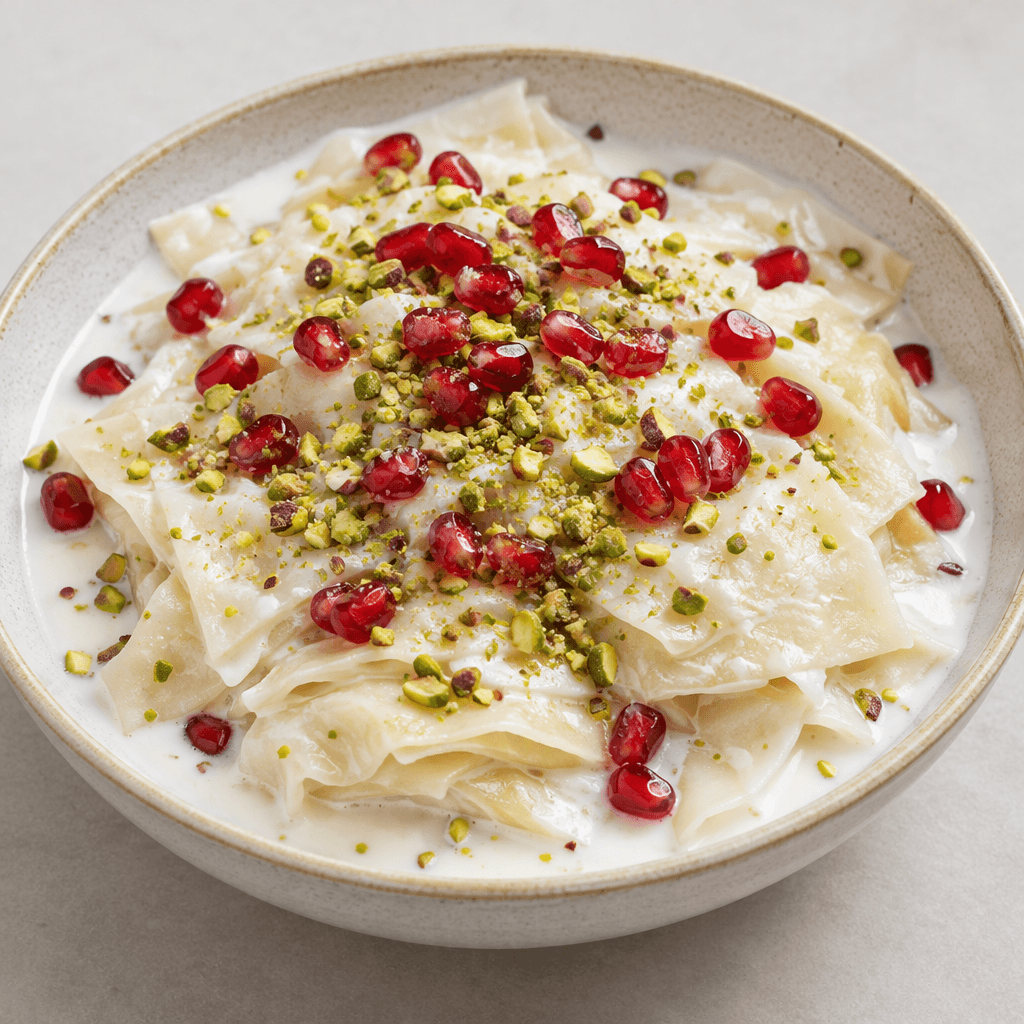
Gullac (low sugar) Calories
Traditional Turkish dessert, milky, low sugar, light
In season: Spring
CALORIES
GI
POTASSIUM
FIBER
Quick answer
1 piece (medium) of Gullac (low sugar) (80 g) has 88 calories. That works out to 110 calories per 100 g. It contains 14.8 g of carbs, 2.6 g of protein, 2 g of fat and 0.2 g of fiber. Its 0.2 µg of B12 covers 10% of the Daily Value. Its glycemic index is 55 (medium), so it raises blood sugar at a moderate pace.
What is Gullac (low sugar)?
Gullac (low sugar) is a traditional Turkish dessert made by softening thin starch-based sheets in milk and layering them in a shallow dish. It has Ottoman roots and is especially associated with Ramadan, when it is often prepared at home and served after iftar.
The milk-soaked layers are tender and softly yielding, usually served chilled with pomegranate seeds, pistachios or walnuts on top. In Turkey it may follow an iftar meal or be offered with tea; elsewhere, it makes a cool, light finish to a shared meal. It is milky and mainly provides carbohydrates, with modest protein. For a lighter serving, keep the nut topping modest and avoid adding extra sugar.
Gullac (low sugar) Nutrition Facts
Selected: 100 g
110
KCAL / 100G
Carbs
18.5g
· 7% DV
Protein
3.2g
· 6% DV
Fat
2.5g
· 3% DV
Fiber
0.2g
· 1% DV
DV is the share of the daily value covered, on a 2,000 kcal reference diet.
Calories come from: Carbs 68% · Protein 12% · Fat 20%
Gullac (low sugar) Vitamins & Minerals
Vitamins
B12
0.3µg · 13% DV
B2
0.13mg · 10% DV
B5
0.4mg · 8% DV
Biotin
2µg · 7% DV
Minerals
Phosphorus
85mg · 12% DV
Calcium
110mg · 11% DV
Iodine
7µg · 5% DV
Selenium
2µg · 4% DV
How Nutritious Is Gullac (low sugar)?
Nutrient density
Medium
How many vitamins, minerals and how much fiber this food carries per calorie. A high score means a lot of nutrition for few calories.
Satiety score
Medium
An EatBetter score computed from fiber, protein and calorie density. A high score means staying full longer on the same calories.
Both scores are calculated per 100 g and do not change with the selected portion. The satiety score is EatBetter's own calculation, not a clinical measure.
Gullac (low sugar) Glycemic Index
GLYCEMIC INDEX
GLYCEMIC LOAD
Accounts for portion size — a more realistic measure than GI alone.
How to Burn Off Gullac (low sugar)
To burn the 110 calories in 100 g:
🚶
Walking (5 km/h)
🏃
Running (8 km/h)
🚴
Cycling
🏊
Swimming
Times are calculated with the MET equation for a 70 kg adult. Actual burn varies with your weight, age and pace.
Is Gullac (low sugar) Processed?
NOVA 3
Processed
1. Unprocessed
2. Minimally Processed
3. Processed
4. Ultra-Processed
NOVA classifies foods into 4 groups by industrial processing. NOVA 1 (unprocessed) is the healthiest.
Does Gullac (low sugar) Contain Allergens?
Contains these allergens:
Which Diets Is Gullac (low sugar) Good For?
Vegan
— Not suitable
Vegetarian
✓ Suitable
Gluten-Free
— Not suitable
Dairy-Free
— Not suitable
Mediterranean
✓ Suitable
Paleo
— Not suitable
Whole30
— Not suitable
DASH
— Not suitable
Keto
— Not suitable
Low FODMAP
— Not suitable
Gullac (low sugar) Fat Profile
SATURATED
1.5g
MONOUNSATURATED
0.6g
POLYUNSATURATED
0.2g
Omega 6:3 ratio 2:1
Below the ideal 4:1 — a good omega balance.
Compare Gullac (low sugar)
Foods Similar to Gullac (low sugar)
Frequently Asked Questions About Gullac (low sugar)
What is low-sugar Gullac made of?
Low-sugar Gullac is made by softening thin starch-and-water sheets in milk and layering them in a dish. The dessert is commonly topped with pomegranate seeds and pistachios; the low-sugar version uses less added sugar than a traditional recipe.
Why is low-sugar Gullac eaten during Ramadan?
Low-sugar Gullac is a traditional Turkish milk dessert often served during Ramadan, especially after iftar. It can be prepared ahead and served chilled, making it convenient for a shared meal, though people enjoy it throughout the year too.
How do you make low-sugar Gullac at home?
To make low-sugar Gullac, stir a modest amount of sugar into warm milk, then soften the sheets in it and layer them in a shallow dish. Add nuts between layers if you like, chill until tender, and finish with pomegranate and pistachios.
What is the difference between low-sugar Gullac and regular Gullac?
Low-sugar Gullac uses less added sugar in the milk mixture, while keeping the same delicate sheets and layered preparation as regular Gullac. It is not necessarily sugar-free: the amount varies by recipe and by who makes it.
Is low-sugar Gullac served warm or cold?
Low-sugar Gullac is served cold. Chilling gives the sheets time to absorb the milk and soften evenly; add the pomegranate seeds and pistachios just before serving for a fresher topping and better contrast in texture.
How should you store low-sugar Gullac, and how long does it keep?
Keep low-sugar Gullac covered in the refrigerator because it is a milk-based dessert. It is best eaten soon after preparation; as it sits, the sheets continue absorbing milk and become increasingly soft. Do not leave it at room temperature for extended periods.
Why does low-sugar Gullac turn mushy?
Low-sugar Gullac can turn mushy if the milk is too hot or the sheets soak for too long. Use warm rather than boiling milk, moisten the sheets briefly, and add the liquid gradually so they soften without losing their layered texture.
What toppings go well on low-sugar Gullac?
Pomegranate seeds and pistachios are classic toppings for low-sugar Gullac, while walnuts or hazelnuts can be layered inside. Add juicy fruit shortly before serving so it does not bleed into the milk or make the top soggy.
Can you make low-sugar Gullac without dairy milk?
Yes, you can make low-sugar Gullac with an unsweetened plant-based drink, but the flavor and how the sheets soften may change. Add the liquid gradually, since different drinks vary in thickness and the sheets may absorb them differently.
Can people with diabetes eat low-sugar Gullac?
Low-sugar Gullac still contains added sugar, and its sheets provide carbohydrates, so it is not automatically suitable for everyone with diabetes. The appropriate portion depends on individual blood-glucose targets; ask your clinician or dietitian for personal guidance.
Have another question about Gullac (low sugar)?
Ask the AI nutrition coach — calories, portions, alternatives and more, answered in seconds in the app.

Scan calories with your camera
Instant AI nutrition analysis

Nutrition data compiled from USDA FoodData Central and scientific sources.