

Ready & Packaged Foods
All →Vegetables & Legumes
All →Desserts & Confectionery
All →Meat & Protein
All →Grains & Bakery
All →Beverages
All →Milk & Dairy
All →

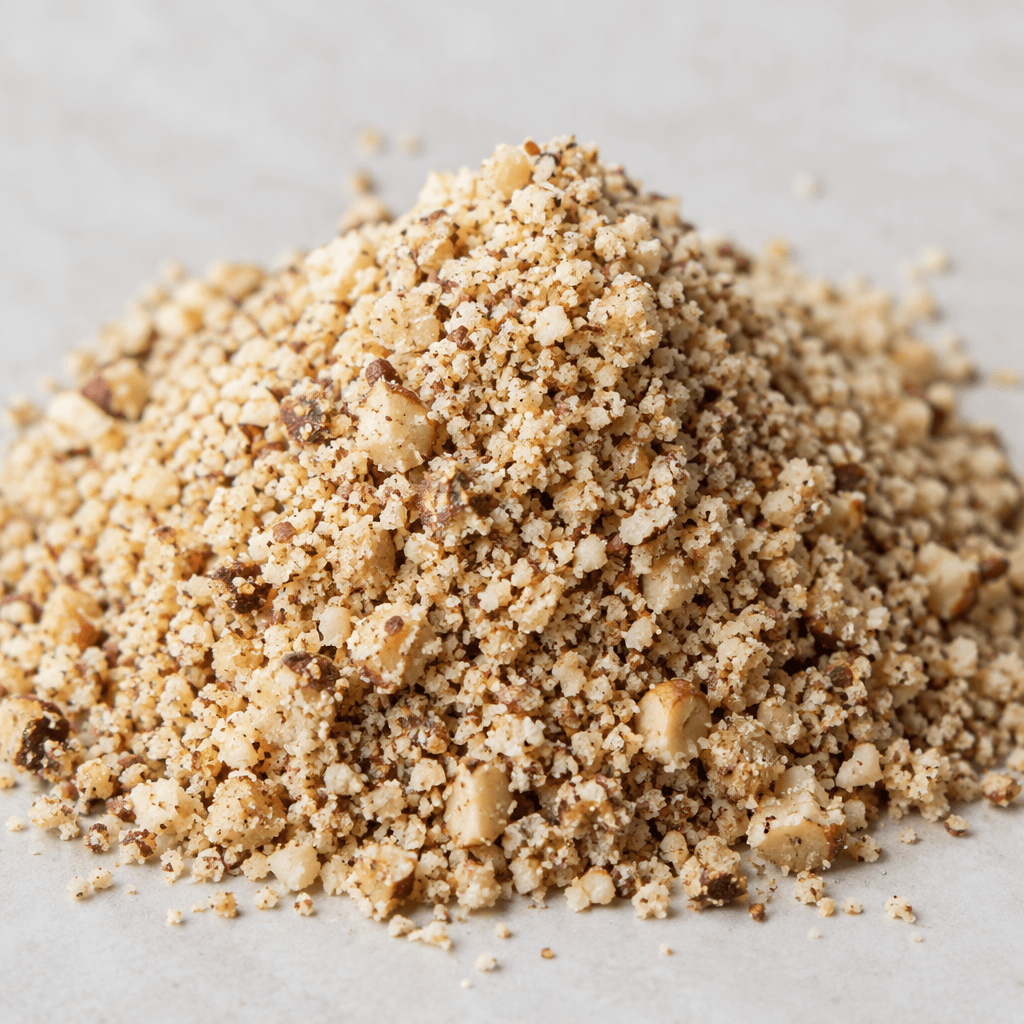
Ground Hazelnut Calories
Rich in vitamin E, healthy fats, protein source
In season: Autumn · Winter
CALORIES
GI
POTASSIUM
FIBER
Quick answer
2 tablespoon (medium) of Ground Hazelnut (20 g) has 126 calories. That works out to 628 calories per 100 g. It contains 3.4 g of carbs, 3 g of protein, 12.2 g of fat and 2 g of fiber. Its 1.2 mg of Manganese covers 54% of the Daily Value. Its glycemic index is 15 (low), so it raises blood sugar slowly.
What is Ground Hazelnut?
Ground hazelnut is made by finely grinding hazelnuts, sometimes leaving a slightly coarse, crumbly texture. Hazelnuts are widely grown around the Black Sea, including in Turkey, and ground hazelnut is a familiar ingredient in baking across many parts of Europe and beyond.
Its rich, gently sweet, nutty flavour works well in cakes, biscuits, pastry fillings and chocolate-based desserts. You can also stir a spoonful into porridge or yoghurt, or sprinkle it over breakfast bowls. It is rich in fats and fibre and provides protein, so it adds both flavour and substance in a small amount. For a lighter result, use it as a topping or replace only part of the flour in a recipe.
Ground Hazelnut Nutrition Facts
Selected: 100 g
628
KCAL / 100G
Carbs
17g
· 6% DV
Protein
15g
· 30% DV
Fat
61g
· 78% DV
Fiber
10g
· 36% DV
DV is the share of the daily value covered, on a 2,000 kcal reference diet.
Calories come from: Carbs 10% · Protein 9% · Fat 81%
Ground Hazelnut Vitamins & Minerals
Vitamins
Vitamin E
15mg · 100% DV
Biotin
24µg · 80% DV
B1
0.64mg · 53% DV
B6
0.56mg · 33% DV
Minerals
Manganese
6mg · 261% DV
Copper
2mg · 222% DV
Phosphorus
290mg · 41% DV
Magnesium
163mg · 39% DV
How Nutritious Is Ground Hazelnut?
Nutrient density
High
How many vitamins, minerals and how much fiber this food carries per calorie. A high score means a lot of nutrition for few calories.
Satiety score
Medium
An EatBetter score computed from fiber, protein and calorie density. A high score means staying full longer on the same calories.
Both scores are calculated per 100 g and do not change with the selected portion. The satiety score is EatBetter's own calculation, not a clinical measure.
Ground Hazelnut Glycemic Index
GLYCEMIC INDEX
GLYCEMIC LOAD
Accounts for portion size — a more realistic measure than GI alone.
How to Burn Off Ground Hazelnut
To burn the 628 calories in 100 g:
🚶
Walking (5 km/h)
🏃
Running (8 km/h)
🚴
Cycling
🏊
Swimming
Times are calculated with the MET equation for a 70 kg adult. Actual burn varies with your weight, age and pace.
Is Ground Hazelnut Processed?
NOVA 2
Minimally Processed
1. Unprocessed
2. Minimally Processed
3. Processed
4. Ultra-Processed
NOVA classifies foods into 4 groups by industrial processing. NOVA 1 (unprocessed) is the healthiest.
Does Ground Hazelnut Contain Allergens?
Contains these allergens:
Which Diets Is Ground Hazelnut Good For?
Vegan
✓ Suitable
Vegetarian
✓ Suitable
Gluten-Free
✓ Suitable
Dairy-Free
— Not suitable
Mediterranean
✓ Suitable
Paleo
✓ Suitable
Whole30
— Not suitable
DASH
— Not suitable
Keto
✓ Suitable
Low FODMAP
— Not suitable
Ground Hazelnut Fat Profile
SATURATED
4.5g
MONOUNSATURATED
45.7g
POLYUNSATURATED
7.9g
Omega 6:3 ratio 86.7:1
Above the ideal 4:1 (86.7:1).
Compare Ground Hazelnut
Foods Similar to Ground Hazelnut
Frequently Asked Questions About Ground Hazelnut
How do you use ground hazelnut?
Ground hazelnut adds a nutty flavour and moist texture to cakes, cookies, brownies and pastry fillings. Sprinkle it over yoghurt or porridge, or mix it into granola; in baking, adjust the recipe because its oil affects the crumb.
Is ground hazelnut the same as hazelnut flour?
Not always. Ground hazelnut can be coarse or finely milled, while hazelnut flour usually refers to a finer grind. Neither behaves exactly like wheat flour, so check the texture and use a recipe designed for ground nuts when baking.
How do you make ground hazelnut at home?
Pulse hazelnuts in a food processor until they reach the texture you want. Stop frequently and scrape down the bowl; continuous blending warms the nuts and releases their oil, turning the ground hazelnut into a paste.
How should you store ground hazelnut?
Store ground hazelnut in an airtight container in a cool, dark place, or refrigerate it to slow the nuts’ natural oils from turning rancid. Discard it if it smells sour or paint-like, tastes sharply bitter, or has become damp.
Can you freeze ground hazelnut?
Yes, ground hazelnut freezes well in an airtight container or freezer bag. Take out only what you need, and let the closed container reach room temperature before opening it to reduce condensation on the nuts.
Can you use ground hazelnut instead of almond flour?
Yes, ground hazelnut can often replace almond flour in recipes, especially cakes and cookies, but it gives a stronger flavour and may make the result slightly oilier. Match the grind as closely as possible and expect some variation in texture.
Can ground hazelnut replace wheat flour in baking?
No, ground hazelnut usually cannot replace all the wheat flour in a recipe one-for-one. It contains no gluten and has more natural oil, so baked goods may become crumbly or dense; use a recipe formulated for nut flour or replace only part.
Should ground hazelnut be made from raw or roasted hazelnuts?
Either works. Ground hazelnut made from raw nuts has a milder flavour, while roasted hazelnuts give baked goods a deeper, toastier taste. Let roasted nuts cool fully before grinding so their oil does not turn the mixture into a paste too quickly.
Should you remove hazelnut skins before making ground hazelnut?
No, removing the thin skins is optional. Leaving them on gives ground hazelnut a deeper, sometimes slightly bitter flavour; for a paler, milder result, rub roasted hazelnuts in a clean towel to loosen and remove most of the skins.
Why does ground hazelnut turn oily or clumpy?
Ground hazelnut becomes oily or clumpy when grinding warms the nuts and releases their natural oil. Pulse in short bursts, chill the hazelnuts beforehand, and process small batches to keep the mixture loose.
Have another question about Ground Hazelnut?
Ask the AI nutrition coach — calories, portions, alternatives and more, answered in seconds in the app.

Scan calories with your camera
Instant AI nutrition analysis

Nutrition data compiled from USDA FoodData Central and scientific sources.