

Ready & Packaged Foods
All →Vegetables & Legumes
All →Desserts & Confectionery
All →Meat & Protein
All →Grains & Bakery
All →Beverages
All →Milk & Dairy
All →

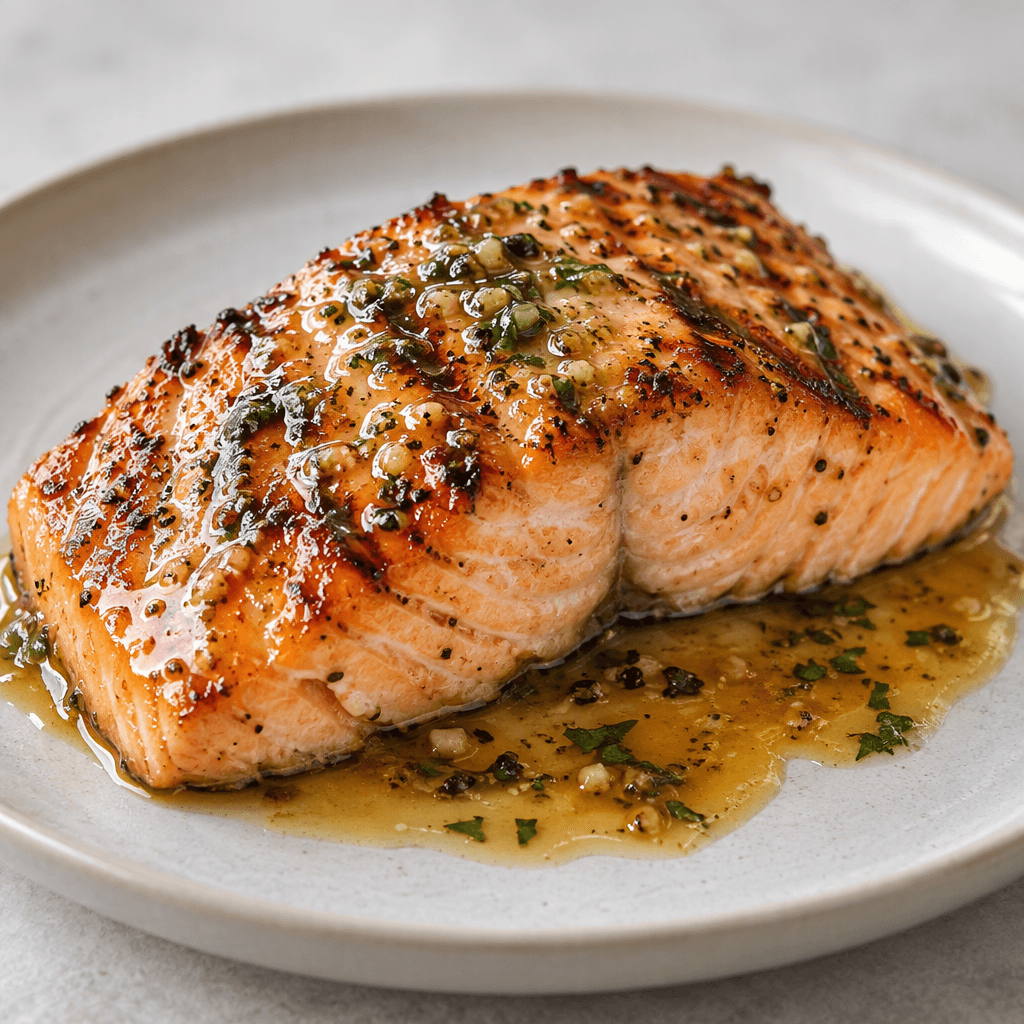
Grilled Salmon with Sauce Calories
Rich in omega-3, protein source, healthy fats, flavorful with sauce
In season: Spring · Summer · Autumn · Winter
CALORIES · 100 G
GI
POTASSIUM · 100 G
FIBER · 100 G
Quick answer
1 piece (medium) of Grilled Salmon with Sauce (150 g) has 270 calories. That works out to 180 calories per 100 g. It contains 3 g of carbs, 28.5 g of protein, 16.5 g of fat and 0.3 g of fiber. Its 5.3 µg of B12 covers 219% of the Daily Value. Its glycemic index is 0 (low), so it raises blood sugar slowly.
Grilled Salmon with Sauce Nutrition Facts
Selected: 1 piece (medium) · 150 g
270
KCAL / 150G
Carbs
3g
· 1% DV
Protein
28.5g
· 57% DV
Fat
16.5g
· 21% DV
Fiber
0.3g
· 1% DV
DV is the share of the daily value covered, on a 2,000 kcal reference diet.
Calories come from: Carbs 4% · Protein 42% · Fat 54%
Grilled Salmon with Sauce nutrition facts table · 1 piece (medium) (150 g)
| Nutrient | Amount | % DV |
|---|---|---|
| Calories | 270 kcal | |
| Total fat | 16.5 g | 21% |
| Saturated fat | 3.3 g | 16% |
| Trans fat | 0 g | |
| Sodium | 270 mg | 12% |
| Total carbohydrate | 3 g | 1% |
| Fiber | 0.3 g | 1% |
| Protein | 28.5 g | 57% |
Calories: Calories measure energy. Average daily need is 2,000 kcal. Excess calories are stored as fat, too few cause weight loss.
Carbs: Your body's primary energy source. The brain runs exclusively on carbs. Daily need: 275g.
Protein: Essential for muscle repair and cell growth. Daily need: 50g. Keeps you full and boosts metabolism.
Fat: Needed for hormone production and vitamin absorption. Daily need: 78g. Limit saturated fats, choose unsaturated.
Fiber: Critical for digestive health and satiety. Daily need: 28g. Stabilizes blood sugar, lowers cholesterol.

Log this food in EatBetter
100,000+ people use it
- Get your daily calorie target
- Snap your meal, log it in seconds
- See every vitamin and mineral

📸 Scan the code to get the app free.

How Many Calories in 1 Medium Grilled Salmon with Sauce?
| Serving | Amount | Calories |
|---|---|---|
| 1 piece (medium) | 150 g | 270 kcal |
| 1 piece (extra small) | 75 g | 135 kcal |
| 100 g | 100 g | 180 kcal |
| 1 piece (small) | 100 g | 180 kcal |
| 1 serving (small) | 120 g | 216 kcal |
| 1 serving (medium) | 180 g | 324 kcal |
| 1 piece (large) | 200 g | 360 kcal |
| 1 serving (large) | 220 g | 396 kcal |
| 1 piece (extra large) | 250 g | 450 kcal |
| 1 piece (jumbo) | 300 g | 540 kcal |
Calculated from 180 calories per 100 g.
Frequently Asked Questions About Grilled Salmon with Sauce
How do you make grilled salmon with sauce at home?
Cook seasoned salmon over a hot, lightly oiled grill, then add the sauce near the end or serve it separately. This keeps the fish from sticking and prevents sugary sauces from scorching before the salmon is done.
What sauce goes best with grilled salmon with sauce?
Lemon-dill butter, creamy yogurt-herb sauce, and garlic-lemon dressing all pair well with grilled salmon with sauce. Choose a bright, acidic sauce to balance the salmon’s richness, or a creamy one for a milder finish.
How do you stop grilled salmon with sauce from sticking to the grill?
Dry the salmon, preheat and oil the grill, and let the fish form a seared surface before turning it. Grilled salmon with sauce is less likely to break when it releases easily from the grates.
How can you tell when grilled salmon with sauce is done?
Grilled salmon with sauce is done when its thickest part turns opaque and separates into flakes with gentle pressure. Check the center rather than relying on the outside color, which sauce can mask.
Should you grill salmon with the skin on for grilled salmon with sauce?
Yes, grilling salmon skin-side down helps protect the flesh and makes the fillet easier to handle. The skin is edible when cooked through, and it can turn crisp if it stays against the hot grill.
What should you serve with grilled salmon with sauce?
Serve grilled salmon with sauce with roasted vegetables, a crisp salad, rice, or potatoes. Choose a simple side when the sauce is rich, so the plate stays balanced and the salmon remains the focus.
Can you use frozen salmon for grilled salmon with sauce?
Yes, thaw frozen salmon fully in the refrigerator before grilling it. Pat it dry before seasoning, since surface moisture makes browning harder and can cause the fish to steam instead of sear.
When should you put sauce on grilled salmon with sauce?
Add most sauces during the final part of grilling or serve them on the side. Apply sugary glazes late because they can burn quickly; a cool yogurt or herb sauce is best spooned on after cooking.
How long does grilled salmon with sauce last in the fridge?
Grilled salmon with sauce keeps for three to four days in a covered container in the refrigerator. Chill leftovers promptly, and discard them if they develop an unusual smell or a sticky surface.
Can you reheat grilled salmon with sauce without drying it out?
Yes, reheat grilled salmon with sauce gently in a covered oven-safe dish with a spoonful of water or extra sauce. Use low heat and stop as soon as it is warmed through to help preserve its texture.
Grilled Salmon with Sauce Vitamins & Minerals
Vitamins
B12
5.25µg · 219% DV
B3
11.25mg · 70% DV
Vitamin D
12µg · 60% DV
B6
0.9mg · 53% DV
Minerals
Selenium
45µg · 82% DV
Phosphorus
330mg · 47% DV
Iodine
45µg · 30% DV
Potassium ⭐
510mg · 15% DV
Sodium
270mg · 12% DV
Grilled Salmon with Sauce Glycemic Index
GLYCEMIC INDEX
GLYCEMIC LOAD
Accounts for portion size — a more realistic measure than GI alone.
How to Burn Off Grilled Salmon with Sauce
To burn the 270 calories in 1 piece (medium) (150 g):
🚶
Walking (5 km/h)
🏃
Running (8 km/h)
🚴
Cycling
🏊
Swimming
Times are calculated with the MET equation for a 70 kg adult. Actual burn varies with your weight, age and pace.
What is Grilled Salmon with Sauce?
Grilled Salmon with Sauce is a salmon fillet cooked over a grill and served with sauce, either spooned over the fish or on the side. The sauce varies by cook and cuisine; lemon, herbs or spices can complement the salmon without changing the simple grilled preparation.
Its tender, rich flesh takes on a lightly smoky edge, making it a popular main course served with vegetables, salad or potatoes in many parts of the world. The sauce adds moisture and a contrasting flavour, so the dish can range from bright and tangy to savoury. Salmon provides protein and omega-3 fats, with 19 g of protein per 100 g. For a lighter plate, ask for the sauce on the side and pair the fish with vegetables.
How Nutritious Is Grilled Salmon with Sauce?
Nutrient density
Very high
How many vitamins, minerals and how much fiber this food carries per calorie. A high score means a lot of nutrition for few calories.
Satiety score
Medium
An EatBetter score computed from fiber, protein and calorie density. A high score means staying full longer on the same calories.
Both scores are calculated per 100 g and do not change with the selected portion. The satiety score is EatBetter's own calculation, not a clinical measure.
Is Grilled Salmon with Sauce Processed?
NOVA 2
Minimally Processed
1. Unprocessed
2. Minimally Processed
3. Processed
4. Ultra-Processed
NOVA classifies foods into 4 groups by industrial processing. NOVA 1 (unprocessed) is the healthiest.
Does Grilled Salmon with Sauce Contain Allergens?
Contains these allergens:
Which Diets Is Grilled Salmon with Sauce Good For?
Vegan
— Not suitable
Vegetarian
— Not suitable
Gluten-Free
✓ Suitable
Dairy-Free
— Not suitable
Mediterranean
✓ Suitable
Paleo
✓ Suitable
Whole30
— Not suitable
DASH
— Not suitable
Keto
✓ Suitable
Low FODMAP
— Not suitable
Grilled Salmon with Sauce Fat Profile
SATURATED
3.3g
MONOUNSATURATED
6.75g
POLYUNSATURATED
3.15g
Omega 6:3 ratio 0.2:1
Below the ideal 4:1 — a good omega balance.
Compare Grilled Salmon with Sauce
Foods Similar to Grilled Salmon with Sauce
Have another question about Grilled Salmon with Sauce?
Ask the AI nutrition coach — calories, portions, alternatives and more, answered in seconds in the app.

Scan calories with your camera
Instant AI nutrition analysis

Nutrition data compiled from USDA FoodData Central and scientific sources.