

Ready & Packaged Foods
All →Vegetables & Legumes
All →Desserts & Confectionery
All →Meat & Protein
All →Grains & Bakery
All →Beverages
All →Milk & Dairy
All →

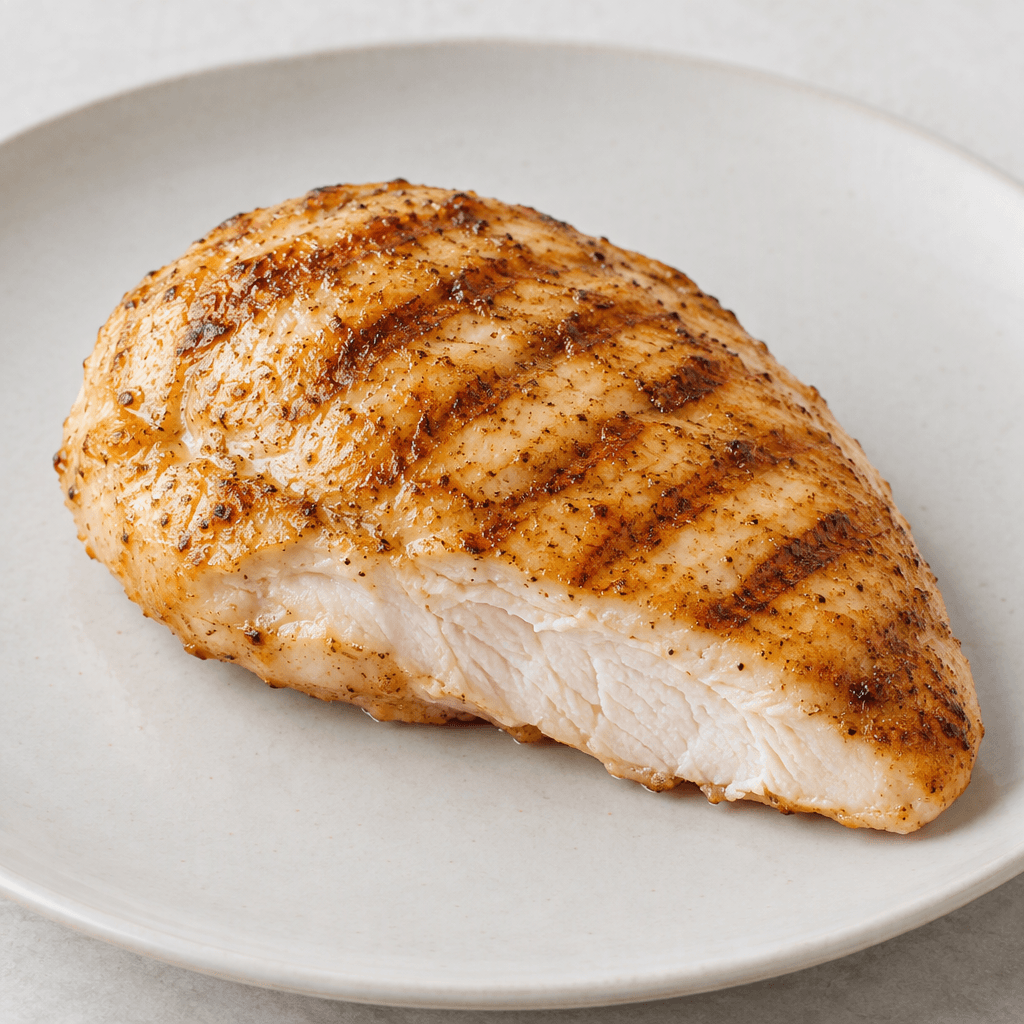
Grilled Chicken Fillet Calories
Lean protein source, low in carbs, rich in B vitamins and selenium
In season: Spring · Summer · Autumn · Winter
CALORIES
GI
POTASSIUM
FIBER
Quick answer
1 piece (medium) of Grilled Chicken Fillet (150 g) has 180 calories. That works out to 120 calories per 100 g. It contains 0 g of carbs, 35.3 g of protein, 3.3 g of fat and 0 g of fiber. Its 20.5 mg of B3 covers 128% of the Daily Value. Its glycemic index is 0 (low), so it raises blood sugar slowly.
What is Grilled Chicken Fillet?
Grilled Chicken Fillet is usually made from a boneless chicken breast portion, seasoned and cooked over a hot grill. The surface gets lightly browned with grill marks, while the centre stays tender and moist when it is not overcooked. It is a familiar preparation in many cuisines, served as a simple main or used in sandwiches and salads.
Its mild flavour works well with herbs, spices, citrus or a savoury sauce. Grilled Chicken Fillet is a lean, protein-rich choice with virtually no carbohydrate, so it can anchor a meal without making it heavy. Pair it with vegetables and grains for a balanced plate, or add it to a salad; watch the cooking time to keep the meat juicy.
Grilled Chicken Fillet Nutrition Facts
Selected: 100 g
120
KCAL / 100G
Carbs
0g
· 0% DV
Protein
23.5g
· 47% DV
Fat
2.2g
· 3% DV
Fiber
0g
· 0% DV
DV is the share of the daily value covered, on a 2,000 kcal reference diet.
Calories come from: Carbs 0% · Protein 83% · Fat 17%
Grilled Chicken Fillet Vitamins & Minerals
Vitamins
B3
13.7mg · 86% DV
B6
0.6mg · 35% DV
Biotin
7µg · 23% DV
B5
1mg · 20% DV
Minerals
Selenium
23µg · 42% DV
Phosphorus
210mg · 30% DV
Potassium ⭐
330mg · 10% DV
Zinc
1mg · 9% DV
How Nutritious Is Grilled Chicken Fillet?
Nutrient density
High
How many vitamins, minerals and how much fiber this food carries per calorie. A high score means a lot of nutrition for few calories.
Satiety score
Medium
An EatBetter score computed from fiber, protein and calorie density. A high score means staying full longer on the same calories.
Both scores are calculated per 100 g and do not change with the selected portion. The satiety score is EatBetter's own calculation, not a clinical measure.
Grilled Chicken Fillet Glycemic Index
GLYCEMIC INDEX
GLYCEMIC LOAD
Accounts for portion size — a more realistic measure than GI alone.
How to Burn Off Grilled Chicken Fillet
To burn the 120 calories in 100 g:
🚶
Walking (5 km/h)
🏃
Running (8 km/h)
🚴
Cycling
🏊
Swimming
Times are calculated with the MET equation for a 70 kg adult. Actual burn varies with your weight, age and pace.
Is Grilled Chicken Fillet Processed?
NOVA 2
Minimally Processed
1. Unprocessed
2. Minimally Processed
3. Processed
4. Ultra-Processed
NOVA classifies foods into 4 groups by industrial processing. NOVA 1 (unprocessed) is the healthiest.
Does Grilled Chicken Fillet Contain Allergens?
No known major allergens
Which Diets Is Grilled Chicken Fillet Good For?
Vegan
— Not suitable
Vegetarian
— Not suitable
Gluten-Free
✓ Suitable
Dairy-Free
— Not suitable
Mediterranean
✓ Suitable
Paleo
✓ Suitable
Whole30
— Not suitable
DASH
— Not suitable
Keto
✓ Suitable
Low FODMAP
— Not suitable
Grilled Chicken Fillet Fat Profile
SATURATED
0.6g
MONOUNSATURATED
0.7g
POLYUNSATURATED
0.3g
Omega 6:3 ratio 6.3:1
Above the ideal 4:1 (6.3:1).
Compare Grilled Chicken Fillet
Foods Similar to Grilled Chicken Fillet
Frequently Asked Questions About Grilled Chicken Fillet
How do you grill a chicken fillet without it sticking?
Preheat a clean grill well, then lightly oil the chicken fillet rather than pouring oil onto the grill. Place it on the hot surface and leave it undisturbed until it releases easily; forcing it loose can tear the browned surface.
What temperature should a grilled chicken fillet reach?
A grilled chicken fillet is safely cooked when its thickest part reaches 165°F (74°C). Check with an instant-read thermometer inserted into the center, avoiding the grill or any bone; color alone cannot reliably confirm doneness.
How long does a grilled chicken fillet take to cook?
A grilled chicken fillet usually needs only several minutes per side, but thickness and grill heat make the timing vary. Use the 165°F (74°C) internal-temperature check rather than relying on a fixed cooking time.
Should you pound a chicken fillet before grilling it?
Yes, gently pounding a thick chicken fillet to an even thickness helps it cook more uniformly and reduces the chance that its thin end will dry out. Cover it first and use the flat side of a meat mallet.
What is the best marinade for a grilled chicken fillet?
A balanced marinade for a grilled chicken fillet combines oil, an acidic ingredient such as lemon juice or vinegar, and seasonings. Marinate it in the refrigerator, and discard marinade that touched raw chicken unless you boil it before serving.
Why does a grilled chicken fillet turn out tough?
A grilled chicken fillet can turn tough when it is overcooked, especially if it is thin. Check the thickest section with a thermometer and remove it from the grill once it reaches 165°F (74°C), then let it rest briefly before slicing.
Can you meal-prep grilled chicken fillets for the week?
Yes, grilled chicken fillets work well for meal prep. Refrigerate them promptly in sealed portions and use them within 3–4 days; storing sauces and salads separately helps keep the chicken’s texture better until serving.
How should you reheat a grilled chicken fillet without drying it out?
Reheat a grilled chicken fillet gently, covered, with a small splash of water or broth to limit moisture loss. Heat it until steaming hot throughout, and avoid repeated reheating, which can make the lean meat dry and chewy.
Can grilled chicken fillet be frozen after cooking?
Yes, cooked grilled chicken fillet can be frozen in an airtight container or freezer bag once cooled. Thaw it in the refrigerator and use it soon after thawing; freezing may soften its texture, but it remains useful in salads and wraps.
Is grilled chicken fillet a good post-workout meal?
Yes, grilled chicken fillet provides protein that supports muscle repair after exercise. Pair it with a source of carbohydrates, such as potatoes, rice, or fruit, if you also need to replenish energy after a demanding workout.
Have another question about Grilled Chicken Fillet?
Ask the AI nutrition coach — calories, portions, alternatives and more, answered in seconds in the app.

Scan calories with your camera
Instant AI nutrition analysis

Nutrition data compiled from USDA FoodData Central and scientific sources.