

Ready & Packaged Foods
All →Vegetables & Legumes
All →Desserts & Confectionery
All →Meat & Protein
All →Grains & Bakery
All →Beverages
All →Milk & Dairy
All →

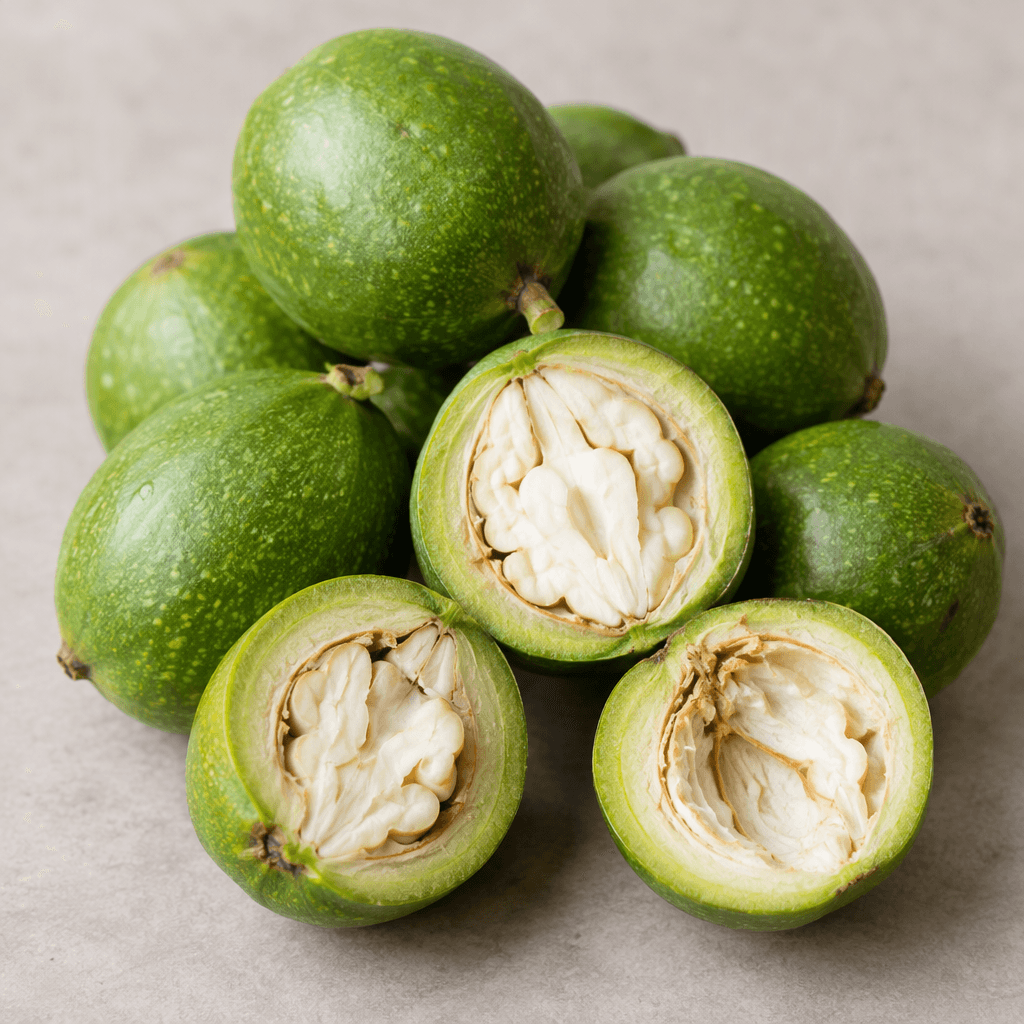
Green walnut Calories
Immature walnut with higher water content and lower fat than mature walnut.
In season: Spring · Summer
CALORIES · 100 G
GI
POTASSIUM · 100 G
FIBER · 100 G
Quick answer
3 piece (medium) of Green walnut (45 g) has 66 calories. That works out to 147 calories per 100 g. It contains 5.3 g of carbs, 1.8 g of protein, 5.5 g of fat and 2.1 g of fiber. Its 0.6 mg of Manganese covers 27% of the Daily Value. Its glycemic index is 15 (low), so it raises blood sugar slowly.
Green walnut Nutrition Facts
Selected: 3 piece (medium) · 45 g
66
KCAL / 45G
Carbs
5.3g
· 2% DV
Protein
1.8g
· 4% DV
Fat
5.5g
· 7% DV
Fiber
2.1g
· 8% DV
DV is the share of the daily value covered, on a 2,000 kcal reference diet.
Calories come from: Carbs 27% · Protein 9% · Fat 64%
Green walnut nutrition facts table · 3 piece (medium) (45 g)
| Nutrient | Amount | % DV |
|---|---|---|
| Calories | 66 kcal | |
| Total fat | 5.5 g | 7% |
| Saturated fat | 0.54 g | 3% |
| Trans fat | 0 g | |
| Sodium | 0.9 mg | 0% |
| Total carbohydrate | 5.3 g | 2% |
| Fiber | 2.1 g | 8% |
| Protein | 1.8 g | 4% |
Calories: Calories measure energy. Average daily need is 2,000 kcal. Excess calories are stored as fat, too few cause weight loss.
Carbs: Your body's primary energy source. The brain runs exclusively on carbs. Daily need: 275g.
Protein: Essential for muscle repair and cell growth. Daily need: 50g. Keeps you full and boosts metabolism.
Fat: Needed for hormone production and vitamin absorption. Daily need: 78g. Limit saturated fats, choose unsaturated.
Fiber: Critical for digestive health and satiety. Daily need: 28g. Stabilizes blood sugar, lowers cholesterol.

Log this food in EatBetter
100,000+ people use it
- Get your daily calorie target
- Snap your meal, log it in seconds
- See every vitamin and mineral

📸 Scan the code to get the app free.

How Many Calories in 3 Pieces of Green walnut?
| Serving | Amount | Calories |
|---|---|---|
| 3 piece (medium) | 45 g | 66 kcal |
| 1 piece (small) | 12 g | 18 kcal |
| 2 piece (medium) | 24 g | 35 kcal |
| 0.25 cup (chopped) | 30 g | 44 kcal |
| ½ cup (chopped) | 60 g | 88 kcal |
| 5 piece (large) | 75 g | 110 kcal |
| 100 g | 100 g | 147 kcal |
| 8 piece (extra large) | 120 g | 176 kcal |
| 1 cup (chopped) | 120 g | 176 kcal |
Calculated from 147 calories per 100 g.
Frequently Asked Questions About Green walnut
What is a green walnut?
A green walnut is an immature walnut picked before its hard shell and kernel have fully developed. Its outer husk is still green and soft, so the whole fruit can be used in preserves, pickles, or traditional liqueurs.
Can you eat green walnuts raw?
Yes, green walnuts can be eaten raw, but they are often more bitter and astringent than mature walnuts. Try a small piece first; many recipes soak or cook them to mellow the sharp flavor.
When should green walnuts be picked?
Green walnuts are picked while the outer husk is soft and the developing shell can still be cut through easily. The season varies by climate; a knife or skewer should pass through the fruit without hitting a hard shell.
How do you make green walnut jam?
Green walnut jam is usually made by soaking pierced or scored walnuts, changing the water to reduce bitterness, then simmering them in syrup. Recipes vary, including whether they use limewater, so follow one tested method from start to finish.
How do you remove the bitterness from green walnuts?
Soaking pierced or scored green walnuts and changing the water repeatedly can reduce their bitterness. The time needed varies with the fruit and recipe; taste a small piece as you go rather than assuming one soaking time fits every batch.
Can you pickle green walnuts?
Yes, green walnuts can be pickled whole while their shells are still soft. They are commonly soaked or cured first to reduce bitterness, then covered with vinegar and spices; use a reliable preserving recipe for safe storage.
Why do green walnuts stain your hands?
The green walnut’s outer husk contains natural pigments that can leave persistent brown or black stains on skin. Wear gloves when cutting or peeling the fruit, and protect work surfaces from juice and splashes.
How do you store fresh green walnuts?
Keep fresh green walnuts unwashed in a breathable container in the refrigerator and use them promptly. Remove any bruised or moldy fruit; because they are immature and moist, they do not keep like dried, mature walnuts.
Can you freeze green walnuts?
Yes, green walnuts can be frozen, although thawing may soften their texture. Wash and dry them well, prepare them as needed for your recipe, and pack them airtight; thawed walnuts are generally better suited to cooking than eating raw.
What is the difference between green walnuts and regular walnuts?
Green walnuts are harvested before their hard shell and kernel mature, while regular walnuts are fully developed and dried. Green walnuts are softer, moister, and more astringent, making them especially useful for preserves, pickles, and walnut liqueur.
Green walnut Vitamins & Minerals
Vitamins
Vitamin C
17.1mg · 19% DV
Biotin
2.25µg · 8% DV
B6
0.11mg · 6% DV
Folate
23.4µg · 6% DV
Minerals
Manganese
0.63mg · 27% DV
Copper
0.19mg · 21% DV
Phosphorus
74mg · 11% DV
Magnesium
35mg · 8% DV
Potassium ⭐
131mg · 4% DV
Sodium
0.9mg · 0% DV
Green walnut Glycemic Index
GLYCEMIC INDEX
GLYCEMIC LOAD
Accounts for portion size — a more realistic measure than GI alone.
How to Burn Off Green walnut
To burn the 66 calories in 3 piece (medium) (45 g):
🚶
Walking (5 km/h)
🏃
Running (8 km/h)
🚴
Cycling
🏊
Swimming
Times are calculated with the MET equation for a 70 kg adult. Actual burn varies with your weight, age and pace.
What is Green walnut?
Green walnut is an immature walnut picked while its outer hull is still green and the inner shell has not hardened. The young nuts are used in preserves in Turkey and parts of eastern Europe; in Italy, they are also steeped to make nocino, a dark walnut liqueur. Their raw flavour is notably tannic and astringent, so they are more often preserved or infused than eaten as a snack.
Turkish-style walnut preserve is served in small portions at breakfast or with tea, while nocino is typically sipped after a meal. Compared with mature walnuts, green walnuts contain more water and less fat, while still providing fibre. Pair a sweet preserve with plain yoghurt, or keep the serving modest if you want to limit added sugar.
How Nutritious Is Green walnut?
Nutrient density
High
How many vitamins, minerals and how much fiber this food carries per calorie. A high score means a lot of nutrition for few calories.
Satiety score
Medium
An EatBetter score computed from fiber, protein and calorie density. A high score means staying full longer on the same calories.
Both scores are calculated per 100 g and do not change with the selected portion. The satiety score is EatBetter's own calculation, not a clinical measure.
Is Green walnut Processed?
NOVA 1
Unprocessed
1. Unprocessed
2. Minimally Processed
3. Processed
4. Ultra-Processed
NOVA classifies foods into 4 groups by industrial processing. NOVA 1 (unprocessed) is the healthiest.
Does Green walnut Contain Allergens?
Contains these allergens:
Which Diets Is Green walnut Good For?
Vegan
✓ Suitable
Vegetarian
✓ Suitable
Gluten-Free
✓ Suitable
Dairy-Free
— Not suitable
Mediterranean
✓ Suitable
Paleo
✓ Suitable
Whole30
— Not suitable
DASH
— Not suitable
Keto
— Not suitable
Low FODMAP
— Not suitable
Green walnut Fat Profile
SATURATED
0.54g
MONOUNSATURATED
0.81g
POLYUNSATURATED
3.24g
Omega 6:3 ratio 6.4:1
Above the ideal 4:1 (6.4:1).
Compare Green walnut
Foods Similar to Green walnut
Have another question about Green walnut?
Ask the AI nutrition coach — calories, portions, alternatives and more, answered in seconds in the app.

Scan calories with your camera
Instant AI nutrition analysis

Nutrition data compiled from USDA FoodData Central and scientific sources.