

Ready & Packaged Foods
All →Vegetables & Legumes
All →Desserts & Confectionery
All →Meat & Protein
All →Grains & Bakery
All →Beverages
All →Milk & Dairy
All →

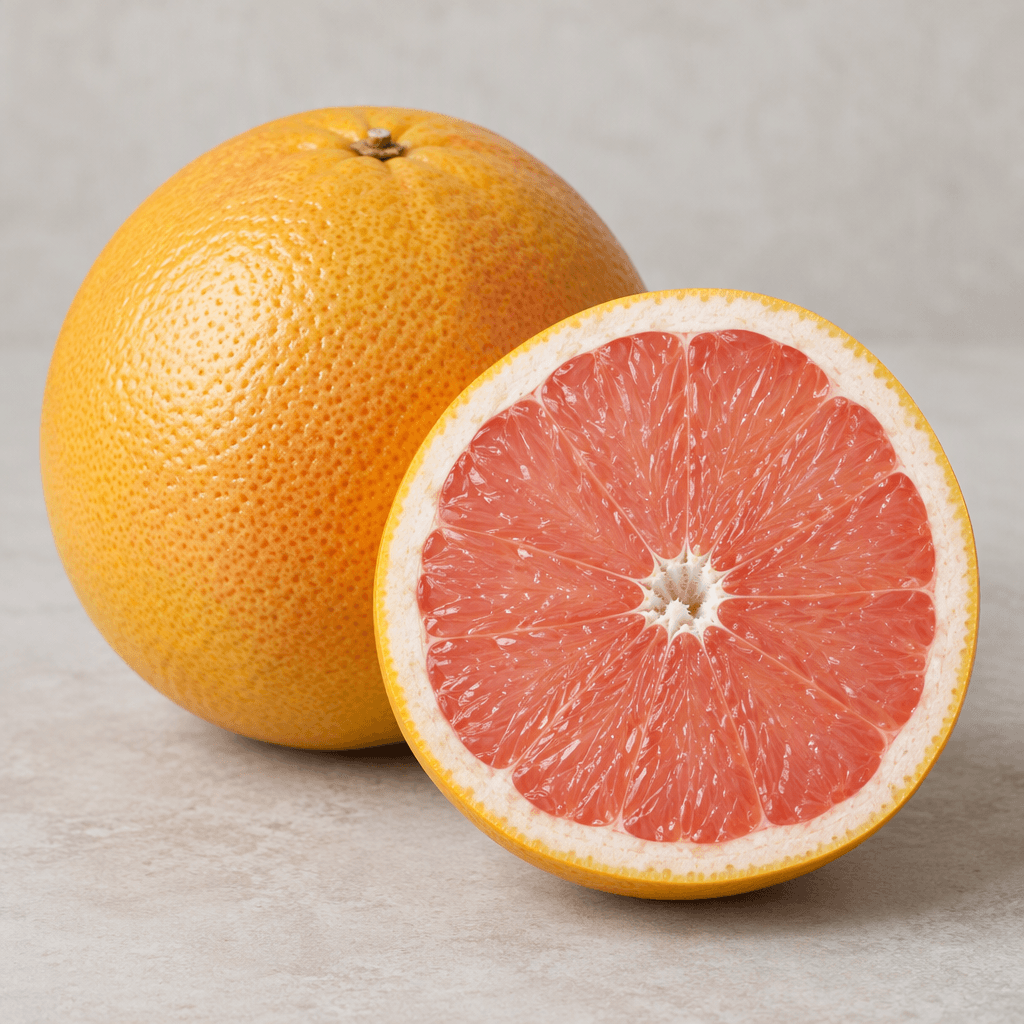
Grapefruit Calories
High in vitamin C, low calorie, antioxidant
In season: Winter · Spring
CALORIES
GI
POTASSIUM
FIBER
Quick answer
1 piece (medium) of Grapefruit (230 g) has 97 calories. That works out to 42 calories per 100 g. It contains 24.6 g of carbs, 1.8 g of protein, 0.2 g of fat and 3.7 g of fiber. Its 71.8 mg of Vitamin C covers 80% of the Daily Value. Its glycemic index is 25 (low), so it raises blood sugar slowly.
What is Grapefruit?
Grapefruit is a citrus fruit believed to have originated in the Caribbean as a natural cross between sweet orange and pomelo. Beneath its thick, dimpled rind, the flesh ranges from pale yellow to pink and is divided by thin, sometimes bitter membranes. Its flavour balances tartness and sweetness, with the bitterness varying by variety.
It is often eaten halved with a spoon at breakfast, added to fruit salads, or squeezed for juice; in many places, it also makes a refreshing snack. Grapefruit is low in calories and provides vitamin C, along with some fibre. For a more filling snack, pair the segments with plain yoghurt, and eat them whole rather than juicing them when you want to retain the fibre.
Grapefruit Nutrition Facts
Selected: 100 g
42
KCAL / 100G
Carbs
10.7g
· 4% DV
Protein
0.8g
· 2% DV
Fat
0.1g
· 0% DV
Fiber
1.6g
· 6% DV
DV is the share of the daily value covered, on a 2,000 kcal reference diet.
Calories come from: Carbs 91% · Protein 7% · Fat 2%
Grapefruit Vitamins & Minerals
Vitamins
Vitamin C
31.2mg · 35% DV
B5
0.28mg · 6% DV
Vitamin A
46µg · 5% DV
B1
0.05mg · 4% DV
Minerals
Potassium ⭐
135mg · 4% DV
Phosphorus
18mg · 3% DV
Calcium
22mg · 2% DV
Magnesium
9mg · 2% DV
How Nutritious Is Grapefruit?
Nutrient density
High
How many vitamins, minerals and how much fiber this food carries per calorie. A high score means a lot of nutrition for few calories.
Satiety score
Medium
An EatBetter score computed from fiber, protein and calorie density. A high score means staying full longer on the same calories.
Both scores are calculated per 100 g and do not change with the selected portion. The satiety score is EatBetter's own calculation, not a clinical measure.
Grapefruit Glycemic Index
GLYCEMIC INDEX
GLYCEMIC LOAD
Accounts for portion size — a more realistic measure than GI alone.
How to Burn Off Grapefruit
To burn the 42 calories in 100 g:
🚶
Walking (5 km/h)
🏃
Running (8 km/h)
🚴
Cycling
🏊
Swimming
Times are calculated with the MET equation for a 70 kg adult. Actual burn varies with your weight, age and pace.
Is Grapefruit Processed?
NOVA 1
Unprocessed
1. Unprocessed
2. Minimally Processed
3. Processed
4. Ultra-Processed
NOVA classifies foods into 4 groups by industrial processing. NOVA 1 (unprocessed) is the healthiest.
Does Grapefruit Contain Allergens?
No known major allergens
Which Diets Is Grapefruit Good For?
Vegan
✓ Suitable
Vegetarian
✓ Suitable
Gluten-Free
✓ Suitable
Dairy-Free
— Not suitable
Mediterranean
✓ Suitable
Paleo
✓ Suitable
Whole30
— Not suitable
DASH
— Not suitable
Keto
— Not suitable
Low FODMAP
— Not suitable
Grapefruit Fat Profile
SATURATED
0.02g
MONOUNSATURATED
0.01g
POLYUNSATURATED
0.02g
Compare Grapefruit
Foods Similar to Grapefruit
Frequently Asked Questions About Grapefruit
What medicines interact with grapefruit?
Grapefruit can change how the body processes certain medicines, raising or lowering their levels. Interactions include some cholesterol, blood pressure, heart-rhythm and transplant medicines. Ask your doctor or pharmacist about your specific medication before eating grapefruit or drinking its juice.
Does grapefruit help with weight loss?
No, grapefruit does not cause weight loss on its own. Its water and fibre can make it a satisfying fruit choice, especially eaten whole instead of as juice, but it does not burn fat or replace an overall eating plan.
How do you cut and eat a grapefruit?
Wash the grapefruit, then cut it in half and eat the segments with a spoon, or peel it and separate the wedges. For easier-to-eat, less bitter pieces, remove the thick white pith and membranes with a knife.
How can you tell if a grapefruit is ripe?
A ripe grapefruit feels heavy for its size and has firm, smooth skin. Avoid fruit with soft, sunken spots, mould or deep bruising; a lighter fruit may be dry inside.
Should grapefruit be refrigerated?
Grapefruit can stay at room temperature for a short time, but refrigeration helps it keep longer. Store cut grapefruit covered in the fridge and eat it within a few days; discard pieces that develop mould or an off smell.
Why does grapefruit taste bitter?
Grapefruit’s white pith and membranes contain bitter-tasting compounds, so they can make each bite sharper than the juicy flesh. Removing the membranes usually softens the flavour, while the variety and ripeness also affect how bitter it tastes.
What is the difference between pink and white grapefruit?
Pink grapefruit gets its colour from natural pigments and often tastes sweeter, while white grapefruit is commonly more tart or bitter. Both are grapefruit; sweetness and flavour vary with the particular variety and growing conditions.
Is grapefruit juice as healthy as eating a whole grapefruit?
Whole grapefruit is usually the more filling choice because it retains the fruit’s fibre and takes longer to eat. Juice has less fibre, and it is easy to drink the juice of several fruits at once.
Can people with diabetes eat grapefruit?
Yes, grapefruit can fit into many diabetes meal plans as a whole fruit. Its juice is easier to consume quickly and has less fibre, so whole segments are often a more satisfying option; grapefruit may also interact with some medicines.
Can you freeze grapefruit?
Yes, you can freeze grapefruit segments for later use, though thawed pieces become softer and are less suitable for eating fresh. Remove the peel and membranes first, freeze the segments in a sealed container, and use them in smoothies or cooked dishes.
Have another question about Grapefruit?
Ask the AI nutrition coach — calories, portions, alternatives and more, answered in seconds in the app.

Scan calories with your camera
Instant AI nutrition analysis

Nutrition data compiled from USDA FoodData Central and scientific sources.