

Ready & Packaged Foods
All →Vegetables & Legumes
All →Desserts & Confectionery
All →Meat & Protein
All →Grains & Bakery
All →Beverages
All →Milk & Dairy
All →

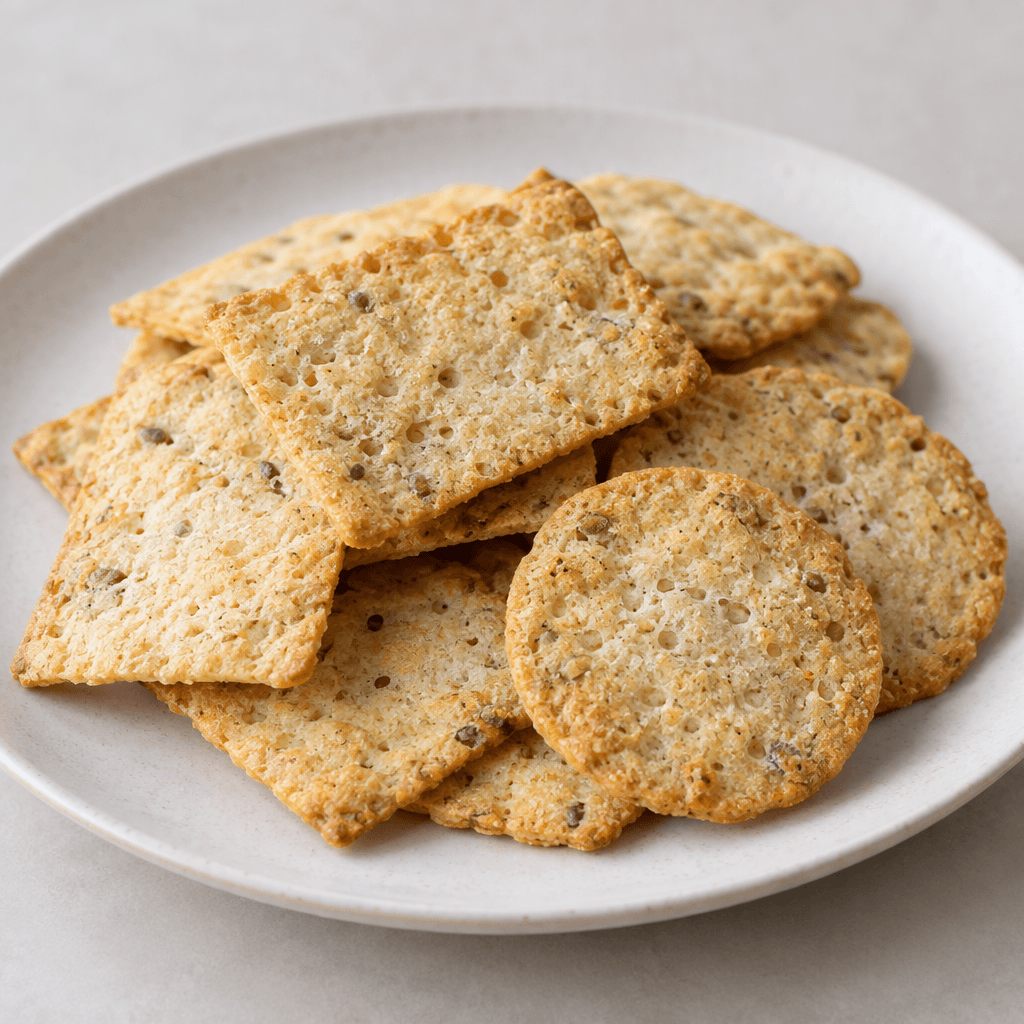
Gluten-Free Cracker Calories
Gluten-free, usually rice or corn flour based, lightly salted and crispy snack.
CALORIES
GI
POTASSIUM
FIBER
Quick answer
5 piece (medium) of Gluten-Free Cracker (30 g) has 129 calories. That works out to 430 calories per 100 g. It contains 24 g of carbs, 1.7 g of protein, 3 g of fat and 0.8 g of fiber. Its 144 mg of Sodium covers 6% of the Daily Value. Its glycemic index is 75 (high), so it raises blood sugar quickly.
What is Gluten-Free Cracker?
A gluten-free cracker is a thin, crisp savoury biscuit made without wheat flour, often using rice or corn flour instead. It tends to have a mild, lightly salted taste and a dry, crunchy texture, so it works with both savoury toppings and dips.
It can be served at breakfast, alongside soup or cheese, or as an easy snack with tea or coffee. In many places, people top crackers with hummus, soft cheese or sliced vegetables; they also make a handy base for small bites when entertaining. Nutritionally, they are mainly a carbohydrate snack, with 80 g of carbohydrates per 100 g. Pair a few with a protein-rich topping and fresh vegetables for a more balanced snack.
Gluten-Free Cracker Nutrition Facts
Selected: 100 g
430
KCAL / 100G
Carbs
80g
· 29% DV
Protein
5.5g
· 11% DV
Fat
10g
· 13% DV
Fiber
2.5g
· 9% DV
DV is the share of the daily value covered, on a 2,000 kcal reference diet.
Calories come from: Carbs 74% · Protein 5% · Fat 21%
Gluten-Free Cracker Vitamins & Minerals
Vitamins
B1
0.12mg · 10% DV
B3
1.2mg · 8% DV
B6
0.08mg · 5% DV
Biotin
1.5µg · 5% DV
Minerals
Sodium
480mg · 21% DV
Zinc
1mg · 9% DV
Phosphorus
65mg · 9% DV
Iron
1mg · 6% DV
How Nutritious Is Gluten-Free Cracker?
Nutrient density
Low
How many vitamins, minerals and how much fiber this food carries per calorie. A high score means a lot of nutrition for few calories.
Satiety score
Low
An EatBetter score computed from fiber, protein and calorie density. A high score means staying full longer on the same calories.
Both scores are calculated per 100 g and do not change with the selected portion. The satiety score is EatBetter's own calculation, not a clinical measure.
Gluten-Free Cracker Glycemic Index
GLYCEMIC INDEX
GLYCEMIC LOAD
Accounts for portion size — a more realistic measure than GI alone.
How to Burn Off Gluten-Free Cracker
To burn the 430 calories in 100 g:
🚶
Walking (5 km/h)
🏃
Running (8 km/h)
🚴
Cycling
🏊
Swimming
Times are calculated with the MET equation for a 70 kg adult. Actual burn varies with your weight, age and pace.
Is Gluten-Free Cracker Processed?
NOVA 3
Processed
1. Unprocessed
2. Minimally Processed
3. Processed
4. Ultra-Processed
NOVA classifies foods into 4 groups by industrial processing. NOVA 1 (unprocessed) is the healthiest.
Does Gluten-Free Cracker Contain Allergens?
No known major allergens
Which Diets Is Gluten-Free Cracker Good For?
Vegan
✓ Suitable
Vegetarian
✓ Suitable
Gluten-Free
✓ Suitable
Dairy-Free
— Not suitable
Mediterranean
✓ Suitable
Paleo
— Not suitable
Whole30
— Not suitable
DASH
— Not suitable
Keto
— Not suitable
Low FODMAP
— Not suitable
Gluten-Free Cracker Fat Profile
SATURATED
2.1g
MONOUNSATURATED
3.2g
POLYUNSATURATED
3.8g
Omega 6:3 ratio 110:1
Above the ideal 4:1 (110:1).
Compare Gluten-Free Cracker
Foods Similar to Gluten-Free Cracker
Frequently Asked Questions About Gluten-Free Cracker
What is a gluten-free cracker made of?
A gluten-free cracker is commonly made with rice or corn flour or starch, plus ingredients such as oil, salt, seeds, or binders. The exact recipe varies, so two crackers can differ noticeably in crunch and flavor.
How do you keep a gluten-free cracker crispy after opening?
Keep a gluten-free cracker in an airtight container in a cool, dry place after opening. Moist air quickly softens its crisp texture; briefly warming softened crackers in the oven can help restore some crunch.
What goes well with a gluten-free cracker?
A gluten-free cracker pairs well with hummus, cheese, nut butter, avocado, or sliced vegetables. Add wet toppings just before serving, since they can soak through the thin cracker and make it lose its crunch.
Can people with celiac disease eat a gluten-free cracker?
Yes, a gluten-free cracker can suit people with celiac disease when it is properly labeled and made to prevent cross-contact with gluten. Shared serving utensils and bulk bins can still introduce crumbs from wheat products.
Why does a gluten-free cracker crumble so easily?
A gluten-free cracker may crumble because it lacks gluten, the stretchy network that helps wheat dough hold together. Rice-flour varieties can be especially fragile, so handle the pack gently and avoid stacking heavy items on it.
Can you use a gluten-free cracker instead of breadcrumbs?
Yes, crushed gluten-free crackers can replace breadcrumbs in coatings, meatballs, or baked toppings. Crush them finely for an even coating, and remember that seasoned crackers may add extra salt to the recipe.
How is a gluten-free cracker different from a regular cracker?
A gluten-free cracker uses alternatives such as rice, corn, or seed flours instead of wheat, barley, or rye. It may taste more neutral and have a drier or more delicate texture than a wheat cracker.
Can you make gluten-free crackers at home?
Yes, you can make gluten-free crackers at home with rice or corn flour, water, oil, and salt. Roll the dough thin and evenly, then cut it into similar-sized pieces so they bake at the same rate.
Is a gluten-free cracker a good snack for people with diabetes?
A gluten-free cracker is not automatically a better choice for blood sugar; rice- or corn-starch-based varieties can raise it quickly. Pairing a few crackers with protein-rich cheese or hummus makes a more balanced snack.
Can you eat a gluten-free cracker with soup?
Yes, a gluten-free cracker can be served alongside soup or crumbled over it as a crunchy topping. Add it just before eating, because it softens quickly once it absorbs broth.
Have another question about Gluten-Free Cracker?
Ask the AI nutrition coach — calories, portions, alternatives and more, answered in seconds in the app.

Scan calories with your camera
Instant AI nutrition analysis

Nutrition data compiled from USDA FoodData Central and scientific sources.