

Ready & Packaged Foods
All →Vegetables & Legumes
All →Desserts & Confectionery
All →Meat & Protein
All →Grains & Bakery
All →Beverages
All →Milk & Dairy
All →

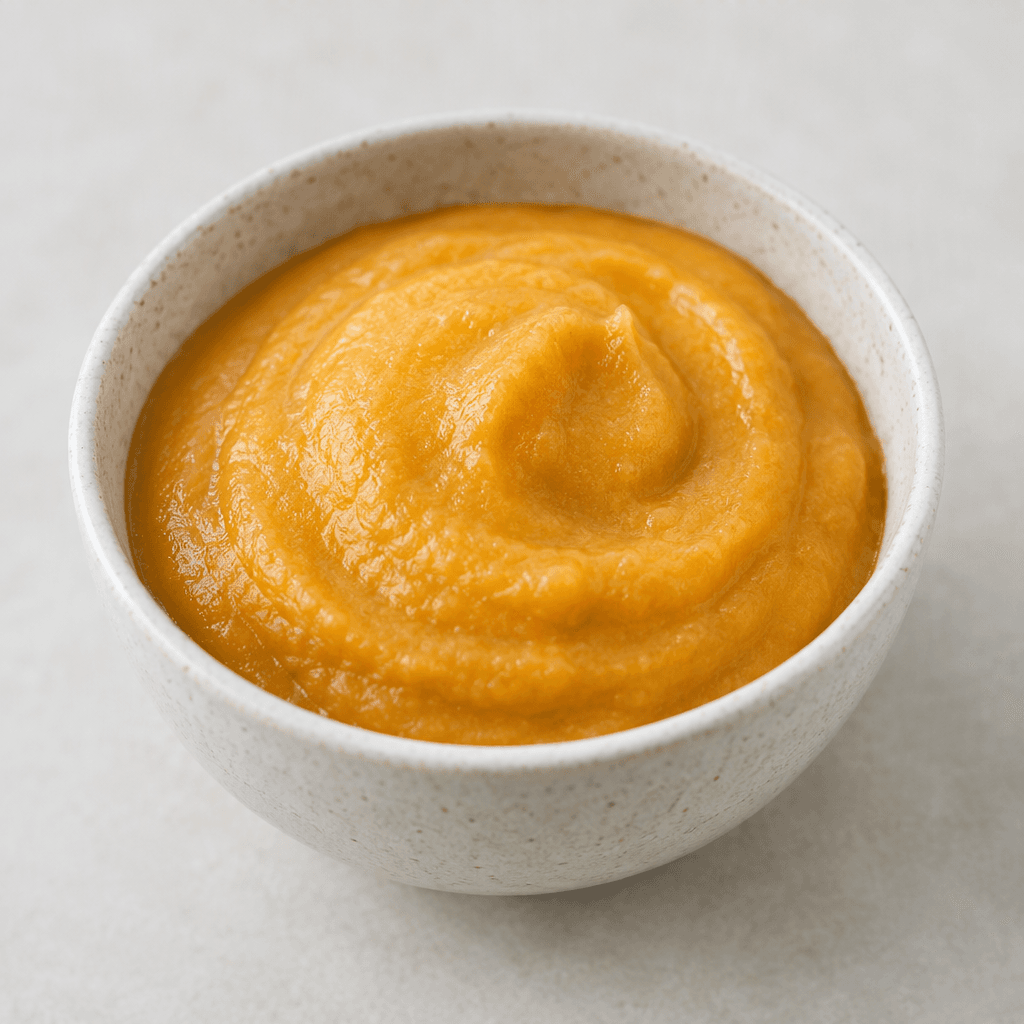
Gerber organic baby complementary food Calories
Organic, additive-free, suitable complementary food for babies
In season: Spring · Summer · Autumn · Winter
CALORIES · 100 G
GI
POTASSIUM · 100 G
FIBER · 100 G
Quick answer
1 pack (medium) of Gerber organic baby complementary food (90 g) has 59 calories. That works out to 65 calories per 100 g. It contains 13.1 g of carbs, 1.1 g of protein, 0.2 g of fat and 1.5 g of fiber. Its 4.5 mg of Vitamin C covers 5% of the Daily Value. Its glycemic index is 45 (low), so it raises blood sugar slowly.
Gerber organic baby complementary food Nutrition Facts
Selected: 1 pack (medium) · 90 g
59
KCAL / 90G
Carbs
13.1g
· 5% DV
Protein
1.1g
· 2% DV
Fat
0.2g
· 0% DV
Fiber
1.5g
· 5% DV
DV is the share of the daily value covered, on a 2,000 kcal reference diet.
Calories come from: Carbs 89% · Protein 8% · Fat 3%
Gerber organic baby complementary food nutrition facts table · 1 pack (medium) (90 g)
| Nutrient | Amount | % DV |
|---|---|---|
| Calories | 59 kcal | |
| Total fat | 0.2 g | 0% |
| Saturated fat | 0.03 g | 0% |
| Trans fat | 0 g | |
| Sodium | 4.5 mg | 0% |
| Total carbohydrate | 13.1 g | 5% |
| Fiber | 1.5 g | 5% |
| Protein | 1.1 g | 2% |
Calories: Calories measure energy. Average daily need is 2,000 kcal. Excess calories are stored as fat, too few cause weight loss.
Carbs: Your body's primary energy source. The brain runs exclusively on carbs. Daily need: 275g.
Protein: Essential for muscle repair and cell growth. Daily need: 50g. Keeps you full and boosts metabolism.
Fat: Needed for hormone production and vitamin absorption. Daily need: 78g. Limit saturated fats, choose unsaturated.
Fiber: Critical for digestive health and satiety. Daily need: 28g. Stabilizes blood sugar, lowers cholesterol.

Log this food in EatBetter
100,000+ people use it
- Get your daily calorie target
- Snap your meal, log it in seconds
- See every vitamin and mineral

📸 Scan the code to get the app free.

How Many Calories in 1 Pack of Gerber organic baby complementary food?
| Serving | Amount | Calories |
|---|---|---|
| 1 pack (medium) | 90 g | 59 kcal |
| 1 tablespoon (medium) | 15 g | 10 kcal |
| 1 pack (small) | 60 g | 39 kcal |
| 100 g | 100 g | 65 kcal |
| 1 cup (medium) | 100 g | 65 kcal |
| 1 pack (large) | 120 g | 78 kcal |
| 2 pack (double) | 180 g | 117 kcal |
Calculated from 65 calories per 100 g.
Frequently Asked Questions About Gerber organic baby complementary food
When can a baby start Gerber organic baby complementary food?
A baby can generally start Gerber organic baby complementary food at around 6 months, when they show readiness for solids, such as sitting with support and controlling their head. Choose a texture suited to the baby’s stage rather than relying on age alone.
Is Gerber organic baby complementary food safe for babies?
Yes, Gerber organic baby complementary food is intended for babies when the variety and texture are age-appropriate and it is handled as directed. Feed your baby seated and supervised, and avoid saving leftovers that have been in contact with the baby’s mouth.
Can babies eat Gerber organic baby complementary food straight from the pouch?
It is better to squeeze Gerber organic baby complementary food into a bowl and offer it by spoon. This lets you supervise each bite and prevents saliva from getting into the remaining food; spoon-feeding also helps babies practise eating from a spoon.
How long does Gerber organic baby complementary food last after opening?
Gerber organic baby complementary food should be refrigerated after opening and used within the time stated on that product’s package. Different varieties and package formats can have different instructions, so do not assume an opened pouch or jar keeps indefinitely.
Does Gerber organic baby complementary food have added sugar?
Some varieties of Gerber organic baby complementary food may differ in their ingredients, so there is no single answer for the whole range. Fruit-based food can contain naturally occurring fruit sugars; the ingredient list distinguishes these from added sugar.
Can Gerber organic baby complementary food be warmed in the microwave?
Yes, you can warm Gerber organic baby complementary food after transferring it to a microwave-safe bowl. Heat briefly, stir thoroughly to remove hot spots, and test the temperature before feeding; never microwave a sealed jar or pouch.
Can Gerber organic baby complementary food replace homemade baby food?
No, Gerber organic baby complementary food does not need to replace homemade meals. It can be a convenient option alongside varied foods, while breast milk or infant formula remains an important part of a baby’s diet during the first year.
Is Gerber organic baby complementary food healthier than homemade food?
Not automatically: Gerber organic baby complementary food and homemade food can both fit into a baby’s diet. Organic describes how ingredients are produced, not a guarantee of greater nutrition; recipes, textures, and ingredients vary between products and home-cooked meals.
Can Gerber organic baby complementary food be frozen?
Gerber organic baby complementary food may be frozen in clean, small portions if the package instructions allow it. Freezing can change the texture after thawing, so stir it well and do not refreeze food that has already been thawed.
How much Gerber organic baby complementary food should I give my baby?
Start with a small spoonful of Gerber organic baby complementary food and let your baby’s appetite and cues guide the meal. The package is not a required serving size for every baby; stop when your baby turns away or shows they are full.
Gerber organic baby complementary food Vitamins & Minerals
Vitamins
Vitamin C
4.5mg · 5% DV
Vitamin A
27µg · 3% DV
B1
0.03mg · 3% DV
B6
0.03mg · 2% DV
Minerals
Copper
0.02mg · 2% DV
Phosphorus
14mg · 2% DV
Potassium ⭐
54mg · 2% DV
Magnesium
5.4mg · 1% DV
Sodium
4.5mg · 0% DV
Gerber organic baby complementary food Glycemic Index
GLYCEMIC INDEX
GLYCEMIC LOAD
Accounts for portion size — a more realistic measure than GI alone.
How to Burn Off Gerber organic baby complementary food
To burn the 59 calories in 1 pack (medium) (90 g):
🚶
Walking (5 km/h)
🏃
Running (8 km/h)
🚴
Cycling
🏊
Swimming
Times are calculated with the MET equation for a 70 kg adult. Actual burn varies with your weight, age and pace.
What is Gerber organic baby complementary food?
Gerber organic baby complementary food is a packaged product for babies starting complementary foods. Depending on the variety, it may be made with fruit, vegetables or grains. Organic ingredients do not mean every recipe is the same, so check the product label for its specific contents.
Its soft texture is intended for spoon-feeding, and it can be offered at a baby’s usual mealtime. Some varieties are smooth, while others have more texture. Nutritionally, it is mainly carbohydrate and low in fat; 100 g provides 65 kcal. Follow the age and serving guidance on the pack, and choose a texture suited to the baby’s stage of feeding.
How Nutritious Is Gerber organic baby complementary food?
Nutrient density
Medium
How many vitamins, minerals and how much fiber this food carries per calorie. A high score means a lot of nutrition for few calories.
Satiety score
Medium
An EatBetter score computed from fiber, protein and calorie density. A high score means staying full longer on the same calories.
Both scores are calculated per 100 g and do not change with the selected portion. The satiety score is EatBetter's own calculation, not a clinical measure.
Is Gerber organic baby complementary food Processed?
NOVA 3
Processed
1. Unprocessed
2. Minimally Processed
3. Processed
4. Ultra-Processed
NOVA classifies foods into 4 groups by industrial processing. NOVA 1 (unprocessed) is the healthiest.
Does Gerber organic baby complementary food Contain Allergens?
No known major allergens
Which Diets Is Gerber organic baby complementary food Good For?
Vegan
✓ Suitable
Vegetarian
✓ Suitable
Gluten-Free
✓ Suitable
Dairy-Free
— Not suitable
Mediterranean
✓ Suitable
Paleo
— Not suitable
Whole30
— Not suitable
DASH
— Not suitable
Keto
— Not suitable
Low FODMAP
— Not suitable
Gerber organic baby complementary food Fat Profile
SATURATED
0.03g
MONOUNSATURATED
0.02g
POLYUNSATURATED
0.05g
Compare Gerber organic baby complementary food
Foods Similar to Gerber organic baby complementary food
Have another question about Gerber organic baby complementary food?
Ask the AI nutrition coach — calories, portions, alternatives and more, answered in seconds in the app.

Scan calories with your camera
Instant AI nutrition analysis

Nutrition data compiled from USDA FoodData Central and scientific sources.