

Ready & Packaged Foods
All →Vegetables & Legumes
All →Desserts & Confectionery
All →Meat & Protein
All →Grains & Bakery
All →Beverages
All →Milk & Dairy
All →

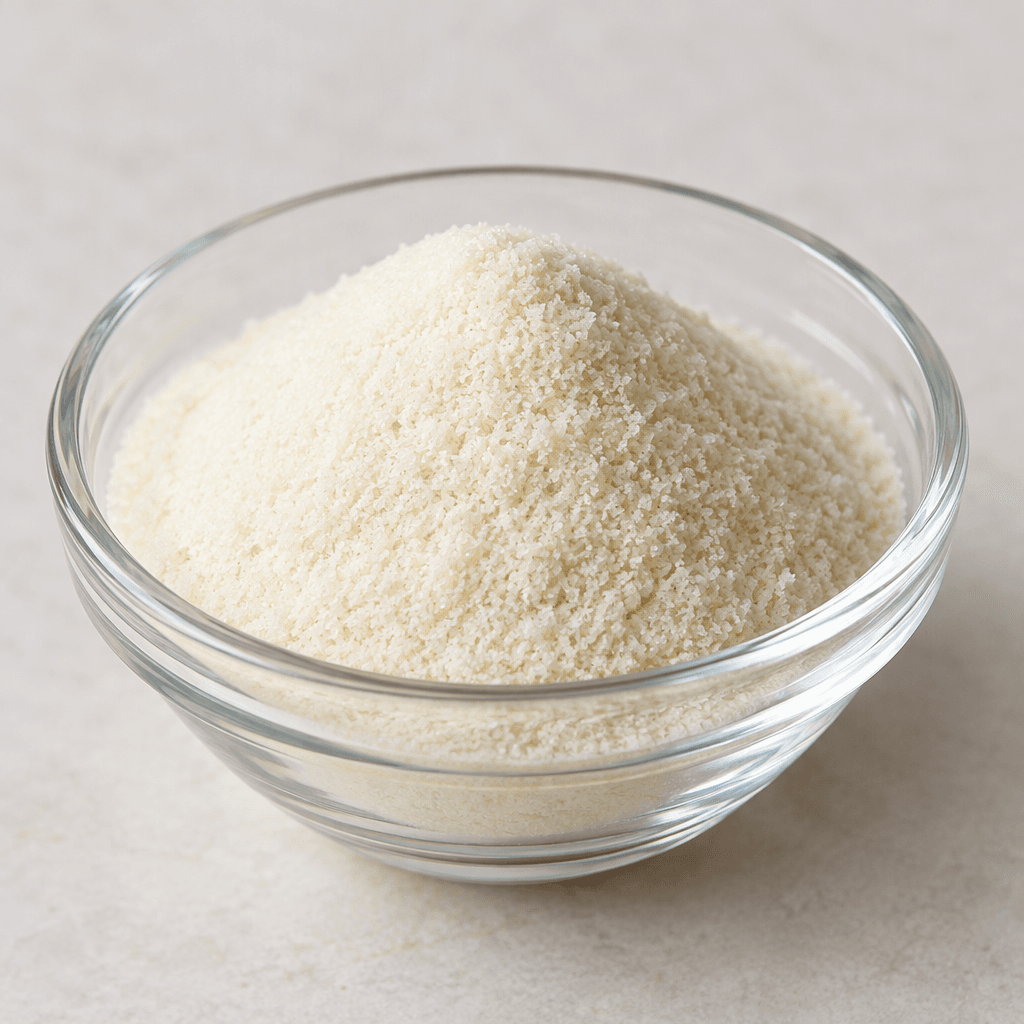
Gelatin Calories
Animal protein source, low carbohydrate, gelling agent
CALORIES · 100 G
GI
POTASSIUM · 100 G
FIBER · 100 G
Quick answer
1 tablespoon (medium) of Gelatin (10 g) has 35 calories. That works out to 350 calories per 100 g. It contains 0 g of carbs, 8.5 g of protein, 0 g of fat and 0 g of fiber. Its glycemic index is 0 (low), so it raises blood sugar slowly.
Gelatin Nutrition Facts
Selected: 1 tablespoon (medium) · 10 g
35
KCAL / 10G
Carbs
0g
· 0% DV
Protein
8.5g
· 17% DV
Fat
0g
· 0% DV
Fiber
0g
· 0% DV
DV is the share of the daily value covered, on a 2,000 kcal reference diet.
Calories come from: Carbs 0% · Protein 100% · Fat 0%
Gelatin nutrition facts table · 1 tablespoon (medium) (10 g)
| Nutrient | Amount | % DV |
|---|---|---|
| Calories | 35 kcal | |
| Total fat | 0 g | 0% |
| Saturated fat | 0 g | 0% |
| Trans fat | 0 g | |
| Sodium | 20 mg | 1% |
| Total carbohydrate | 0 g | 0% |
| Fiber | 0 g | 0% |
| Protein | 8.5 g | 17% |
Calories: Calories measure energy. Average daily need is 2,000 kcal. Excess calories are stored as fat, too few cause weight loss.
Carbs: Your body's primary energy source. The brain runs exclusively on carbs. Daily need: 275g.
Protein: Essential for muscle repair and cell growth. Daily need: 50g. Keeps you full and boosts metabolism.
Fat: Needed for hormone production and vitamin absorption. Daily need: 78g. Limit saturated fats, choose unsaturated.
Fiber: Critical for digestive health and satiety. Daily need: 28g. Stabilizes blood sugar, lowers cholesterol.

Log this food in EatBetter
100,000+ people use it
- Get your daily calorie target
- Snap your meal, log it in seconds
- See every vitamin and mineral

📸 Scan the code to get the app free.

How Many Calories in 1 Tablespoon of Gelatin?
| Serving | Amount | Calories |
|---|---|---|
| 1 tablespoon (medium) | 10 g | 35 kcal |
| 1 teaspoon (small) | 3 g | 11 kcal |
| 1 piece (small) | 5 g | 18 kcal |
| 1 pack (mini) | 7 g | 25 kcal |
| 1 serving (medium) | 15 g | 53 kcal |
| 2 tablespoon (large) | 20 g | 70 kcal |
| 100 g | 100 g | 350 kcal |
| 1 cup (large) | 240 g | 840 kcal |
Calculated from 350 calories per 100 g.
Frequently Asked Questions About Gelatin
What is gelatin made from?
Gelatin is made by extracting collagen from animal tissues, commonly the skin, bones, or connective tissue of cattle or pigs. The source varies by product, so the word “gelatin” alone does not identify which animal was used.
How do you bloom gelatin?
To bloom powdered gelatin, sprinkle it evenly over cold water or another cold liquid and let it absorb the liquid until swollen. Then dissolve it gently in a warm mixture; adding it straight to hot liquid can leave lumps.
Is gelatin vegan?
No. Conventional gelatin is made from animal collagen, so it is not vegan. Agar, pectin, and some carrageenan products can set foods without animal-derived gelatin, but each behaves differently in recipes.
Does gelatin expire?
Yes, gelatin can lose quality over time, especially if moisture gets into the package. Keep it tightly sealed in a cool, dry place and follow the date and storage instructions printed on its packaging.
Why is my gelatin dessert not setting?
A gelatin dessert may not set if the gelatin was not fully dissolved, too little was used, or an enzyme-rich fresh fruit was added. Bloom the gelatin first, dissolve it gently, and chill the mixture until firm.
How much gelatin do I need to set a liquid?
The amount depends on the gelatin’s form and the firmness you want. Use the recipe or packet guidance for its stated liquid quantity; powdered gelatin and sheets are not always interchangeable by volume or piece count.
Is gelatin the same as collagen peptides?
No. Gelatin is collagen that has been altered by heat and forms a gel as it cools. Collagen peptides are processed into smaller pieces that dissolve more readily and do not set liquids into a gel.
Why does fresh pineapple stop gelatin from setting?
Fresh pineapple contains bromelain, an enzyme that breaks down gelatin proteins and prevents a firm set. Cooking the pineapple deactivates the enzyme; canned pineapple is usually heat-treated and can generally be used in gelatin desserts.
Can you freeze gelatin desserts?
You can freeze them, but the texture often suffers after thawing. A gelatin dessert may release liquid or turn grainy, so chilling it in the refrigerator is a better way to set and store it.
Is gelatin halal?
Gelatin is halal only when its animal source and production meet halal requirements. Look for recognized halal certification; a label stating “beef gelatin” by itself does not confirm how the animal was sourced or slaughtered.
Gelatin Vitamins & Minerals
Vitamins
Vitamin A
0µg · 0% DV
B1
0mg · 0% DV
B2
0mg · 0% DV
B3
0mg · 0% DV
Minerals
Sodium
20mg · 1% DV
Copper
0.01mg · 1% DV
Phosphorus
3mg · 0% DV
Iron
0.05mg · 0% DV
Potassium ⭐
0.1mg · 0% DV
Gelatin Glycemic Index
GLYCEMIC INDEX
GLYCEMIC LOAD
Accounts for portion size — a more realistic measure than GI alone.
How to Burn Off Gelatin
To burn the 35 calories in 1 tablespoon (medium) (10 g):
🚶
Walking (5 km/h)
🏃
Running (8 km/h)
🚴
Cycling
🏊
Swimming
Times are calculated with the MET equation for a 70 kg adult. Actual burn varies with your weight, age and pace.
What is Gelatin?
Gelatin is a gelling ingredient made from collagen in animal connective tissue, sold as powder or thin sheets. It is used in desserts and other dishes to help liquids set, from fruit jellies and cheesecakes to mousse and savoury aspics.
Its flavour is neutral, and once dissolved and chilled it gives mixtures a soft, springy texture. Bloom the powder in cold water first, or soak sheets as directed, then stir into a warm mixture. Gelatin is almost entirely protein—85 g per 100 g—with no carbohydrate or fat, though recipes usually use only a little. Because it comes from animals, choose agar-agar or another plant-based setting agent for vegetarian cooking.
How Nutritious Is Gelatin?
Nutrient density
Medium
How many vitamins, minerals and how much fiber this food carries per calorie. A high score means a lot of nutrition for few calories.
Satiety score
Medium
An EatBetter score computed from fiber, protein and calorie density. A high score means staying full longer on the same calories.
Both scores are calculated per 100 g and do not change with the selected portion. The satiety score is EatBetter's own calculation, not a clinical measure.
Is Gelatin Processed?
NOVA 2
Minimally Processed
1. Unprocessed
2. Minimally Processed
3. Processed
4. Ultra-Processed
NOVA classifies foods into 4 groups by industrial processing. NOVA 1 (unprocessed) is the healthiest.
Does Gelatin Contain Allergens?
No known major allergens
Which Diets Is Gelatin Good For?
Vegan
— Not suitable
Vegetarian
— Not suitable
Gluten-Free
✓ Suitable
Dairy-Free
— Not suitable
Mediterranean
✓ Suitable
Paleo
✓ Suitable
Whole30
— Not suitable
DASH
— Not suitable
Keto
✓ Suitable
Low FODMAP
— Not suitable
Gelatin Fat Profile
SATURATED
0g
MONOUNSATURATED
0g
POLYUNSATURATED
0g
Compare Gelatin
Foods Similar to Gelatin
Have another question about Gelatin?
Ask the AI nutrition coach — calories, portions, alternatives and more, answered in seconds in the app.

Scan calories with your camera
Instant AI nutrition analysis

Nutrition data compiled from USDA FoodData Central and scientific sources.