

Ready & Packaged Foods
All →Vegetables & Legumes
All →Desserts & Confectionery
All →Meat & Protein
All →Grains & Bakery
All →Beverages
All →Milk & Dairy
All →

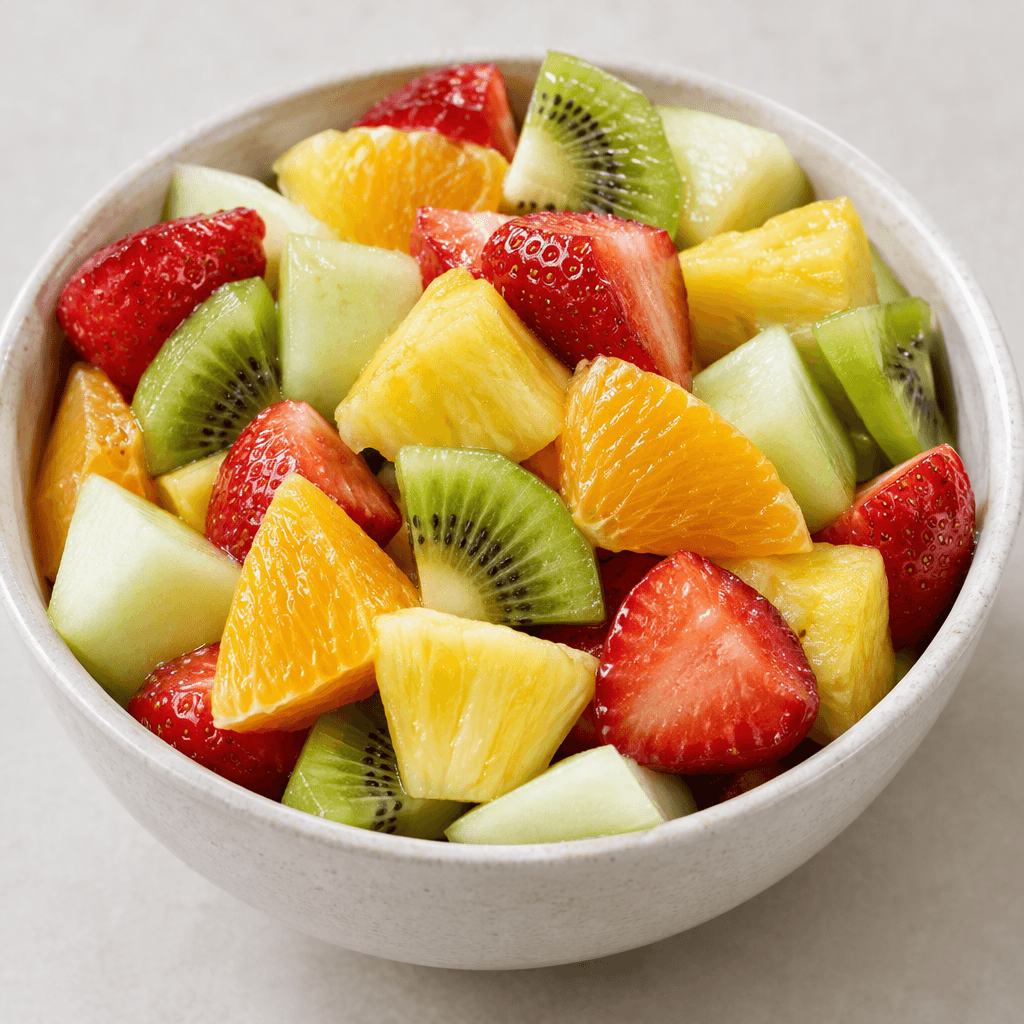
Fruit salad Calories
Refreshing mixed fruit, rich in vitamins and fiber
In season: Spring · Summer · Autumn · Winter
CALORIES
GI
POTASSIUM
FIBER
Quick answer
1 cup (medium) of Fruit salad (150 g) has 83 calories. That works out to 55 calories per 100 g. It contains 19.8 g of carbs, 1 g of protein, 0.3 g of fat and 3.2 g of fiber. Its 37.5 mg of Vitamin C covers 42% of the Daily Value. Its glycemic index is 50 (medium), so it raises blood sugar at a moderate pace.
What is Fruit salad?
Fruit salad brings together bite-sized pieces of fresh fruit—often a mix of sweet, tart and juicy varieties—in a simple bowl. It has no single place of origin: versions are made around the world, with the fruit chosen according to season and local availability. The pieces keep their distinct colours and textures, while their juices mingle as the salad rests.
It works as a breakfast side, a light snack or a fresh finish to a meal, and is often served chilled. In English-speaking homes, the mix may be adapted to whatever fruit is ripe or on hand; extra syrup is optional, not essential. It provides fibre and naturally occurring carbohydrates, and pairs well with plain yoghurt when you want a more filling snack.
Fruit salad Nutrition Facts
Selected: 100 g
55
KCAL / 100G
Carbs
13.2g
· 5% DV
Protein
0.7g
· 1% DV
Fat
0.2g
· 0% DV
Fiber
2.1g
· 8% DV
DV is the share of the daily value covered, on a 2,000 kcal reference diet.
Calories come from: Carbs 92% · Protein 5% · Fat 3%

Log this food in EatBetter
100,000+ people use it
- Get your daily calorie target
- Snap your meal, log it in seconds
- See every vitamin and mineral

📸 Scan the code to get the app free.

Fruit salad Vitamins & Minerals
Vitamins
Vitamin C
25mg · 28% DV
Folate
18µg · 5% DV
B6
0.07mg · 4% DV
B5
0.2mg · 4% DV
Minerals
Potassium ⭐
180mg · 5% DV
Magnesium
11mg · 3% DV
Phosphorus
17mg · 2% DV
Copper
0mg · 0% DV
How Nutritious Is Fruit salad?
Nutrient density
High
How many vitamins, minerals and how much fiber this food carries per calorie. A high score means a lot of nutrition for few calories.
Satiety score
Medium
An EatBetter score computed from fiber, protein and calorie density. A high score means staying full longer on the same calories.
Both scores are calculated per 100 g and do not change with the selected portion. The satiety score is EatBetter's own calculation, not a clinical measure.
Fruit salad Glycemic Index
GLYCEMIC INDEX
GLYCEMIC LOAD
Accounts for portion size — a more realistic measure than GI alone.
How to Burn Off Fruit salad
To burn the 55 calories in 100 g:
🚶
Walking (5 km/h)
🏃
Running (8 km/h)
🚴
Cycling
🏊
Swimming
Times are calculated with the MET equation for a 70 kg adult. Actual burn varies with your weight, age and pace.
Is Fruit salad Processed?
NOVA 2
Minimally Processed
1. Unprocessed
2. Minimally Processed
3. Processed
4. Ultra-Processed
NOVA classifies foods into 4 groups by industrial processing. NOVA 1 (unprocessed) is the healthiest.
Does Fruit salad Contain Allergens?
No known major allergens
Which Diets Is Fruit salad Good For?
Vegan
✓ Suitable
Vegetarian
✓ Suitable
Gluten-Free
✓ Suitable
Dairy-Free
— Not suitable
Mediterranean
✓ Suitable
Paleo
✓ Suitable
Whole30
— Not suitable
DASH
— Not suitable
Keto
— Not suitable
Low FODMAP
— Not suitable
Fruit salad Fat Profile
SATURATED
0.03g
MONOUNSATURATED
0.02g
POLYUNSATURATED
0.03g
Omega 6:3 ratio 2:1
Below the ideal 4:1 — a good omega balance.
Compare Fruit salad
Foods Similar to Fruit salad
Frequently Asked Questions About Fruit salad
What fruit is best for fruit salad?
A mix of firm and juicy fruit works best in fruit salad, such as apples, grapes, strawberries, oranges, kiwi and melon. Choose fruit that is ripe but not mushy, and avoid using too much very juicy fruit if you want the salad to stay crisp.
How do you make fruit salad?
To make fruit salad, wash and dry the fruit, peel it if needed, and cut it into bite-sized pieces. Add delicate fruit last, toss apples or bananas with a little citrus juice to slow browning, and chill the salad until serving.
How do you keep fruit salad from turning brown?
Toss cut apples and bananas with lemon or orange juice to slow browning in fruit salad. Keep the salad covered and refrigerated, and add the most delicate fruit just before serving; citrus helps, but it cannot keep cut fruit looking fresh indefinitely.
How long does fruit salad last in the fridge?
Fruit salad usually keeps for 3–4 days in a covered container in the refrigerator. Its texture is best during the first day or two, since cut fruit releases juice over time. Discard it if it smells off or looks spoiled.
Can you make fruit salad the night before?
Yes, you can prepare fruit salad the night before, but keep the cut fruit covered and chilled. For the freshest texture, store browning-prone fruit such as apples and bananas separately and toss everything together shortly before serving.
What dressing goes well with fruit salad?
A squeeze of lime or orange juice makes a light dressing for fruit salad and helps keep some cut fruit from browning. For a creamy version, serve it with yogurt; add either just before serving so the fruit does not become watery.
Can you use frozen fruit in fruit salad?
Yes, you can use frozen fruit in fruit salad, but thawed pieces are softer and release more liquid than fresh fruit. Thaw and drain them first, then fold them in shortly before serving; they work especially well in a chilled, spoonable version.
Why is my fruit salad watery?
Fruit salad becomes watery when cut fruit releases its juices, especially after sitting or when very juicy fruit is mixed in. Drain canned fruit thoroughly, cut the fruit close to serving time, and add any dressing only at the end.
Can you freeze fruit salad?
You can freeze fruit salad, but it will not keep its fresh, firm texture after thawing. The fruit tends to soften and release liquid, so use thawed fruit in smoothies or sauces rather than expecting it to serve like freshly cut salad.
What should you serve with fruit salad?
Fruit salad pairs well with yogurt, oatmeal, pancakes or a light dessert such as cake. For a brunch spread, serve it chilled alongside savory dishes; keep creamy toppings separate until serving so the fruit stays fresher.
Have another question about Fruit salad?
Ask the AI nutrition coach — calories, portions, alternatives and more, answered in seconds in the app.

Scan calories with your camera
Instant AI nutrition analysis

Nutrition data compiled from USDA FoodData Central and scientific sources.