

Ready & Packaged Foods
All →Vegetables & Legumes
All →Desserts & Confectionery
All →Meat & Protein
All →Grains & Bakery
All →Beverages
All →Milk & Dairy
All →

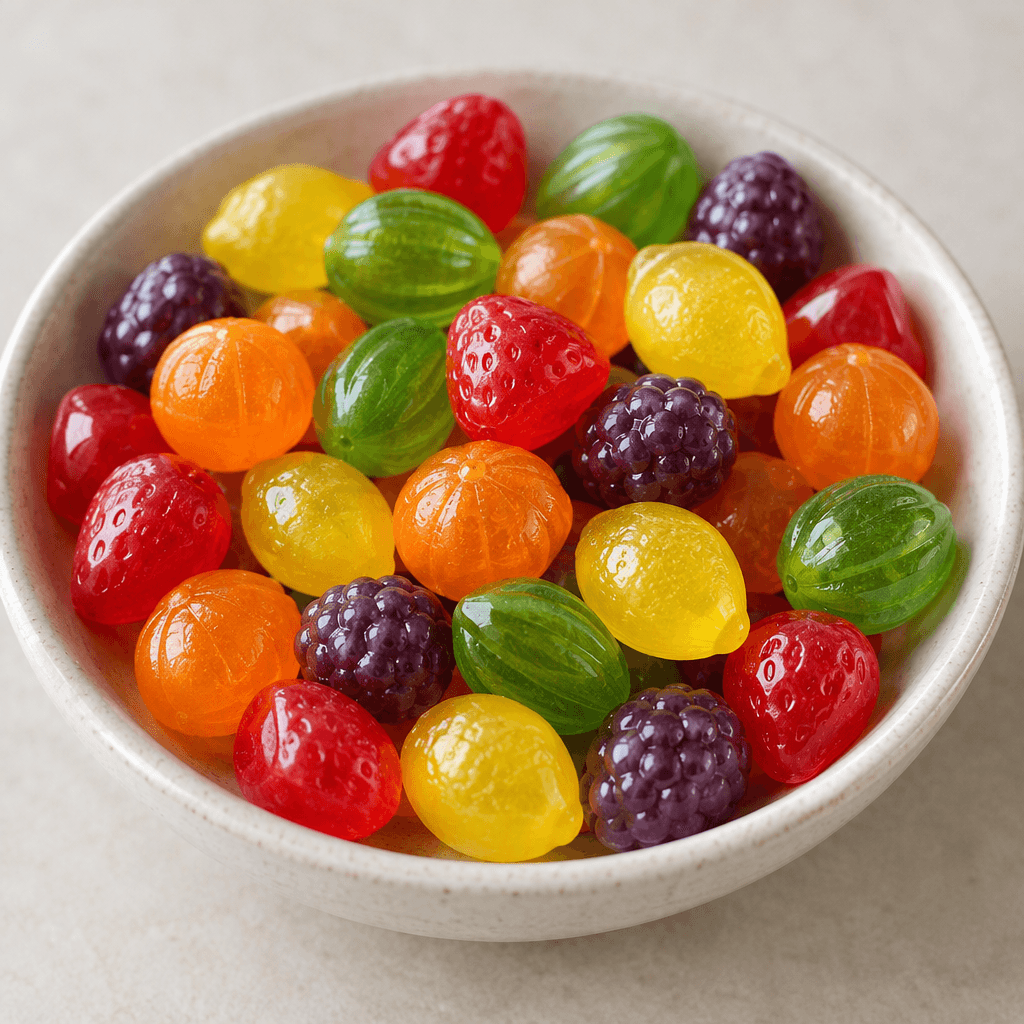
Fruit Candy Calories
Colorful, fruit-flavored candy; high sugar, low nutrients
CALORIES
GI
POTASSIUM
FIBER
Quick answer
5 piece (medium) of Fruit Candy (25 g) has 98 calories. That works out to 390 calories per 100 g. It contains 24.3 g of carbs, 0 g of protein, 0 g of fat and 0 g of fiber. Its glycemic index is 80 (high), so it raises blood sugar quickly.
What is Fruit Candy?
Fruit Candy is a small, glossy hard sweet made by boiling sugar and adding fruit-style flavourings and colour. It is usually sold in assorted bright colours and shapes; the flavour is confectionery-like rather than a serving of actual fruit.
People enjoy it as an occasional sweet, often from a shared candy dish or alongside tea and coffee. Letting a piece dissolve slowly suits its firm texture. Fruit Candy is almost entirely carbohydrate, with 97 g per 100 g, and provides no fibre or protein. For a less sugary snack, have just a few pieces and pair them with fresh fruit or an unsweetened drink.
Fruit Candy Nutrition Facts
Selected: 100 g
390
KCAL / 100G
Carbs
97g
· 35% DV
Protein
0g
· 0% DV
Fat
0.1g
· 0% DV
Fiber
0g
· 0% DV
DV is the share of the daily value covered, on a 2,000 kcal reference diet.
Calories come from: Carbs 100% · Protein 0% · Fat 0%
Fruit Candy Vitamins & Minerals
Vitamins
Vitamin A
0µg · 0% DV
B1
0mg · 0% DV
B2
0mg · 0% DV
B3
0mg · 0% DV
Minerals
Calcium
2mg · 0% DV
Iron
0mg · 0% DV
Magnesium
1mg · 0% DV
Zinc
0mg · 0% DV
How Nutritious Is Fruit Candy?
Nutrient density
Low
How many vitamins, minerals and how much fiber this food carries per calorie. A high score means a lot of nutrition for few calories.
Satiety score
Low
An EatBetter score computed from fiber, protein and calorie density. A high score means staying full longer on the same calories.
Both scores are calculated per 100 g and do not change with the selected portion. The satiety score is EatBetter's own calculation, not a clinical measure.
Fruit Candy Glycemic Index
GLYCEMIC INDEX
GLYCEMIC LOAD
Accounts for portion size — a more realistic measure than GI alone.
How to Burn Off Fruit Candy
To burn the 390 calories in 100 g:
🚶
Walking (5 km/h)
🏃
Running (8 km/h)
🚴
Cycling
🏊
Swimming
Times are calculated with the MET equation for a 70 kg adult. Actual burn varies with your weight, age and pace.
Is Fruit Candy Processed?
NOVA 4
Ultra-Processed
1. Unprocessed
2. Minimally Processed
3. Processed
4. Ultra-Processed
NOVA classifies foods into 4 groups by industrial processing. NOVA 1 (unprocessed) is the healthiest.
Does Fruit Candy Contain Allergens?
No known major allergens
Which Diets Is Fruit Candy Good For?
Vegan
✓ Suitable
Vegetarian
✓ Suitable
Gluten-Free
— Not suitable
Dairy-Free
— Not suitable
Mediterranean
— Not suitable
Paleo
— Not suitable
Whole30
— Not suitable
DASH
— Not suitable
Keto
— Not suitable
Low FODMAP
— Not suitable
Fruit Candy Fat Profile
SATURATED
0.05g
MONOUNSATURATED
0.02g
POLYUNSATURATED
0.01g
Compare Fruit Candy
Foods Similar to Fruit Candy
Frequently Asked Questions About Fruit Candy
What is fruit candy made of?
Fruit candy is usually made from sugar or glucose syrup, plus flavorings and coloring. The bright, translucent hard candies often contain fruit-like flavor rather than pieces of fruit, so ingredients vary by product.
Does fruit candy contain real fruit?
Usually not much, if any: fruit candy often gets its taste from flavorings rather than whole fruit. Look for fruit juice or purée in the ingredient list if you want to know whether a particular candy contains real fruit.
How is fruit candy made?
Fruit candy is made by heating sugar and syrup until the mixture becomes concentrated, then adding flavor and color before shaping and cooling it. Hot sugar syrup can cause severe burns, so making hard candy at home requires care.
Why is fruit candy hard and shiny?
Fruit candy becomes hard when concentrated sugar syrup cools into a glass-like solid. Its smooth, glossy surface comes from the cooked candy and its mold; it does not mean the candy contains real fruit.
How should you store fruit candy?
Keep fruit candy in a sealed container in a cool, dry place. Humidity can make the pieces sticky and cause them to clump together, so reseal the package after opening and keep it away from heat.
Does fruit candy go bad?
Fruit candy can absorb moisture, become sticky, and lose flavor over time. Follow the date on the package, and discard candy if its packaging is damaged or the pieces have an unusual appearance or smell.
Is fruit candy safe for toddlers?
No, hard fruit candy can be a choking hazard for toddlers because it is small, smooth, and difficult to chew. Avoid giving it to young children; older children should eat it while seated and supervised.
Is fruit candy bad for your teeth?
Fruit candy can contribute to tooth decay because its sugar feeds mouth bacteria, and sucking on it keeps sugar in contact with teeth for longer. Having it less often and drinking water afterward can reduce exposure.
Can people with diabetes eat fruit candy?
Fruit candy is concentrated sugar and can raise blood glucose quickly. People with diabetes should account for it in their eating plan; ask your clinician or dietitian how it fits with your individual treatment plan.
Can you make fruit candy with real fruit juice?
Yes, you can make fruit candy with fruit juice, but juice adds water and can change how the sugar mixture sets. A small amount of concentrated juice or purée is easier to work with than a large volume of liquid.
Have another question about Fruit Candy?
Ask the AI nutrition coach — calories, portions, alternatives and more, answered in seconds in the app.

Scan calories with your camera
Instant AI nutrition analysis

Nutrition data compiled from USDA FoodData Central and scientific sources.