

Ready & Packaged Foods
All →Vegetables & Legumes
All →Desserts & Confectionery
All →Meat & Protein
All →Grains & Bakery
All →Beverages
All →Milk & Dairy
All →

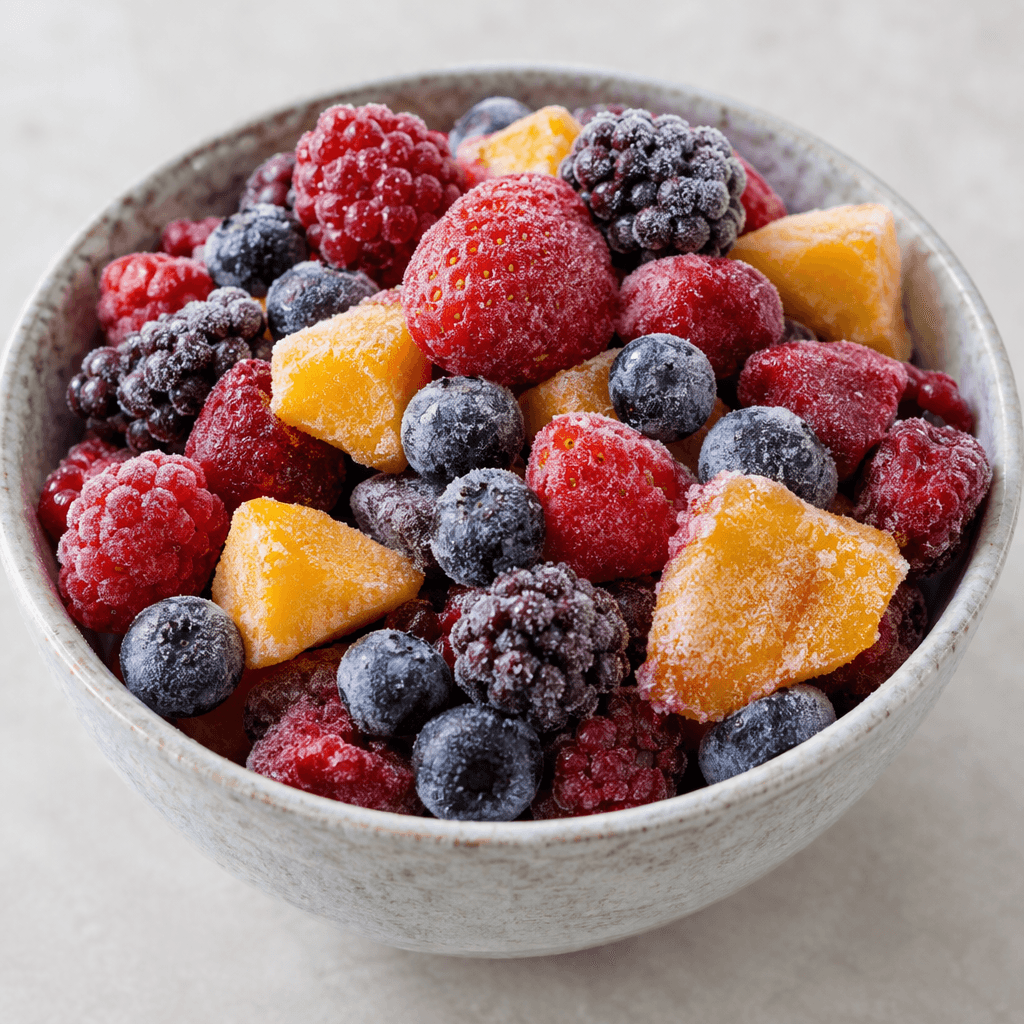
Frozen Fruit Calories
Rich in vitamins and fiber, convenient and long-lasting
In season: Spring · Summer · Autumn · Winter
CALORIES
GI
POTASSIUM
FIBER
Quick answer
1 cup (medium) of Frozen Fruit (140 g) has 70 calories. That works out to 50 calories per 100 g. It contains 16.8 g of carbs, 1 g of protein, 0.3 g of fat and 3.2 g of fiber. Its 25.2 mg of Vitamin C covers 28% of the Daily Value. Its glycemic index is 40 (low), so it raises blood sugar slowly.
What is Frozen Fruit?
Frozen fruit is whole or cut fruit—often berries, though mixes can include other fruits—that has been washed and frozen for storage. Once thawed, it is softer and juicier than fresh fruit; straight from the freezer, it blends easily into smoothies. It is commonly stirred into porridge or yoghurt at breakfast, spooned over desserts, or used in baking and sauces. In places where fresh berries are seasonal or costly, it offers a convenient way to keep fruit on hand.
It is mostly water and natural carbohydrates, with fibre levels varying by fruit; this serving provides 2.3 g per 100 g. Pair it with plain yoghurt or oats for a simple, filling snack, and take out only what you need.
Frozen Fruit Nutrition Facts
Selected: 100 g
50
KCAL / 100G
Carbs
12g
· 4% DV
Protein
0.7g
· 1% DV
Fat
0.2g
· 0% DV
Fiber
2.3g
· 8% DV
DV is the share of the daily value covered, on a 2,000 kcal reference diet.
Calories come from: Carbs 91% · Protein 5% · Fat 4%
Frozen Fruit Vitamins & Minerals
Vitamins
Vitamin C
18mg · 20% DV
Vitamin E
0.7mg · 5% DV
B5
0.2mg · 4% DV
Folate
15µg · 4% DV
Minerals
Potassium ⭐
120mg · 4% DV
Magnesium
10mg · 2% DV
Phosphorus
16mg · 2% DV
Calcium
14mg · 1% DV
How Nutritious Is Frozen Fruit?
Nutrient density
High
How many vitamins, minerals and how much fiber this food carries per calorie. A high score means a lot of nutrition for few calories.
Satiety score
Medium
An EatBetter score computed from fiber, protein and calorie density. A high score means staying full longer on the same calories.
Both scores are calculated per 100 g and do not change with the selected portion. The satiety score is EatBetter's own calculation, not a clinical measure.
Frozen Fruit Glycemic Index
GLYCEMIC INDEX
GLYCEMIC LOAD
Accounts for portion size — a more realistic measure than GI alone.
How to Burn Off Frozen Fruit
To burn the 50 calories in 100 g:
🚶
Walking (5 km/h)
🏃
Running (8 km/h)
🚴
Cycling
🏊
Swimming
Times are calculated with the MET equation for a 70 kg adult. Actual burn varies with your weight, age and pace.
Is Frozen Fruit Processed?
NOVA 2
Minimally Processed
1. Unprocessed
2. Minimally Processed
3. Processed
4. Ultra-Processed
NOVA classifies foods into 4 groups by industrial processing. NOVA 1 (unprocessed) is the healthiest.
Does Frozen Fruit Contain Allergens?
No known major allergens
Which Diets Is Frozen Fruit Good For?
Vegan
✓ Suitable
Vegetarian
✓ Suitable
Gluten-Free
✓ Suitable
Dairy-Free
— Not suitable
Mediterranean
✓ Suitable
Paleo
✓ Suitable
Whole30
— Not suitable
DASH
— Not suitable
Keto
— Not suitable
Low FODMAP
— Not suitable
Frozen Fruit Fat Profile
SATURATED
0.03g
MONOUNSATURATED
0.04g
POLYUNSATURATED
0.05g
Omega 6:3 ratio 3:1
Below the ideal 4:1 — a good omega balance.
Compare Frozen Fruit
Foods Similar to Frozen Fruit
Frequently Asked Questions About Frozen Fruit
Is frozen fruit as healthy as fresh fruit?
Yes, frozen fruit is generally comparable to fresh fruit nutritionally. It is often frozen when ripe, which helps preserve nutrients, and it provides fiber. Thawed fruit may release juice, so add that juice to yogurt or smoothies rather than pouring it away.
Can you eat frozen fruit straight from the freezer?
Yes, frozen fruit can usually be eaten straight from the freezer, though it will be hard and icy. Frozen berries have sometimes been linked to foodborne virus outbreaks, so follow any cooking instructions on the pack, especially for recalled products.
Do you need to thaw frozen fruit before using it?
No, you usually do not need to thaw frozen fruit first. Add it directly to smoothies, baking, or hot cereal; thaw it in the refrigerator when you want softer fruit for toppings or a fruit salad.
Can you put frozen fruit straight into a smoothie?
Yes, add frozen fruit directly to the blender for a cold, thick smoothie. Pour in the liquid first, then add the fruit gradually if your blender struggles with hard pieces.
How do you thaw frozen fruit without it getting mushy?
Thaw frozen fruit slowly in a covered container in the refrigerator. It will soften as ice melts, but gentle thawing helps it retain more shape than leaving it at room temperature; drain excess juice if you need a firmer topping.
Can you refreeze frozen fruit after it has thawed?
Yes, you can refreeze fruit thawed in the refrigerator while it is still cold. Its texture may become softer and wetter after thawing and refreezing. Do not refreeze fruit that has been left at room temperature for an extended period.
Do frozen berries need to be cooked before eating?
Not usually, but frozen berries have been associated with viral outbreaks. Follow the package directions and public-health recalls; heating berries until thoroughly hot is a prudent choice for people at higher risk or when cooking instructions call for it.
Can you bake with frozen fruit without thawing it?
Yes, frozen fruit can usually go straight into muffins, pies, and other baked goods. Fold it in while still frozen to limit color bleeding, and expect the fruit to release extra moisture as it cooks.
How long does frozen fruit last in the freezer?
Frozen fruit kept continuously at 0°F (-18°C) remains safe indefinitely, although its flavor and texture gradually decline. For best quality, use it within about 8 to 12 months and keep the package tightly sealed to limit freezer burn.
Why does frozen fruit have ice crystals on it?
Ice crystals form when moisture freezes on the fruit or when temperature changes cause partial thawing and refreezing. A light frost is usually a quality issue, but fruit frozen into a solid mass may have thawed and refrozen.
Have another question about Frozen Fruit?
Ask the AI nutrition coach — calories, portions, alternatives and more, answered in seconds in the app.

Scan calories with your camera
Instant AI nutrition analysis

Nutrition data compiled from USDA FoodData Central and scientific sources.