

Ready & Packaged Foods
All →Vegetables & Legumes
All →Desserts & Confectionery
All →Meat & Protein
All →Grains & Bakery
All →Beverages
All →Milk & Dairy
All →

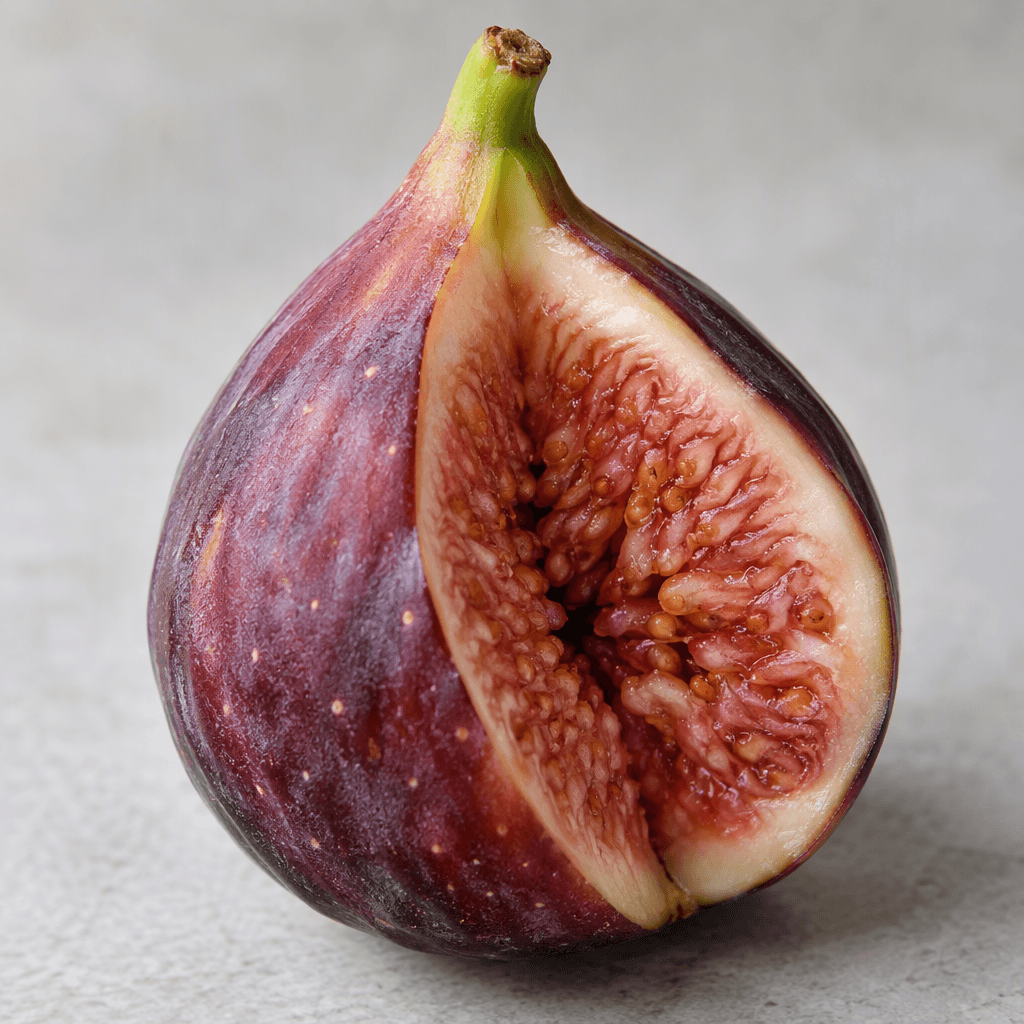
Fresh red fig Calories
Source of fiber and potassium
In season: Summer · Autumn
CALORIES · 100 G
GI
POTASSIUM · 100 G
FIBER · 100 G
Quick answer
1 piece (medium) of Fresh red fig (50 g) has 37 calories. That works out to 74 calories per 100 g. It contains 9.6 g of carbs, 0.4 g of protein, 0.2 g of fat and 1.5 g of fiber. Its glycemic index is 35 (low), so it raises blood sugar slowly.
Fresh red fig Nutrition Facts
Selected: 1 piece (medium) · 50 g
37
KCAL / 50G
Carbs
9.6g
· 3% DV
Protein
0.4g
· 1% DV
Fat
0.2g
· 0% DV
Fiber
1.5g
· 5% DV
DV is the share of the daily value covered, on a 2,000 kcal reference diet.
Calories come from: Carbs 92% · Protein 4% · Fat 4%
Fresh red fig nutrition facts table · 1 piece (medium) (50 g)
| Nutrient | Amount | % DV |
|---|---|---|
| Calories | 37 kcal | |
| Total fat | 0.2 g | 0% |
| Saturated fat | 0.03 g | 0% |
| Trans fat | 0 g | |
| Sodium | 0.5 mg | 0% |
| Total carbohydrate | 9.6 g | 3% |
| Fiber | 1.5 g | 5% |
| Protein | 0.4 g | 1% |
Calories: Calories measure energy. Average daily need is 2,000 kcal. Excess calories are stored as fat, too few cause weight loss.
Carbs: Your body's primary energy source. The brain runs exclusively on carbs. Daily need: 275g.
Protein: Essential for muscle repair and cell growth. Daily need: 50g. Keeps you full and boosts metabolism.
Fat: Needed for hormone production and vitamin absorption. Daily need: 78g. Limit saturated fats, choose unsaturated.
Fiber: Critical for digestive health and satiety. Daily need: 28g. Stabilizes blood sugar, lowers cholesterol.

Log this food in EatBetter
100,000+ people use it
- Get your daily calorie target
- Snap your meal, log it in seconds
- See every vitamin and mineral

📸 Scan the code to get the app free.

How Many Calories in 1 Medium Fresh red fig?
| Serving | Amount | Calories |
|---|---|---|
| 1 piece (medium) | 50 g | 37 kcal |
| 1 piece (small) | 30 g | 22 kcal |
| 1 piece (large) | 70 g | 52 kcal |
| 1 cup (diced) | 75 g | 56 kcal |
| 100 g | 100 g | 74 kcal |
| 2 piece (medium) | 100 g | 74 kcal |
| 1 serving (medium) | 100 g | 74 kcal |
| 3 piece (medium) | 150 g | 111 kcal |
| 1 cup (chopped) | 150 g | 111 kcal |
Calculated from 74 calories per 100 g.
Frequently Asked Questions About Fresh red fig
How can you tell when a fresh red fig is ripe?
A ripe fresh red fig gives slightly when pressed and has a sweet, fruity smell. Choose plump fruit with intact skin; very firm, scentless figs are often underripe, while leaking or sour-smelling ones may be spoiled.
Can you eat the skin of a fresh red fig?
Yes, the skin of a fresh red fig is edible, so peeling is optional. Rinse the fruit gently under running water, pat it dry, and eat it whole or cut it open after removing the stem.
How should you store fresh red figs?
Keep fresh red figs unwashed in the refrigerator, arranged so they are not crushed. They are delicate and do not keep for long, so eat them promptly; wash just before eating and discard any that are moldy or leaking.
Can you freeze fresh red figs?
Yes, fresh red figs can be frozen, but they become soft after thawing. Rinse and dry them thoroughly, remove the stems, and freeze in an airtight container; use thawed figs in smoothies, sauces, or baking rather than expecting fresh-fruit texture.
Why do fresh red figs split open?
Fresh red figs can split as they ripen or take up excess water. Eat a freshly split fig promptly if it smells and looks normal; discard it if the exposed flesh is moldy, sour-smelling, or leaking.
Do fresh red figs ripen after picking?
Fresh red figs do not ripen much after picking. They may soften while stored, but a firm, underripe fig will not develop the same sweetness as one picked ripe, so select fruit that is already slightly soft and fragrant.
What is the difference between a fresh red fig and a black fig?
Fresh red figs typically have reddish skin or flesh, while black figs are named for their darker skin; color alone does not identify a single variety. Taste, texture, and sweetness vary by cultivar and ripeness, so the names are not interchangeable descriptions of one fixed type.
Can you eat a fresh red fig raw?
Yes, fresh red figs are commonly eaten raw, with the skin and tiny seeds included. Rinse one gently, remove the stem if you prefer, and enjoy it whole or sliced; cooking is not needed to make it edible.
When are fresh red figs in season?
Fresh red figs are generally in season in late summer and early autumn, though timing varies by growing region and cultivar. Outside the local harvest, they may be harder to find and less fresh than fruit bought in season.
Can dogs eat fresh red figs?
Dogs can have a small piece of plain fresh red fig, but it is not a necessary part of their diet. Avoid giving large amounts, since the fruit may upset a dog’s stomach, and never offer figs prepared with sweeteners or other ingredients.
Fresh red fig Vitamins & Minerals
Vitamins
B6
0.06mg · 4% DV
B5
0.15mg · 3% DV
B1
0.03mg · 3% DV
Vitamin K
2.35µg · 2% DV
Minerals
Copper
0.04mg · 4% DV
Potassium ⭐
116mg · 3% DV
Manganese
0.07mg · 3% DV
Magnesium
8.5mg · 2% DV
Sodium
0.5mg · 0% DV
Fresh red fig Glycemic Index
GLYCEMIC INDEX
GLYCEMIC LOAD
Accounts for portion size — a more realistic measure than GI alone.
How to Burn Off Fresh red fig
To burn the 37 calories in 1 piece (medium) (50 g):
🚶
Walking (5 km/h)
🏃
Running (8 km/h)
🚴
Cycling
🏊
Swimming
Times are calculated with the MET equation for a 70 kg adult. Actual burn varies with your weight, age and pace.
What is Fresh red fig?
Soft, ripe and often richly coloured inside, a fresh red fig is the edible fruit of the fig tree, widely grown around the Mediterranean and in other warm regions. Its delicate skin is usually eaten too, while the tiny seeds give the flesh a gentle crunch. Choose fruit that yields slightly to the touch and enjoy it soon after buying, as ripe figs bruise easily.
Fresh red figs are eaten on their own, with yoghurt or cheese, and sliced into salads or desserts. They bring fibre and potassium along with natural sweetness, while remaining low in fat. Pair one with plain yoghurt and a few nuts for a more filling snack, or use ripe figs to sweeten porridge without adding sugar.
How Nutritious Is Fresh red fig?
Nutrient density
High
How many vitamins, minerals and how much fiber this food carries per calorie. A high score means a lot of nutrition for few calories.
Satiety score
Medium
An EatBetter score computed from fiber, protein and calorie density. A high score means staying full longer on the same calories.
Both scores are calculated per 100 g and do not change with the selected portion. The satiety score is EatBetter's own calculation, not a clinical measure.
Is Fresh red fig Processed?
NOVA 1
Unprocessed
1. Unprocessed
2. Minimally Processed
3. Processed
4. Ultra-Processed
NOVA classifies foods into 4 groups by industrial processing. NOVA 1 (unprocessed) is the healthiest.
Does Fresh red fig Contain Allergens?
No known major allergens
Which Diets Is Fresh red fig Good For?
Vegan
✓ Suitable
Vegetarian
✓ Suitable
Gluten-Free
✓ Suitable
Dairy-Free
— Not suitable
Mediterranean
✓ Suitable
Paleo
✓ Suitable
Whole30
— Not suitable
DASH
— Not suitable
Keto
— Not suitable
Low FODMAP
— Not suitable
Fresh red fig Fat Profile
SATURATED
0.03g
MONOUNSATURATED
0.04g
POLYUNSATURATED
0.07g
Omega 6:3 ratio 6:1
Above the ideal 4:1 (6:1).
Compare Fresh red fig
Foods Similar to Fresh red fig
Have another question about Fresh red fig?
Ask the AI nutrition coach — calories, portions, alternatives and more, answered in seconds in the app.

Scan calories with your camera
Instant AI nutrition analysis

Nutrition data compiled from USDA FoodData Central and scientific sources.