

Ready & Packaged Foods
All →Vegetables & Legumes
All →Desserts & Confectionery
All →Meat & Protein
All →Grains & Bakery
All →Beverages
All →Milk & Dairy
All →

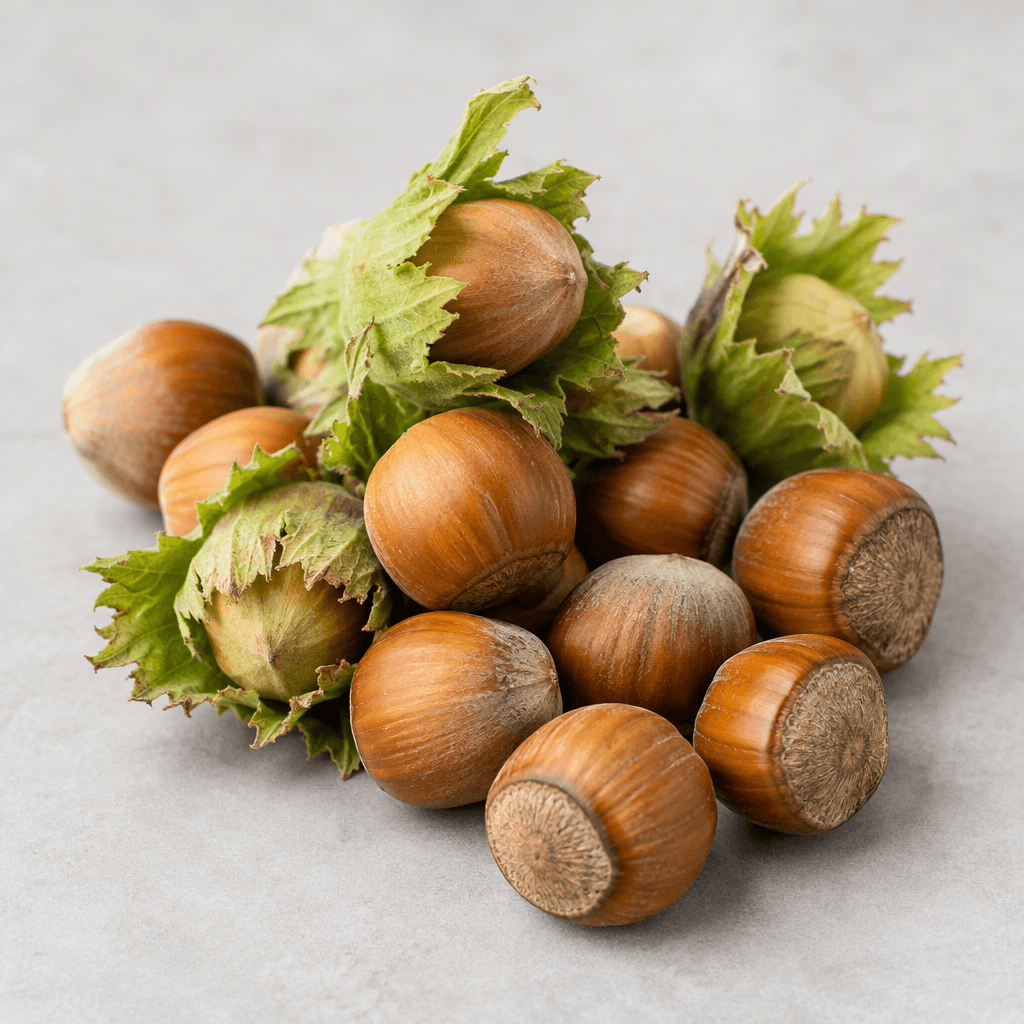
Fresh Hazelnut Calories
Rich in minerals and vitamins, contains healthy fats
In season: Summer · Autumn
CALORIES
GI
POTASSIUM
FIBER
Quick answer
1 piece (medium) of Fresh Hazelnut (15 g) has 44 calories. That works out to 290 calories per 100 g. It contains 2.6 g of carbs, 1.3 g of protein, 3.3 g of fat and 1.1 g of fiber. Its 0.3 mg of Copper covers 28% of the Daily Value. Its glycemic index is 15 (low), so it raises blood sugar slowly.
What is Fresh Hazelnut?
Fresh hazelnuts are newly harvested nuts that have not been dried, often sold in their shells. They are grown in regions including Turkey’s Black Sea coast and parts of Europe, and can be cracked open and eaten as they are. Keep them cool and use them while they are fresh.
Compared with dried hazelnuts, the kernels are softer and moister, with a gentler, greener flavour. In growing regions they are a seasonal snack; elsewhere, look for them at farmers’ markets or specialty shops. Enjoy them on their own, with fruit, or chopped over yoghurt and porridge. Their fat and fibre make them satisfying, with 7.5 g of fibre per 100 g; a light roast brings out a toastier flavour.
Fresh Hazelnut Nutrition Facts
Selected: 100 g
290
KCAL / 100G
Carbs
17g
· 6% DV
Protein
8.5g
· 17% DV
Fat
22g
· 28% DV
Fiber
7.5g
· 27% DV
DV is the share of the daily value covered, on a 2,000 kcal reference diet.
Calories come from: Carbs 23% · Protein 11% · Fat 66%

Log this food in EatBetter
100,000+ people use it
- Get your daily calorie target
- Snap your meal, log it in seconds
- See every vitamin and mineral

📸 Scan the code to get the app free.

Fresh Hazelnut Vitamins & Minerals
Vitamins
Vitamin E
15mg · 100% DV
Biotin
8µg · 27% DV
B1
0.3mg · 25% DV
B6
0.3mg · 18% DV
Minerals
Copper
2mg · 222% DV
Manganese
2mg · 87% DV
Phosphorus
290mg · 41% DV
Magnesium
163mg · 39% DV
Potassium ⭐
680mg · 20% DV
How Nutritious Is Fresh Hazelnut?
Nutrient density
High
How many vitamins, minerals and how much fiber this food carries per calorie. A high score means a lot of nutrition for few calories.
Satiety score
Medium
An EatBetter score computed from fiber, protein and calorie density. A high score means staying full longer on the same calories.
Both scores are calculated per 100 g and do not change with the selected portion. The satiety score is EatBetter's own calculation, not a clinical measure.
Fresh Hazelnut Glycemic Index
GLYCEMIC INDEX
GLYCEMIC LOAD
Accounts for portion size — a more realistic measure than GI alone.
How to Burn Off Fresh Hazelnut
To burn the 290 calories in 100 g:
🚶
Walking (5 km/h)
🏃
Running (8 km/h)
🚴
Cycling
🏊
Swimming
Times are calculated with the MET equation for a 70 kg adult. Actual burn varies with your weight, age and pace.
Is Fresh Hazelnut Processed?
NOVA 1
Unprocessed
1. Unprocessed
2. Minimally Processed
3. Processed
4. Ultra-Processed
NOVA classifies foods into 4 groups by industrial processing. NOVA 1 (unprocessed) is the healthiest.
Does Fresh Hazelnut Contain Allergens?
Contains these allergens:
Which Diets Is Fresh Hazelnut Good For?
Vegan
✓ Suitable
Vegetarian
✓ Suitable
Gluten-Free
✓ Suitable
Dairy-Free
— Not suitable
Mediterranean
✓ Suitable
Paleo
✓ Suitable
Whole30
— Not suitable
DASH
— Not suitable
Keto
✓ Suitable
Low FODMAP
— Not suitable
Fresh Hazelnut Fat Profile
SATURATED
1.7g
MONOUNSATURATED
16g
POLYUNSATURATED
2.7g
Omega 6:3 ratio 34.3:1
Above the ideal 4:1 (34.3:1).
Compare Fresh Hazelnut
Foods Similar to Fresh Hazelnut
Frequently Asked Questions About Fresh Hazelnut
How do you eat fresh hazelnuts?
Crack the hard shell and eat the kernel inside; the leafy green husk is usually discarded. Fresh hazelnut kernels can be eaten as they are, added to salads or breakfast, or roasted for a toastier flavor.
What do fresh hazelnuts taste like?
Fresh hazelnuts have a mild, buttery flavor and a softer, less crisp texture than dried or roasted hazelnuts. Their taste can vary with variety and ripeness, while roasting brings out a stronger, nuttier aroma.
Can you eat fresh hazelnuts raw?
Yes, fresh hazelnuts can be eaten raw once you remove the hard shell and green husk. If the exposed kernels have touched soil or a dirty surface, rinse and dry them before eating.
How do you crack fresh hazelnuts?
Use a nutcracker to break the woody shell without crushing the kernel. If the fresh hazelnuts are still in their green husks, peel those away first; a towel around the nut can help catch shell pieces.
How should you store fresh hazelnuts?
Keep fresh hazelnuts cool and dry, preferably in a breathable container rather than a sealed, damp bag. Refrigerating them can slow spoilage; discard any that develop mold, a rancid smell, or an unpleasant taste.
Can you roast fresh hazelnuts?
Yes, remove the husks and hard shells, then roast the kernels in a pan over low to medium heat or in an oven. Stir or turn them often and stop when they smell fragrant, before they burn.
How are fresh hazelnuts different from dried hazelnuts?
Fresh hazelnuts contain more moisture, so their kernels tend to be softer and their flavor milder. Dried hazelnuts are firmer and keep longer; fresh ones need prompt use or drying before longer storage.
How do you dry fresh hazelnuts at home?
Spread the fresh hazelnuts in a single layer in a dry, well-ventilated, shaded place and turn them occasionally. Protect them from rain and damp air, and wait until the kernels are thoroughly dry before storing them in a closed container.
When are fresh hazelnuts ripe enough to harvest?
Fresh hazelnuts are ready when the kernels have filled out and begin to separate readily from their husks. The husks may turn from green toward yellow or brown, but harvest timing varies by cultivar and growing region.
Can fresh hazelnuts be frozen?
Yes, remove the shells, dry the kernels well, and freeze them in an airtight container. Freezing helps preserve them for later use; portioning them before freezing makes it easier to take out only what you need.
Have another question about Fresh Hazelnut?
Ask the AI nutrition coach — calories, portions, alternatives and more, answered in seconds in the app.

Scan calories with your camera
Instant AI nutrition analysis

Nutrition data compiled from USDA FoodData Central and scientific sources.