

Ready & Packaged Foods
All →Vegetables & Legumes
All →Desserts & Confectionery
All →Meat & Protein
All →Grains & Bakery
All →Beverages
All →Milk & Dairy
All →

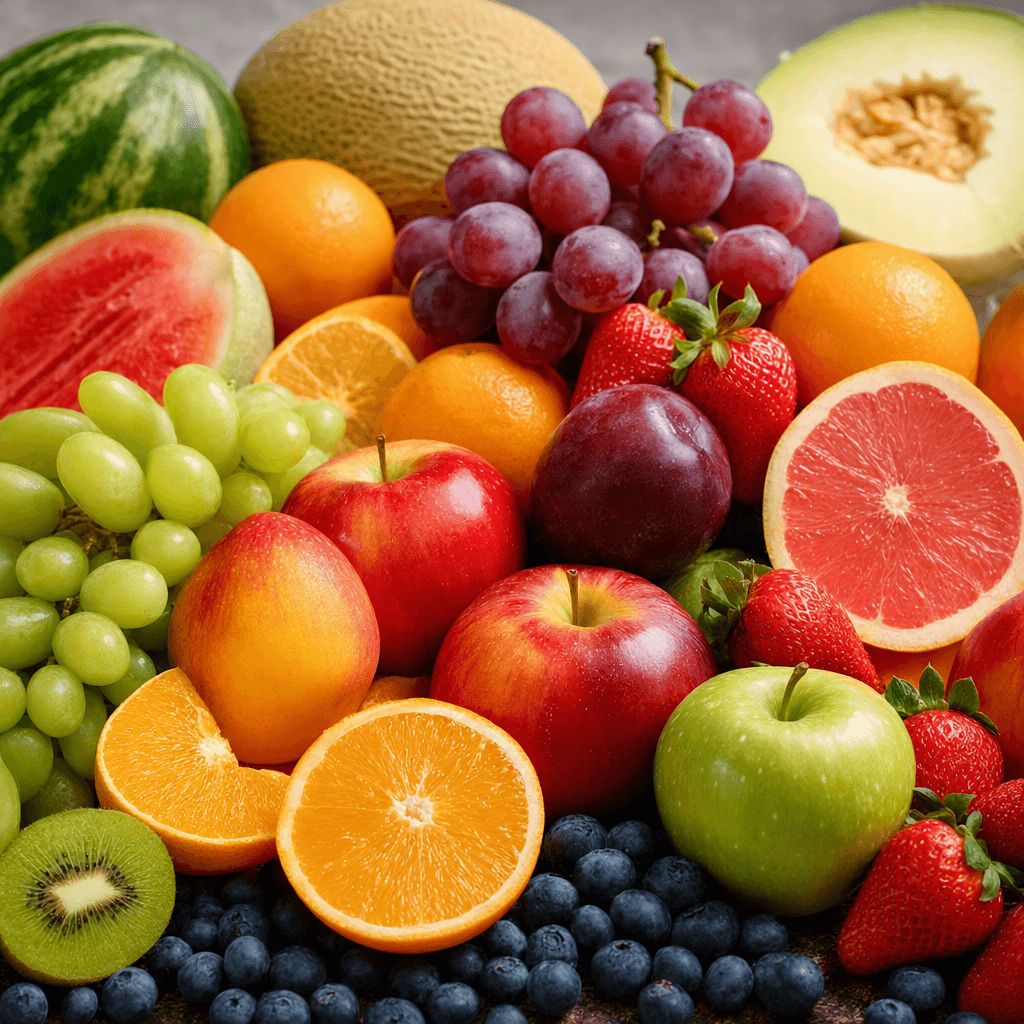
Fresh fruits Calories
Rich in vitamins and fiber, low calorie
In season: Spring · Summer · Autumn · Winter
CALORIES
GI
POTASSIUM
FIBER
Quick answer
1 cup (medium) of Fresh fruits (150 g) has 75 calories. That works out to 50 calories per 100 g. It contains 18 g of carbs, 1 g of protein, 0.3 g of fat and 3.2 g of fiber. Its 27 mg of Vitamin C covers 30% of the Daily Value. Its glycemic index is 45 (low), so it raises blood sugar slowly.
What is Fresh fruits?
Fresh fruits are the edible fruits of plants, eaten whole or cut into pieces; a selection might include apples, oranges, grapes, strawberries and melon. Which ones are available depends on the season and where you live, so the mix varies from place to place.
Their textures range from crisp and firm to soft and juicy, with sweetness and tartness varying by fruit. Enjoy them at breakfast, as a snack, or sliced into porridge, yoghurt or a fruit salad. They contribute water and fibre, while remaining relatively low in calories; 100 g provides 2.1 g of fibre. For an easy, more filling snack, pair a few pieces of fruit with plain yoghurt or a small handful of nuts.
Fresh fruits Nutrition Facts
Selected: 100 g
50
KCAL / 100G
Carbs
12g
· 4% DV
Protein
0.7g
· 1% DV
Fat
0.2g
· 0% DV
Fiber
2.1g
· 8% DV
DV is the share of the daily value covered, on a 2,000 kcal reference diet.
Calories come from: Carbs 91% · Protein 5% · Fat 4%
Fresh fruits Vitamins & Minerals
Vitamins
Vitamin C
18mg · 20% DV
B5
0.2mg · 4% DV
B6
0.06mg · 4% DV
B1
0.03mg · 3% DV
Minerals
Potassium ⭐
120mg · 4% DV
Magnesium
8mg · 2% DV
Phosphorus
15mg · 2% DV
Calcium
10mg · 1% DV
How Nutritious Is Fresh fruits?
Nutrient density
Very high
How many vitamins, minerals and how much fiber this food carries per calorie. A high score means a lot of nutrition for few calories.
Satiety score
Medium
An EatBetter score computed from fiber, protein and calorie density. A high score means staying full longer on the same calories.
Both scores are calculated per 100 g and do not change with the selected portion. The satiety score is EatBetter's own calculation, not a clinical measure.
Fresh fruits Glycemic Index
GLYCEMIC INDEX
GLYCEMIC LOAD
Accounts for portion size — a more realistic measure than GI alone.
How to Burn Off Fresh fruits
To burn the 50 calories in 100 g:
🚶
Walking (5 km/h)
🏃
Running (8 km/h)
🚴
Cycling
🏊
Swimming
Times are calculated with the MET equation for a 70 kg adult. Actual burn varies with your weight, age and pace.
Is Fresh fruits Processed?
NOVA 1
Unprocessed
1. Unprocessed
2. Minimally Processed
3. Processed
4. Ultra-Processed
NOVA classifies foods into 4 groups by industrial processing. NOVA 1 (unprocessed) is the healthiest.
Does Fresh fruits Contain Allergens?
No known major allergens
Which Diets Is Fresh fruits Good For?
Vegan
✓ Suitable
Vegetarian
✓ Suitable
Gluten-Free
✓ Suitable
Dairy-Free
— Not suitable
Mediterranean
✓ Suitable
Paleo
✓ Suitable
Whole30
— Not suitable
DASH
— Not suitable
Keto
— Not suitable
Low FODMAP
— Not suitable
Fresh fruits Fat Profile
SATURATED
0.03g
MONOUNSATURATED
0.02g
POLYUNSATURATED
0.04g
Omega 6:3 ratio 3:1
Below the ideal 4:1 — a good omega balance.
Compare Fresh fruits
Foods Similar to Fresh fruits
Frequently Asked Questions About Fresh fruits
How should fresh fruits be stored to stay fresh longer?
Store fresh fruits according to their ripeness and type: refrigerate delicate berries and grapes, but let firm, unripe fruit ripen on the counter. Keep fruit dry and remove bruised pieces, since moisture and damaged spots can encourage spoilage.
Should you wash fresh fruits before storing them?
No, wash fresh fruits just before eating them rather than before storage. Extra moisture can encourage mold, especially on berries. If you have already washed them, dry them thoroughly before refrigerating.
How do you stop cut fresh fruits from turning brown?
Coat cut apples, pears, or bananas with a little lemon or lime juice to slow browning. Store the pieces in an airtight container in the refrigerator; this helps preserve their appearance but does not make them keep indefinitely.
Can you freeze fresh fruits?
Yes, most fresh fruits can be frozen, though thawing often makes them softer. Wash and dry them, remove pits or stems, and freeze pieces in a single layer before packing them into a sealed container. Use thawed fruit in smoothies or cooking.
Do fresh fruits keep ripening after they are picked?
Some fresh fruits continue to ripen after picking, including bananas, peaches, and pears; others, such as grapes and strawberries, do not significantly ripen further. Leave unripe fruit at room temperature, then refrigerate it once ripe to slow spoilage.
Can you eat the skin of fresh fruits?
Yes, the skin of many fresh fruits, including apples and pears, is edible and contributes fiber. Rinse the fruit under running water and rub the surface before eating; discard damaged or moldy parts.
Are fresh fruits better than canned or dried fruit?
Fresh fruits are not automatically better in every situation, but they provide water and are eaten in their whole form. Canned fruit may contain added syrup, while dried fruit is more concentrated, so compare ingredients and portions when choosing.
Can people with diabetes eat fresh fruits?
Yes, people with diabetes can include fresh fruits in their meals. Whole fruit provides fiber, while juice is easier to consume quickly and has less fiber. Suitable portions and choices vary with an individual care plan, so ask your clinician or dietitian for personal guidance.
Do fresh fruits cause weight gain?
No, fresh fruits do not inherently cause weight gain. Their fiber and water can make them filling; weight changes are influenced by overall eating patterns. Whole fruit is generally more satisfying than juice or fruit sweetened with sugar.
Is it safe to eat fresh fruits at night?
Yes, eating fresh fruits at night is generally safe, and the time of day does not make fruit uniquely fattening. If a large serving close to bedtime causes discomfort, have a smaller portion earlier.
Have another question about Fresh fruits?
Ask the AI nutrition coach — calories, portions, alternatives and more, answered in seconds in the app.

Scan calories with your camera
Instant AI nutrition analysis

Nutrition data compiled from USDA FoodData Central and scientific sources.