

Ready & Packaged Foods
All →Vegetables & Legumes
All →Desserts & Confectionery
All →Meat & Protein
All →Grains & Bakery
All →Beverages
All →Milk & Dairy
All →

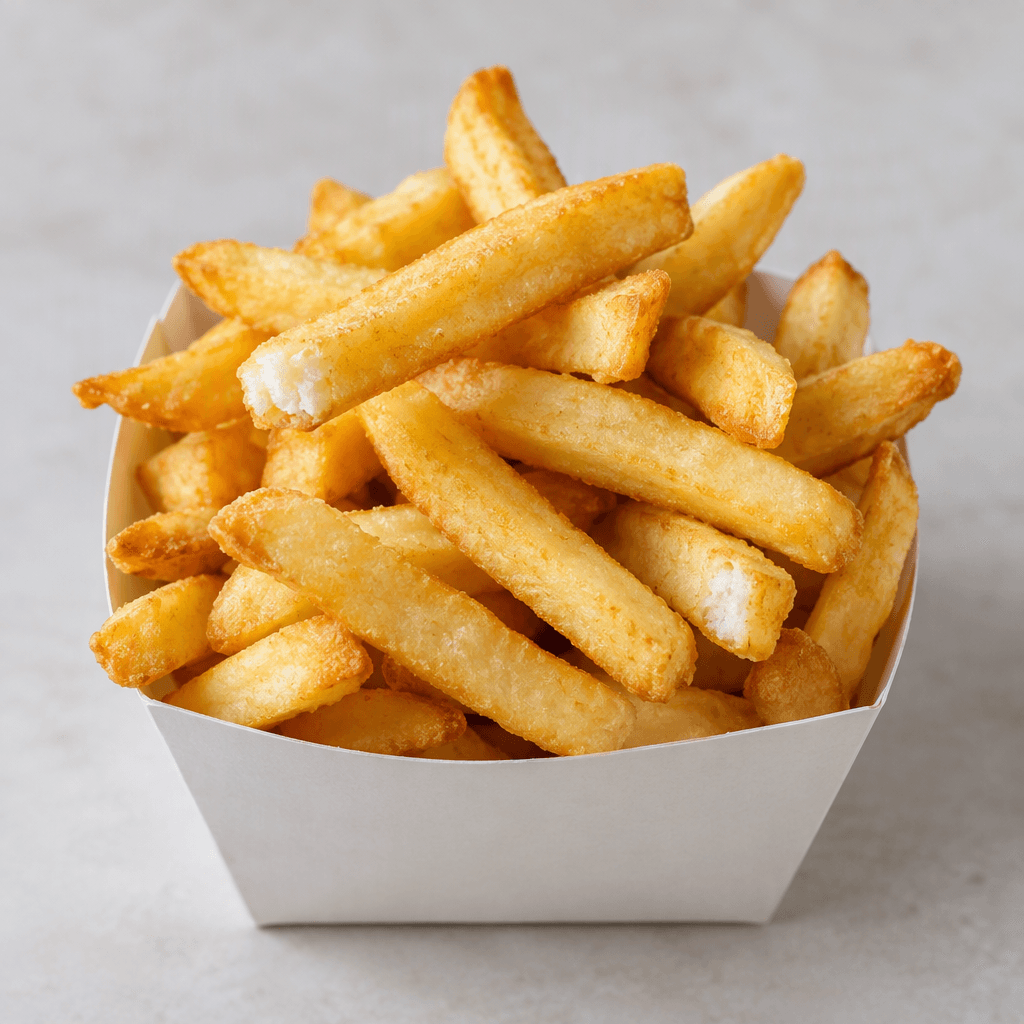
French fries (medium) Calories
Medium portion of fried potatoes, high in calories and fat, popular fast food.
In season: Spring · Summer · Autumn · Winter
CALORIES
GI
POTASSIUM
FIBER
Quick answer
1 serving (medium) of French fries (medium) (117 g) has 365 calories. That works out to 312 calories per 100 g. It contains 48.4 g of carbs, 4 g of protein, 17.5 g of fat and 4.4 g of fiber. Its 677.4 mg of Potassium covers 20% of the Daily Value. Its glycemic index is 75 (high), so it raises blood sugar quickly.
What is French fries (medium)?
French fries (medium) are potato sticks fried until golden, with a crisp outside and a soft, pale centre. Their origins are often associated with Belgium and France, but they are now a familiar side dish and fast-food staple around the world.
They are commonly served alongside burgers, sandwiches or grilled foods, and can also be enjoyed on their own with a dipping sauce. Fries are relatively high in energy and fat, with a little fibre from the potatoes. For a more balanced meal, pair them with vegetables or a salad; at home, baking cut potatoes with a modest amount of oil is an option when you want a lighter alternative.
French fries (medium) Nutrition Facts
Selected: 100 g
312
KCAL / 100G
Carbs
41.4g
· 15% DV
Protein
3.4g
· 7% DV
Fat
15g
· 19% DV
Fiber
3.8g
· 14% DV
DV is the share of the daily value covered, on a 2,000 kcal reference diet.
Calories come from: Carbs 53% · Protein 4% · Fat 43%
French fries (medium) Vitamins & Minerals
Vitamins
B6
0.18mg · 11% DV
Vitamin E
1.7mg · 11% DV
B5
0.5mg · 10% DV
B3
1.4mg · 9% DV
Minerals
Potassium ⭐
579mg · 17% DV
Sodium
210mg · 9% DV
Phosphorus
52mg · 7% DV
Iron
1mg · 6% DV
How Nutritious Is French fries (medium)?
Nutrient density
Low
How many vitamins, minerals and how much fiber this food carries per calorie. A high score means a lot of nutrition for few calories.
Satiety score
Low
An EatBetter score computed from fiber, protein and calorie density. A high score means staying full longer on the same calories.
Both scores are calculated per 100 g and do not change with the selected portion. The satiety score is EatBetter's own calculation, not a clinical measure.
French fries (medium) Glycemic Index
GLYCEMIC INDEX
GLYCEMIC LOAD
Accounts for portion size — a more realistic measure than GI alone.
How to Burn Off French fries (medium)
To burn the 312 calories in 100 g:
🚶
Walking (5 km/h)
🏃
Running (8 km/h)
🚴
Cycling
🏊
Swimming
Times are calculated with the MET equation for a 70 kg adult. Actual burn varies with your weight, age and pace.
Is French fries (medium) Processed?
NOVA 3
Processed
1. Unprocessed
2. Minimally Processed
3. Processed
4. Ultra-Processed
NOVA classifies foods into 4 groups by industrial processing. NOVA 1 (unprocessed) is the healthiest.
Does French fries (medium) Contain Allergens?
No known major allergens
Which Diets Is French fries (medium) Good For?
Vegan
— Not suitable
Vegetarian
✓ Suitable
Gluten-Free
— Not suitable
Dairy-Free
— Not suitable
Mediterranean
— Not suitable
Paleo
— Not suitable
Whole30
— Not suitable
DASH
— Not suitable
Keto
— Not suitable
Low FODMAP
— Not suitable
French fries (medium) Fat Profile
SATURATED
2.6g
MONOUNSATURATED
6.3g
POLYUNSATURATED
4.2g
Omega 6:3 ratio 126.7:1
Above the ideal 4:1 (126.7:1).
Compare French fries (medium)
Foods Similar to French fries (medium)
Frequently Asked Questions About French fries (medium)
How do you make French fries crispy at home?
To make French fries crispy, rinse the cut potatoes, dry them thoroughly, and fry in small batches so the oil does not cool down. Crowding the pan traps moisture and makes the fries soft rather than crisp.
What potatoes are best for French fries?
Starchy potatoes, such as russets, are usually best for French fries because they develop a fluffy center and crisp exterior. Waxy potatoes hold their shape well but can produce a denser, less fluffy fry.
Why do French fries get soggy?
French fries get soggy when the potatoes are wet, the oil is not hot enough, or too many fries are added at once. Dry the cut potatoes well and fry in batches to help them brown instead of steam.
How do you make French fries in an air fryer?
For air-fryer French fries, dry the cut potatoes, toss them with a little oil, and arrange them in a single layer. Shake the basket during cooking so the fries brown more evenly; an overcrowded basket tends to steam them.
How do you reheat French fries and keep them crispy?
Reheat French fries in an oven or air fryer to bring back some crispness. A microwave warms them quickly but often makes them soft from trapped steam. Spread the fries out rather than piling them together.
Can you freeze French fries after cooking them?
Yes, cooked French fries can be frozen, though they may not be as crisp after thawing. Reheat them straight from frozen in an oven or air fryer rather than relying on a microwave for the best texture.
How long do French fries last in the fridge?
French fries can be kept in a covered container in the refrigerator after they have cooled. Refrigerate leftovers promptly and reheat them thoroughly; their texture will soften during storage, even when they are still safe to eat.
What oil is best for frying French fries?
A neutral-flavored oil that can tolerate high heat works well for French fries. Do not use oil that is smoking, and discard frying oil that has become unusually dark, foamy, or noticeably off-smelling.
Are French fries unhealthy to eat often?
French fries are fried in oil, so eating large portions frequently can make it harder to keep an overall balanced eating pattern. Having them less often or choosing a smaller serving can help, especially alongside vegetables or a protein-rich food.
Why are French fries sometimes fried twice?
French fries are sometimes fried twice to create a crisp exterior while keeping the inside soft. The first fry cooks the potato through; a second, hotter fry browns and crisps the outside. Drying the potatoes between stages also helps.
Have another question about French fries (medium)?
Ask the AI nutrition coach — calories, portions, alternatives and more, answered in seconds in the app.

Scan calories with your camera
Instant AI nutrition analysis

Nutrition data compiled from USDA FoodData Central and scientific sources.