

Ready & Packaged Foods
All →Vegetables & Legumes
All →Desserts & Confectionery
All →Meat & Protein
All →Grains & Bakery
All →Beverages
All →Milk & Dairy
All →

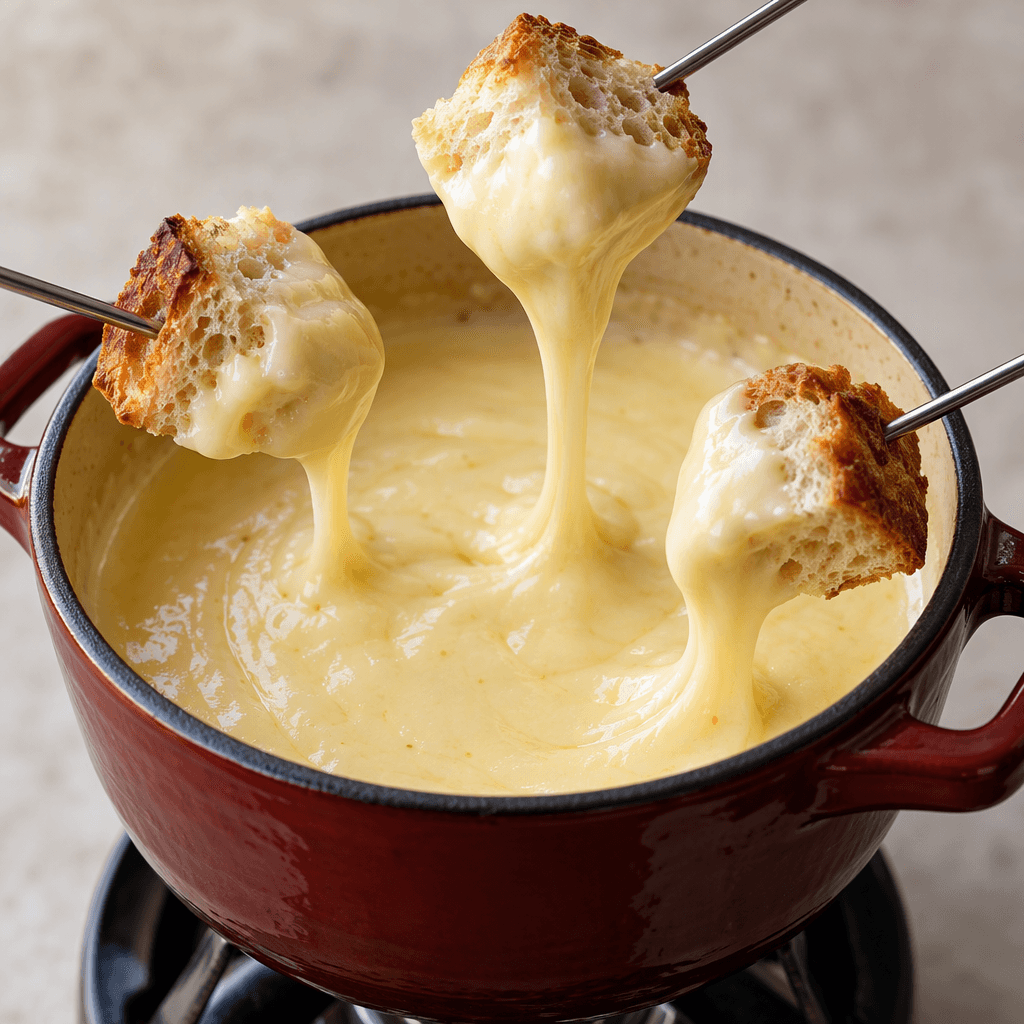
Cheese fondue Calories
Melted cheese with white wine, garlic, served with bread
In season: Autumn · Winter
CALORIES · 100 G
GI
POTASSIUM · 100 G
FIBER · 100 G
Quick answer
1 serving (medium) of Cheese fondue (120 g) has 384 calories. That works out to 320 calories per 100 g. It contains 7.2 g of carbs, 18 g of protein, 31.2 g of fat and 0 g of fiber. Its 504 mg of Phosphorus covers 72% of the Daily Value. Its glycemic index is 30 (low), so it raises blood sugar slowly.
Cheese fondue Nutrition Facts
Selected: 1 serving (medium) · 120 g
384
KCAL / 120G
Carbs
7.2g
· 3% DV
Protein
18g
· 36% DV
Fat
31.2g
· 40% DV
Fiber
0g
· 0% DV
DV is the share of the daily value covered, on a 2,000 kcal reference diet.
Calories come from: Carbs 8% · Protein 19% · Fat 73%
Cheese fondue nutrition facts table · 1 serving (medium) (120 g)
| Nutrient | Amount | % DV |
|---|---|---|
| Calories | 384 kcal | |
| Total fat | 31.2 g | 40% |
| Saturated fat | 19.2 g | 96% |
| Trans fat | 0.6 g | |
| Sodium | 1080 mg | 47% |
| Total carbohydrate | 7.2 g | 3% |
| Fiber | 0 g | 0% |
| Protein | 18 g | 36% |
Calories: Calories measure energy. Average daily need is 2,000 kcal. Excess calories are stored as fat, too few cause weight loss.
Carbs: Your body's primary energy source. The brain runs exclusively on carbs. Daily need: 275g.
Protein: Essential for muscle repair and cell growth. Daily need: 50g. Keeps you full and boosts metabolism.
Fat: Needed for hormone production and vitamin absorption. Daily need: 78g. Limit saturated fats, choose unsaturated.
Fiber: Critical for digestive health and satiety. Daily need: 28g. Stabilizes blood sugar, lowers cholesterol.

Log this food in EatBetter
100,000+ people use it
- Get your daily calorie target
- Snap your meal, log it in seconds
- See every vitamin and mineral

📸 Scan the code to get the app free.

How Many Calories in 1 Serving of Cheese fondue?
| Serving | Amount | Calories |
|---|---|---|
| 1 serving (medium) | 120 g | 384 kcal |
| 1 piece (small) | 30 g | 96 kcal |
| 1 piece (medium) | 50 g | 160 kcal |
| 1 serving (small) | 80 g | 256 kcal |
| 1 piece (large) | 80 g | 256 kcal |
| 100 g | 100 g | 320 kcal |
| 1 cup (medium) | 150 g | 480 kcal |
| 1 serving (large) | 180 g | 576 kcal |
Calculated from 320 calories per 100 g.
Frequently Asked Questions About Cheese fondue
What is cheese fondue made of?
Cheese fondue is traditionally made with melted Swiss cheeses, white wine, and garlic, with a little starch often added to keep the mixture smooth. Bread is the classic dipper, while regional recipes may include kirsch, nutmeg, or different cheese blends.
Which cheese is best for cheese fondue?
Gruyère and Emmental are classic choices for cheese fondue because they melt smoothly and balance one another in flavor. A blend works especially well; very soft or low-fat cheeses can turn stringy or separate instead of forming a creamy dip.
How do you make cheese fondue at home?
To make cheese fondue, rub a pot with garlic, warm white wine in it, then gradually stir in grated cheese over low heat. A little starch helps stabilize the mixture; keep stirring until smooth and serve it warm with bread.
What can you dip in cheese fondue besides bread?
Boiled baby potatoes, blanched broccoli or cauliflower, apple slices, and firm cooked vegetables all work well in cheese fondue. Choose pieces that can stay on a fork and hold the melted cheese rather than becoming soft or falling apart.
Why does cheese fondue become lumpy or separate?
Cheese fondue usually becomes lumpy when it gets too hot or the cheese is added too quickly. Use low heat, grate the cheese, and stir it in gradually; a small splash of warm wine can help loosen a mixture that has become too thick.
Can you make cheese fondue without wine?
Yes, you can make cheese fondue without wine by using nonalcoholic white wine or vegetable broth with a little lemon juice. Add the liquid gradually, since the acidity helps the cheese melt smoothly and keeps the finished fondue from tasting flat.
What is traditionally served with cheese fondue?
Crusty bread is the traditional accompaniment to cheese fondue, often served alongside boiled potatoes and crisp vegetables. A simple green salad or pickles can add a fresh, sharp contrast to the rich cheese.
Does the alcohol cook out of cheese fondue?
No, not necessarily; some alcohol can remain in cheese fondue because it is usually heated gently and for a short time. If you need to avoid alcohol, choose an alcohol-free wine or a suitable broth instead.
How should you eat cheese fondue?
Eat cheese fondue by spearing a bite-sized piece of bread or another dipper with a fondue fork and coating it in the warm cheese. Let excess cheese drip back into the pot, and use a separate fork for eating if sharing the pot.
How do you store and reheat leftover cheese fondue?
Refrigerate leftover cheese fondue in a covered container once it has cooled, and use it soon. Reheat it gently over low heat while stirring in a little milk, wine, or broth; high heat can make the cheese separate.
Cheese fondue Vitamins & Minerals
Vitamins
B12
1.44µg · 60% DV
Vitamin A
324µg · 36% DV
B2
0.42mg · 32% DV
B5
0.6mg · 12% DV
Minerals
Phosphorus
504mg · 72% DV
Calcium
660mg · 66% DV
Sodium
1080mg · 47% DV
Zinc
3.24mg · 29% DV
Potassium ⭐
132mg · 4% DV
Cheese fondue Glycemic Index
GLYCEMIC INDEX
GLYCEMIC LOAD
Accounts for portion size — a more realistic measure than GI alone.
How to Burn Off Cheese fondue
To burn the 384 calories in 1 serving (medium) (120 g):
🚶
Walking (5 km/h)
🏃
Running (8 km/h)
🚴
Cycling
🏊
Swimming
Times are calculated with the MET equation for a 70 kg adult. Actual burn varies with your weight, age and pace.
What is Cheese fondue?
Cheese fondue is a Swiss dish of cheese melted into a smooth communal pot, commonly with white wine and garlic. Diners dip bite-sized pieces of bread into the warm mixture, keeping the pot over a gentle heat so it stays creamy.
Its savoury, tangy flavour and rich, stretchy texture make it well suited to a leisurely shared meal, especially in cold weather. It is often served as a centrepiece with bread; in English-speaking homes, crisp vegetables or small potatoes can also add variety. Cheese fondue is substantial, with much of its energy coming from fat and a useful amount of protein. Pair it with a crisp salad if you’d like a fresher, lighter contrast.
How Nutritious Is Cheese fondue?
Nutrient density
Medium
How many vitamins, minerals and how much fiber this food carries per calorie. A high score means a lot of nutrition for few calories.
Satiety score
Low
An EatBetter score computed from fiber, protein and calorie density. A high score means staying full longer on the same calories.
Both scores are calculated per 100 g and do not change with the selected portion. The satiety score is EatBetter's own calculation, not a clinical measure.
Is Cheese fondue Processed?
NOVA 3
Processed
1. Unprocessed
2. Minimally Processed
3. Processed
4. Ultra-Processed
NOVA classifies foods into 4 groups by industrial processing. NOVA 1 (unprocessed) is the healthiest.
Does Cheese fondue Contain Allergens?
Contains these allergens:
Which Diets Is Cheese fondue Good For?
Vegan
— Not suitable
Vegetarian
✓ Suitable
Gluten-Free
— Not suitable
Dairy-Free
— Not suitable
Mediterranean
— Not suitable
Paleo
— Not suitable
Whole30
— Not suitable
DASH
— Not suitable
Keto
— Not suitable
Low FODMAP
— Not suitable
Cheese fondue Fat Profile
SATURATED
19.2g
MONOUNSATURATED
8.4g
POLYUNSATURATED
1.44g
Omega 6:3 ratio 7.2:1
Above the ideal 4:1 (7.2:1).
Compare Cheese fondue
Foods Similar to Cheese fondue
Have another question about Cheese fondue?
Ask the AI nutrition coach — calories, portions, alternatives and more, answered in seconds in the app.

Scan calories with your camera
Instant AI nutrition analysis

Nutrition data compiled from USDA FoodData Central and scientific sources.