

Ready & Packaged Foods
All →Vegetables & Legumes
All →Desserts & Confectionery
All →Meat & Protein
All →Grains & Bakery
All →Beverages
All →Milk & Dairy
All →

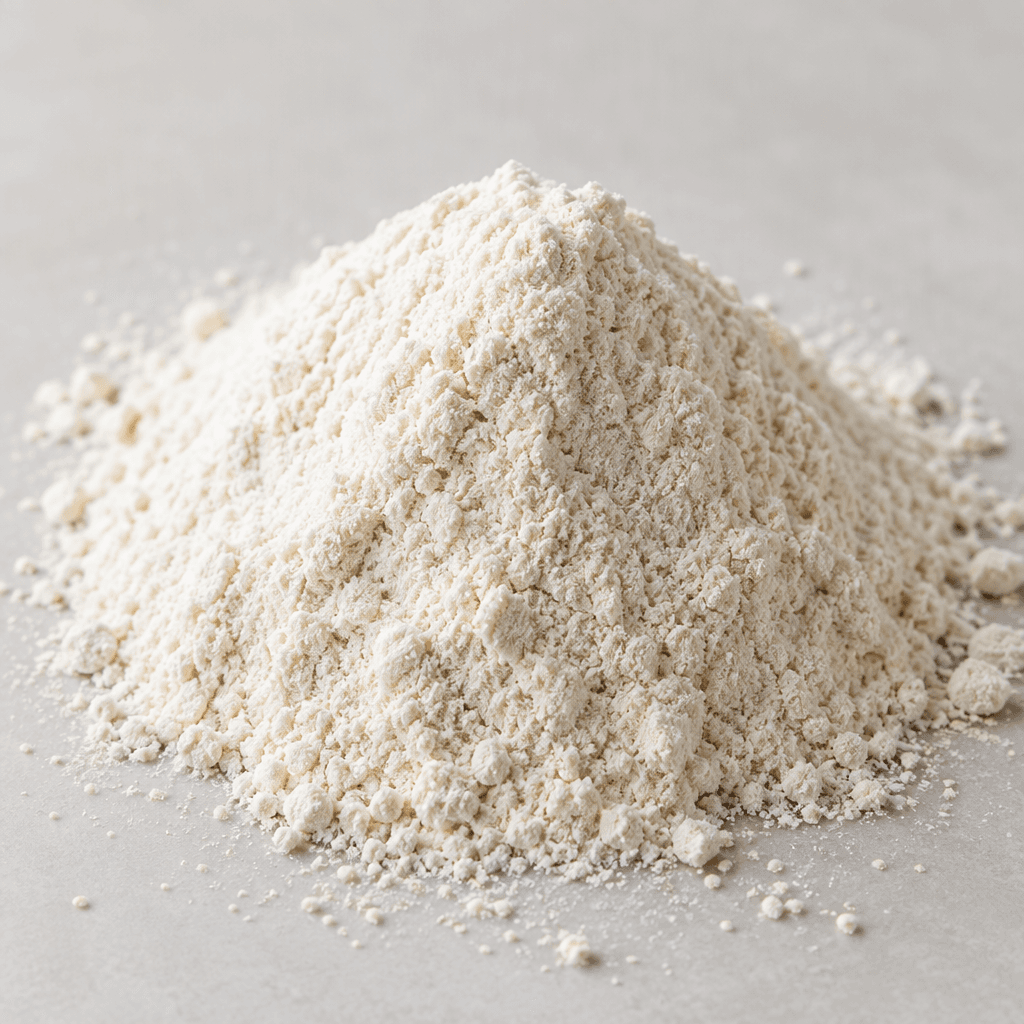
Wheat Flour (Raw) Calories
Wheat Flour (Raw)
In season: Spring · Summer · Autumn · Winter
CALORIES · 100 G
GI
POTASSIUM · 100 G
FIBER · 100 G
Quick answer
1 cup (medium) of Wheat Flour (Raw) (120 g) has 437 calories. That works out to 364 calories per 100 g. It contains 91.6 g of carbs, 12.4 g of protein, 1.2 g of fat and 3.2 g of fiber. Its 33.6 µg of Selenium covers 61% of the Daily Value. Its glycemic index is 70 (high), so it raises blood sugar quickly.
Wheat Flour (Raw) Nutrition Facts
Selected: 1 cup (medium) · 120 g
437
KCAL / 120G
Carbs
91.6g
· 33% DV
Protein
12.4g
· 25% DV
Fat
1.2g
· 2% DV
Fiber
3.2g
· 11% DV
DV is the share of the daily value covered, on a 2,000 kcal reference diet.
Calories come from: Carbs 86% · Protein 12% · Fat 2%
Wheat Flour (Raw) nutrition facts table · 1 cup (medium) (120 g)
| Nutrient | Amount | % DV |
|---|---|---|
| Calories | 437 kcal | |
| Total fat | 1.2 g | 2% |
| Saturated fat | 0.19 g | 1% |
| Trans fat | 0 g | |
| Sodium | 2.4 mg | 0% |
| Total carbohydrate | 91.6 g | 33% |
| Fiber | 3.2 g | 11% |
| Protein | 12.4 g | 25% |
Calories: Calories measure energy. Average daily need is 2,000 kcal. Excess calories are stored as fat, too few cause weight loss.
Carbs: Your body's primary energy source. The brain runs exclusively on carbs. Daily need: 275g.
Protein: Essential for muscle repair and cell growth. Daily need: 50g. Keeps you full and boosts metabolism.
Fat: Needed for hormone production and vitamin absorption. Daily need: 78g. Limit saturated fats, choose unsaturated.
Fiber: Critical for digestive health and satiety. Daily need: 28g. Stabilizes blood sugar, lowers cholesterol.

Log this food in EatBetter
100,000+ people use it
- Get your daily calorie target
- Snap your meal, log it in seconds
- See every vitamin and mineral

📸 Scan the code to get the app free.

How Many Calories in 1 Cup of Wheat Flour (Raw)?
| Serving | Amount | Calories |
|---|---|---|
| 1 cup (medium) | 120 g | 437 kcal |
| 1 g | 1 g | 4 kcal |
| 1 tablespoon (medium) | 8 g | 29 kcal |
| 1 tablespoon (large) | 12 g | 44 kcal |
| ½ cup (small) | 60 g | 218 kcal |
| 100 g | 100 g | 364 kcal |
| 2 cup (large) | 240 g | 874 kcal |
| 1 piece (jumbo) | 500 g | 1820 kcal |
Calculated from 364 calories per 100 g.
Frequently Asked Questions About Wheat Flour (Raw)
Can you eat raw wheat flour?
No, raw wheat flour is not considered safe to eat. Flour can carry harmful bacteria, so avoid tasting raw batter or dough and cook flour-containing foods thoroughly before eating.
How should you store wheat flour?
Store wheat flour in a clean, airtight container in a cool, dry, dark place. Keep it away from moisture and strong-smelling foods so it does not clump or absorb unwanted odors.
Can wheat flour be frozen?
Yes, wheat flour can be frozen in an airtight container. Let it come to room temperature while still sealed before opening, which helps keep condensation from making the flour damp.
How can you tell if wheat flour has gone bad?
Wheat flour may be spoiled if it smells sour, musty, or rancid, or if its color has changed. Damp clumps, mold, or insects are reasons to discard it; do not taste it to check.
Does wheat flour need to be sifted?
No, wheat flour does not always need sifting. Sift it if it has formed lumps or if a recipe calls for a lighter, more evenly mixed result, such as in a delicate cake.
Can whole-wheat flour replace white wheat flour in baking?
Yes, whole-wheat flour can replace white wheat flour, but the result will usually be denser and have a stronger flavor. It absorbs more liquid, so the dough or batter may need a little extra moisture.
Why does wheat-flour dough fail to rise?
Wheat-flour dough may fail to rise if the yeast is inactive, the liquid is too hot, or the dough has not had enough time in a warm place. Wheat flour itself does not make dough rise; a leavening agent is needed.
How should you measure wheat flour for baking?
For a more consistent result, fluff wheat flour in its container, spoon it into the measuring cup, and level the top. Scooping directly with the cup can pack in extra flour and make baked goods dry.
How do you stop wheat flour from clumping in gravy?
To prevent wheat flour from clumping in gravy, whisk it into cold liquid first or cook it with fat to make a roux. Add that mixture gradually to the hot liquid while whisking.
What is the difference between wheat flour and bread flour?
Bread flour is a type of wheat flour with more protein than many standard flours. That extra protein helps form stronger gluten, giving bread dough more structure and chew.
Wheat Flour (Raw) Vitamins & Minerals
Vitamins
B1
0.54mg · 45% DV
B3
1.56mg · 10% DV
B5
0.48mg · 10% DV
Folate
31.2µg · 8% DV
Minerals
Selenium
34µg · 62% DV
Manganese
0.84mg · 37% DV
Copper
0.24mg · 27% DV
Phosphorus
130mg · 19% DV
Potassium ⭐
128mg · 4% DV
Sodium
2.4mg · 0% DV
Wheat Flour (Raw) Glycemic Index
GLYCEMIC INDEX
GLYCEMIC LOAD
Accounts for portion size — a more realistic measure than GI alone.
How to Burn Off Wheat Flour (Raw)
To burn the 437 calories in 1 cup (medium) (120 g):
🚶
Walking (5 km/h)
🏃
Running (8 km/h)
🚴
Cycling
🏊
Swimming
Times are calculated with the MET equation for a 70 kg adult. Actual burn varies with your weight, age and pace.
What is Wheat Flour (Raw)?
Raw wheat flour is made by milling wheat kernels into a fine, dry powder. It is a pantry staple used to build structure in bread, pasta, cakes and pastries, and to thicken sauces or soups. Its mild flavour lets other ingredients come through, while water turns it into a workable dough or batter.
Across the English-speaking world, it is usually eaten after cooking or baking rather than straight from the bag: think toast, noodles, biscuits and homemade pastry. It is mainly a source of carbohydrate, with 76.3 g per 100 g. For reliable results, measure it carefully; swapping some of it for whole-wheat flour can add more fibre to a recipe.
How Nutritious Is Wheat Flour (Raw)?
Nutrient density
Low
How many vitamins, minerals and how much fiber this food carries per calorie. A high score means a lot of nutrition for few calories.
Satiety score
Low
An EatBetter score computed from fiber, protein and calorie density. A high score means staying full longer on the same calories.
Both scores are calculated per 100 g and do not change with the selected portion. The satiety score is EatBetter's own calculation, not a clinical measure.
Is Wheat Flour (Raw) Processed?
NOVA 2
Minimally Processed
1. Unprocessed
2. Minimally Processed
3. Processed
4. Ultra-Processed
NOVA classifies foods into 4 groups by industrial processing. NOVA 1 (unprocessed) is the healthiest.
Does Wheat Flour (Raw) Contain Allergens?
Contains these allergens:
Which Diets Is Wheat Flour (Raw) Good For?
Vegan
✓ Suitable
Vegetarian
✓ Suitable
Gluten-Free
— Not suitable
Dairy-Free
— Not suitable
Mediterranean
✓ Suitable
Paleo
— Not suitable
Whole30
— Not suitable
DASH
— Not suitable
Keto
— Not suitable
Low FODMAP
— Not suitable
Wheat Flour (Raw) Fat Profile
SATURATED
0.19g
MONOUNSATURATED
0.14g
POLYUNSATURATED
0.61g
Omega 6:3 ratio 11.2:1
Above the ideal 4:1 (11.2:1).
Compare Wheat Flour (Raw)
Foods Similar to Wheat Flour (Raw)
Have another question about Wheat Flour (Raw)?
Ask the AI nutrition coach — calories, portions, alternatives and more, answered in seconds in the app.

Scan calories with your camera
Instant AI nutrition analysis

Nutrition data compiled from USDA FoodData Central and scientific sources.